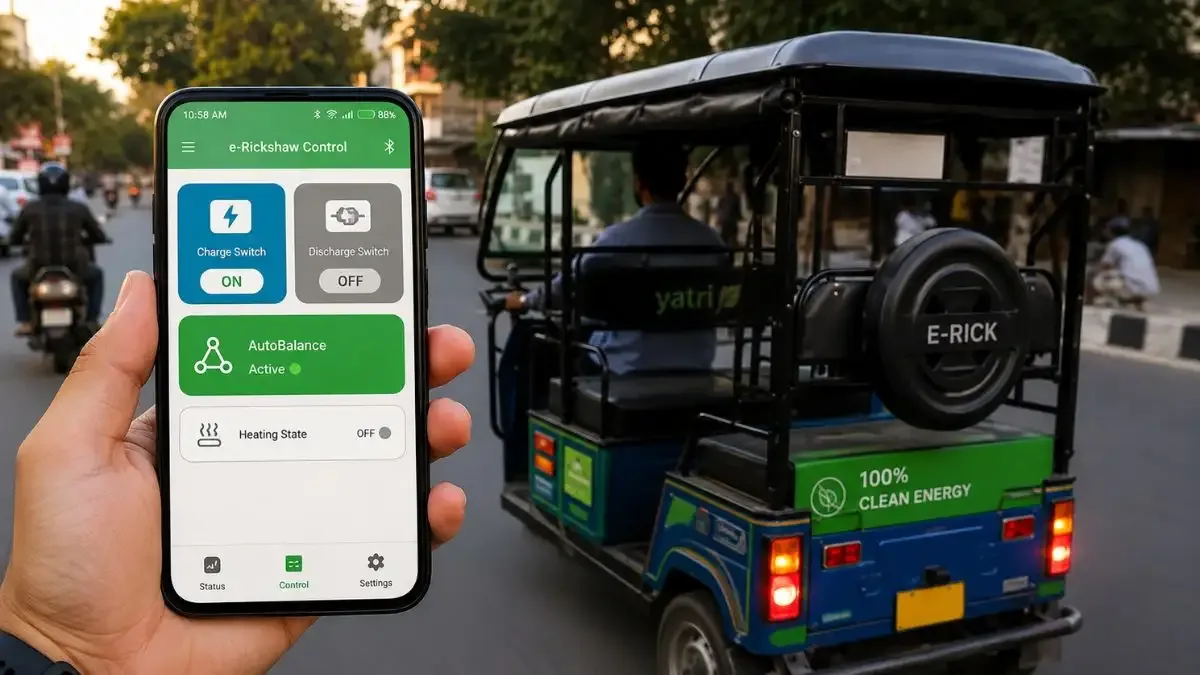
BAT-BMS App E-Rickshaws Scandal: How a Chinese Battery Tool Became India's Weirdest Road Hazard
Somewhere in Delhi traffic, a rickshaw just stopped. Dead. No warning, no smoke, no mechanical failure. The driver sat there, confused, pedaling nothing. And somewhere nearby, a stranger with a phone was laughing.
That's the scene playing out across India right now because of the BAT-BMS app e-rickshaws controversy, and honestly, once you understand how it works, the confusion turns into something closer to alarm.
Why This Actually Matters
E-rickshaw driving isn't glamorous work. It's daily wages, hour by hour, ride by ride. So when a random person can walk up with a phone and switch off someone's livelihood mid-route through this BAT-BMS app e-rickshaws exploit, that's not a joke, that's theft of time and money from people who can't easily absorb the loss. Some drivers have reportedly paid strangers a hundred or two hundred rupees just to get their vehicle moving again. Others pushed their rickshaws home, one driver reportedly for nearly three kilometres.
The BAT-BMS app e-rickshaws issue also matters because it exposes something bigger, how much everyday tech we trust without ever checking what's actually inside it.
What's Actually Going On, Explained Simply
Here's the concept, stripped down. Many budget lithium batteries used in Indian e-rickshaws come with a Bluetooth battery management system, or BMS. Think of it like the battery's internal supervisor, tracking charge, temperature, and health. One legitimate feature inside that Bluetooth battery management system is a discharge switch, meant for mechanics to safely cut power before repairs.
The problem is Bluetooth. Some of these battery packs broadcast an open, unsecured connection, no password, no authentication, nothing. BAT-BMS, an app made by the Chinese company Shenzhen Grenergy Technology, was originally built as a legitimate battery monitoring tool, mostly for solar and marine setups, never with e-rickshaws in mind. Because it can talk to any compatible Bluetooth battery within roughly 10 to 15 metres, people behind the tirri trend realised they could connect to a random rickshaw's battery and flip that discharge switch, stalling the vehicle instantly, no wires touched.
Read More: Iran-Israel War LIVE: Middle East Tensions & Global Stability
How the Tirri Trend Actually Spread
People online started calling this the tirri trend, and it moved fast across Instagram, YouTube, and X, turning the BAT-BMS app e-rickshaws incident into a full blown viral moment.
- Someone spots an e-rickshaw in traffic
- They open the BAT-BMS app, scan nearby Bluetooth devices, and connect
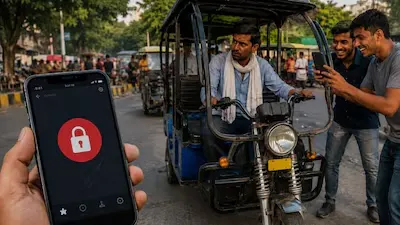
- They trigger the discharge switch, cutting power to the motor mid-ride
- The driver stalls, confused, often in the middle of live traffic
- The prankster films the reaction, sometimes pretending to help, for social media
One viral caption framed it as revenge, something like the drivers having caused enough trouble already, so now they'd suffer. Which, honestly, says more about the mindset behind this than the technology itself.
Read More: Anti-Ageing Skincare Routine 2026: How to Reduce Wrinkles and Fine Lines Naturally
Real Consequences of the BAT-BMS App E-Rickshaws Trend
This wasn't confined to one city. Videos surfaced showing drivers stranded across multiple states, some visibly distressed, some crying on camera. The BAT-BMS app e-rickshaws clips kept multiplying by the day. An elderly driver in one clip had to push his stalled e-rickshaw for kilometres because he had no idea what had just happened to his vehicle.
The e-rickshaw drivers affected by this aren't just losing a few minutes. A stalled vehicle mid-route means missed fares, wasted fuel or charge, and in some cases, real danger if the rickshaw stops in fast moving traffic.
Cyber law expert Pawan Duggal put it plainly, calling this far more than an online prank. Accessing someone's vehicle system without consent falls under Sections 43 and 66 of India's Information Technology Act, carrying penalties up to three years imprisonment and fines reaching five lakh rupees. That's the kind of teeth the Information Technology Act actually has, a serious warning for anyone treating e-rickshaw drivers as easy targets.
Mistakes People Are Making Around This Story
A lot of coverage makes it sound like every e-rickshaw in India is vulnerable. That's not accurate. A large share of India's e-rickshaws still run on lead-acid batteries, which have zero Bluetooth capability and are completely unaffected. Even among lithium-powered vehicles, many use proprietary BMS software that simply won't talk to third-party apps like BAT-BMS. The risk exists, but it isn't universal, and treating every rickshaw as equally exposed just spreads unnecessary panic.
Pro Tips Worth Knowing
Following the backlash, the Ministry of Electronics and Information Technology directed both Google Play Store and Apple's App Store to remove BAT-BMS, along with two similarly flagged apps, Lossigy and Epoch-i-ion. If you're an e-rickshaw owner running a lithium battery, it's worth asking your dealer or mechanic whether the Bluetooth battery management system has password protection, and if not, whether it can be added or disabled entirely.
Closing Thoughts
There's something quietly unsettling about how small this vulnerability actually was, a missing password screen, nothing more, and how far its consequences reached. The BAT-BMS app e-rickshaws episode probably won't be the last time an ordinary consumer tool gets repurposed for harm nobody designed it for. What changes now is whether manufacturers start locking things down before the next viral trend finds the next open door.
Disclaimer: This article is based on information available across the web. Parchar Manch does not take responsibility for its complete accuracy, as the content could not be fully verified.
FAQs
What is the BAT-BMS app?
It's a Bluetooth battery monitoring app made by Shenzhen Grenergy Technology, originally meant for solar and marine battery systems.
How did the BAT-BMS app e-rickshaws misuse actually work?
People connected to unsecured Bluetooth batteries in e-rickshaws and triggered a built-in discharge switch, cutting power mid-ride.
Is my e-rickshaw at risk?
Only if it runs a Bluetooth-enabled lithium battery without password protection. Lead-acid battery vehicles are unaffected.
Has the app been banned?
The government directed app stores to remove BAT-BMS along with two related apps after the controversy went viral.
What should e-rickshaw drivers do now?
Check with a mechanic whether your battery's Bluetooth connection is password protected, and report any suspicious tampering immediately.