
PM Awas Yojana Eligibility Criteria 2026: Who Can Apply for PMAY Benefits?
The process of buying or building a home may seem easy until the numbers start to show up. Income limits. House ownership rules. The amount of loans. Subsidy terms. In the middle, there are many who begin looking for a simple answer to the question: Am I qualified?
That's why knowing the eligibility requirements for 2026 is important. The answer will depend on whether you qualify under PMAY-U 2.0 in an urban location or PMAY-Gramin in rural areas. It isn't one benefit that is the same for each applicant.
For urban families, PMAY-U 2.0 is in the process of being implemented from 2024 until 2029, with various support options for households that are eligible.
Eligibility criteria for PMAY Yojana 2026: The Basic Rules
The most crucial part of PMAY Yojana's eligibility criteria for 2026 is the simple fact that Eligibility is determined using the details of your family, such as income, place of residence, housing ownership and housing benefits.
For PMAY-U 2.0, the beneficiary family usually includes a spouse, husband and any unmarried children. The family must not possess a pucca home anywhere in India under their name or that of a member of the family.
Anyone who has received a benefit under specific housing schemes of the government in the past 20 years can be excluded based on the current eligibility requirements.
Thus, PMAY Awas Yojana eligibility criteria for 2026 are not solely based on income. This is where a lot of applications fall short.
PMAY Income Limit 2026: Which Income Group Do You Fall Into?
PMAY income limit 2026: The income limit for PMAY 2026 to PMAY-U 2.0 is broken down into three broad categories:
- EWS: Annual household income up to Rs.3 lakh
- LIG: Annual household income that is greater than 3 lakh and up to Rs 6 lakh
- MIG: Household income that is above 6 lakh and up to Rs 9 lakh
These limits are essential in determining Pm awas Yojana eligibility criteria for 2026, particularly for the interest subsidy Scheme.
It is recommended that the Income limit for the PMAY scheme in 2026 must be analysed with the help of household income, not merely based on one individual's earnings. If several household members are earning, then the PMAY scheme's criteria and definition of eligibility must be carefully considered.
The Calculator for PMAY subsidies will allow you to determine the potential benefit, but it's not able to substitute for the official eligibility test. The distinction between eligibility and subsidy isn't that important.
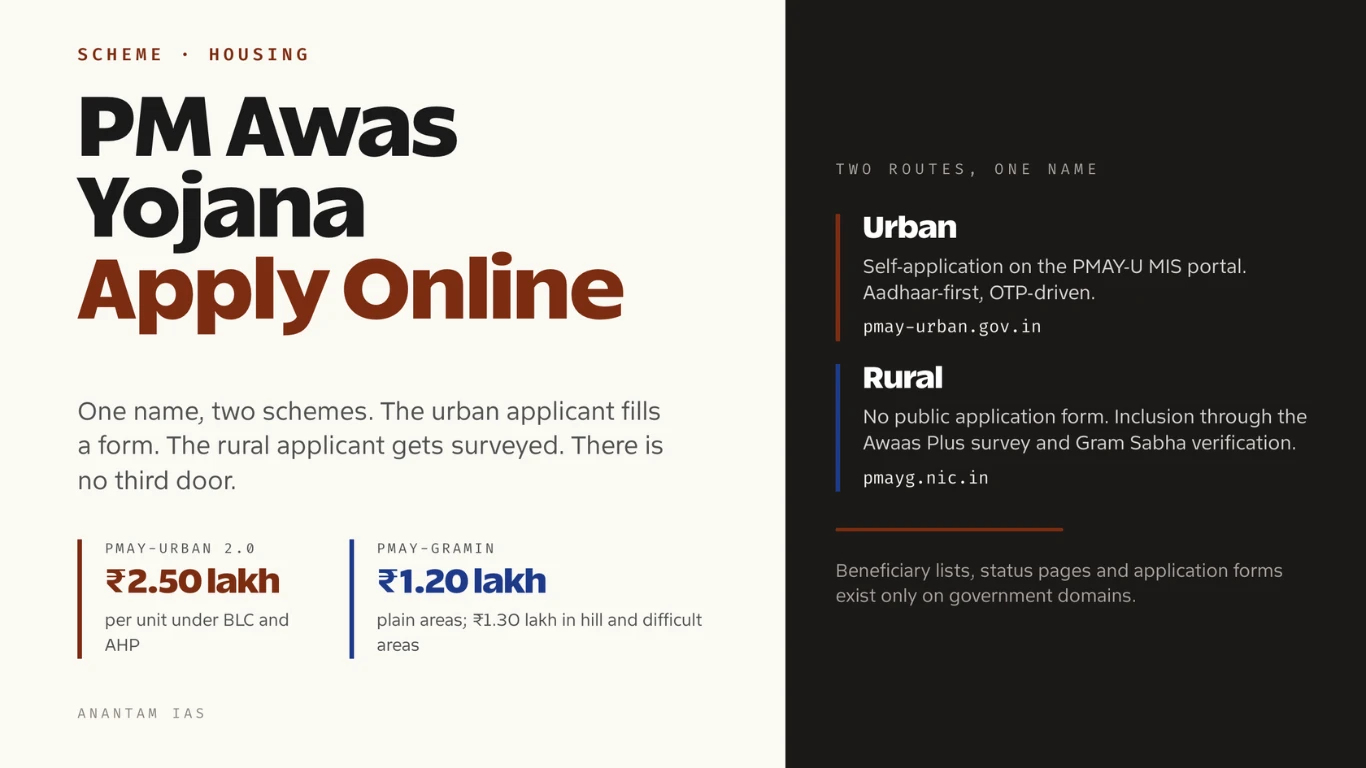
PMAY Urban vs Gramin: First Check Where You Live
The distinction in PMAY urban vs. gramin is among the most important aspects that an applicant must be aware of.
PMAY-U 2.0 is designed specifically for households in urban areas that are eligible. It is a support program that includes 4 verticals: Beneficiary-Led Construction, Affordable Housing in Partnership, Affordable Rental Housing and the Interest Subsidy Scheme.
PMAY-Gramin, however, focuses on housing in rural areas and has its own identification of beneficiaries and implementation process with the Ministry of Rural Development. The PMAY-G website continues to release progress as well as information about beneficiaries.
In the end, it is clear that the PMAY urban or gramin issue isn't about picking which scheme provides the greatest benefit. The eligibility criteria are based on the area of jurisdiction for the applicant's residence. Even those areas close to the urban boundary have to be assessed in accordance with the jurisdiction of their officials.
This is what makes Pm awas Yojana eligibility requirements 2026 more specific to the location than most people realise.
PMAY-U 2.0 Eligibility: Who Can Apply in Urban Areas?
Understanding the PMAY-U 2.0 eligibility can be made easier by breaking it down into a handful of checkpoints.
A person who lives in the city could be considered for the program if the family
- The income category is applicable to EWS, LIG or MIG income categories.
- There is no pucca home anywhere in India
- Meets the requirements of the PMAY-U 2.0 vertical
- Has not received housing benefits in the preceding period.
In the case of this Interest Subsidy Scheme, the current requirements include a household income of as high as Rs9 lakh, the home loan amount of up to Rs 25 lakh the value of a property of up to Rs35 lakh, and carpet areas that is up to 120 square metres. The subsidy amount is 4percent on the initial amount of the loan, which is Rs 8 lakh for a period of up to 12 years and a maximum subsidy of Rs 1.80 lakh, depending on the terms of the scheme.
This is why PMAY-U 2.0 eligibility should be assessed before making a purchase, or considering that each home loan can be considered eligible.
How the PMAY Subsidy Calculator Can Help
The Calculator for PMAY subsidies can be useful if you know the basic requirements for eligibility. It will give you an idea of how your income, as well as loan amount and duration, could affect the amount of subsidy that is available.
But the subsidy calculator for PMAY must be considered an estimate. The actual benefit is contingent upon verification by an official, the chosen scheme vertical and the particular conditions that are attached to the request.
Imagine an average family earning around 7 lakh per year, but with no pucca home or pucca house anywhere else in India. If they intend to purchase a home worth Rs 32 lakh by using a loan of Rs 20 lakh and are within the income limit that is considered to be within the ISS vertical, subject to the additional requirements of PMAY-U 2.0 eligibility conditions.
The calculator provides an initial point. The official verification will give the result.

Real Examples of Pm Awas Yojana Eligibility Criteria 2026
Think about Ravi as well as his entire family. Their household income per year is about Rs 5 lakh. They reside in an urban area that is eligible and have no family member who has a home in the pucca area. In accordance with their income limits for PMAY in 2026, they fall into the LIG category and could be eligible for the PMAY-U 2.0 benefit, based on the vertical, as well as other factors.
Consider Meena, whose household income is about Rs 8 lakh. Her family has met the no-pucca house requirement and is planning to get an equity loan for a home within the limit of the law. The applicant's PMAY-U 2.0 eligibility might allow for an application in the Interest Subsidy Scheme.
These examples illustrate why PMAY-U 2.0's eligibility requirements for 2026 cannot be based on income alone.
Mistakes Applicants Keep Making
The first mistake is that it's confusing the old PMAY regulations with the new PMAY-U 2.0 framework. The second one is misinterpreting the difference between PMAY urban and gramin and implementing without checking the jurisdiction.
Another mistake that is common is to use a Subsidy Calculator for PMAY and believing that the shown amount is assured. It's not.
Sometimes, applicants overlook the property ownership of a person in the family who is eligible. According to Pm awas Yojana eligibility requirements for 2026, the family-level ownership check is crucial.
A Few Practical Tips Before You Apply
Before submitting your application, confirm the income limits for PMAY in 2026 with accurate household numbers. Verify whether your place is within the PMAY urban vs. gramin framework. Check your PMAY-U 2.0 eligibility according to the specific benefit you're looking for.
Make use of the PMAY calculator for subsidy only after having a thorough understanding of the limits set by the government. Most importantly, avoid hiding any previous benefits to housing or property ownership. If you are denied a housing application after waiting for weeks, it is the type of disappointment that is often avoidable.
The true value of knowing PM Awas Yojana eligibility requirements 2026 isn't simply knowing if you are eligible to apply. It's knowing which is best for your circumstances prior to deciding whether you want to spend money, obtain a loan, or make an investment choice.
Must read: Best Home Improvement Ideas 2026 to Increase Property Value
FAQs
What are the PMAY eligibility criteria for 2026?
The primary requirements include income limits, the location of the house, no ownership of a pucca house anywhere in India and conformity with the other scheme-specific rules. For applicants from urban areas, the current PMAY-U 2.0 conditions are of particular importance.
What is the PMAY income limit for 2026?
In PMAY-U 2.0, EWS is up to Rs 3 lakh. LIG is higher than the Rs 3 lakh mark, up to Rs 6 lakh, and MIG is greater than the Rs 6 lakh mark, up to Rs 9 lakh annually in household income.
What's the distinction between PMAY Urban and Gramin?
PMAY-U is a scheme that applies to urban areas, whereas PMAY-Gramin focuses on rural housing within a distinct framework. Your jurisdictional authority decides on the appropriate scheme.
Is there a way to use a PMAY subsidy calculator to determine my admissibility?
No. A calculator for PMAY subsidies gives an estimate. The final eligibility and the amount of subsidy will depend on verification by the government and scheme terms.
Who is eligible under the PMAY-U 2.0 rules of eligibility?
EWS in urban areas who are eligible, LIG as well as MIG families who satisfy income, house ownership, previous benefit and particular conditions of the scheme could be eligible under PMAY-U 2.0.