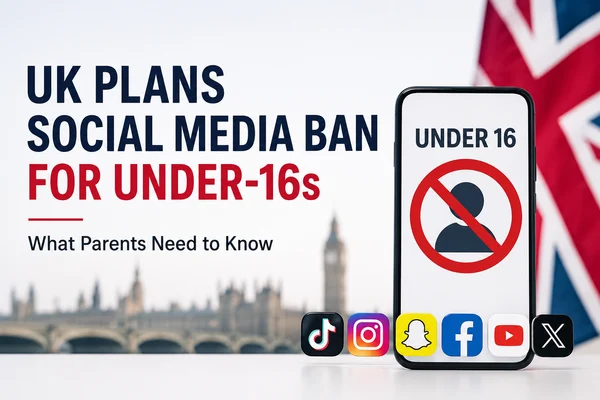
UK Social Media Ban for Under-16s: What the Spring 2027 Law Will Actually Change for Families
Britain has made its decision. The UK government has formally announced that social media platforms will be banned from offering services to children under 16, with the first set of regulations expected to come before Parliament before the end of 2026 and potentially in force by Spring 2027. This is not a consultation outcome or a policy intention paper anymore. It is a government commitment with a timeline.
The platforms named directly: Snapchat, TikTok, YouTube, Instagram, Facebook, and X. All of them, gone from the phones of anyone under 16 in the UK, or at least, that is what the law will require.
Why the UK Social Media Ban for Under-16s Is Bigger Than It Looks
The headline is the age restriction. But the real scope of the UK social media law extends well beyond a simple block on accounts.
The government's announcement includes additional protections across a much wider set of online services. Livestreaming platforms and gaming sites will face new restrictions specifically around features that allow strangers to communicate with children under 16. Think about what that means practically: any platform with a live chat feature or user interaction capability falls into this net.
There is also a provision that most people have not focused on yet. AI romantic companion chatbots, the kind designed to simulate intimate relationships or engage in emotional roleplay, will be required to enforce a minimum age of 18. This is a direct response to documented concerns about the emotional manipulation risk these tools pose to teenagers, and to specific incidents involving AI chatbots generating harmful content after being flagged in multiple countries.
Further measures still under consideration include overnight curfews on social media access for under-18s and mandatory breaks in infinite scrolling, the design feature that keeps users consuming content without natural stopping points.
How the Age Verification Will Work
This is the part where every similar law has historically run into trouble. Knowing someone is under 16 online is genuinely difficult. The Online Safety Act of 2023, already one of the world's stricter digital safety frameworks, did not resolve this problem, and the government has acknowledged that secondary legislation is needed to close existing loopholes.
Platforms will be required to implement credible age verification mechanisms, though the specific technology has not been finalised. Some pornography sites in the UK responded to earlier age-check requirements by simply blocking British users entirely rather than implementing verification. The possibility that some social media platforms respond similarly is real, and it is a risk regulators are aware of.
Legal experts have pointed out that the inclusion of livestreaming platforms and AI chatbots significantly complicates enforcement, particularly for services based outside the UK or accessible through VPNs. The government has stated it is seeking "visible, credible enforcement," which is a recognition that credibility is precisely what similar laws in other countries have struggled to establish.
Read More: June 2026 Horoscope: What the Stars Are Saying for Every Zodiac Sign This Month
The Global Momentum Behind This Move
The UK is explicitly describing its approach as "Australia Plus." Australia became the first country in the world to legislate a social media ban for under-16s in late 2024. The UK is following, but with additional provisions that go beyond the Australian model, hence the "Plus."
Spain, Greece, Slovenia, and France have all announced moves in the same direction. France's proposed ban targets under-15s. The convergence of Western governments toward age-based social media restrictions represents a genuine regulatory shift driven largely by children's mental health research, parental advocacy campaigns, and political pressure from groups like Smartphone Free Childhood in the UK.
PM Keir Starmer framed the issue as protecting children from being pulled into "a world of endless scrolling, anxiety and comparison." That language reflects the growing body of evidence linking heavy social media use during adolescence to anxiety, depression, and disrupted development.
Closing Thought
The UK social media ban for under-16s will be tested by the same problem that tests every digital regulation: enforcement. A law that platforms can technically circumvent, or that teenagers can route around with a VPN and a fake birthday, is symbolically powerful but practically limited. The Spring 2027 timeline gives the government months to answer the enforcement question. How well they answer it will determine whether this becomes a meaningful policy or an expensive statement.
Read More: YRF Spy Universe Just Changed Forever: Inside the Alpha Film Teaser with Alia Bhatt and Bobby Deol
Disclaimer: This article is based on information available across the web. Parchar Manch does not take responsibility for its complete accuracy, as the content could not be fully verified.
FAQs
Which social media platforms are affected by the UK under-16 ban?
The government has named Snapchat, TikTok, YouTube, Instagram, Facebook, and X as platforms affected. Messaging services like WhatsApp and Signal are not currently expected to be included.
When does the UK social media ban for under-16s come into force?
The first set of regulations could be brought before Parliament before Christmas 2026 and may come into force in Spring 2027, subject to parliamentary approval.
Will WhatsApp and gaming apps also be restricted?
WhatsApp and similar messaging services are not expected to be part of the main ban. However, gaming sites and livestreaming platforms will face additional restrictions on harmful features like stranger communication with children under 16.
How will platforms verify that users are under 16?
The specific age verification technology has not been finalised. The government has committed to seeking credible enforcement mechanisms, but this remains one of the law's most technically challenging aspects.
What is the AI chatbot restriction in the new law?
AI chatbots designed to simulate romantic or intimate relationships will be required to enforce a minimum user age of 18. This is a separate provision from the social media ban itself.
Is this ban similar to Australia's social media law?
The UK is describing its approach as "Australia Plus," meaning it goes beyond the Australian model by also targeting livestreaming, AI chatbots, and gaming platforms, in addition to traditional social media.