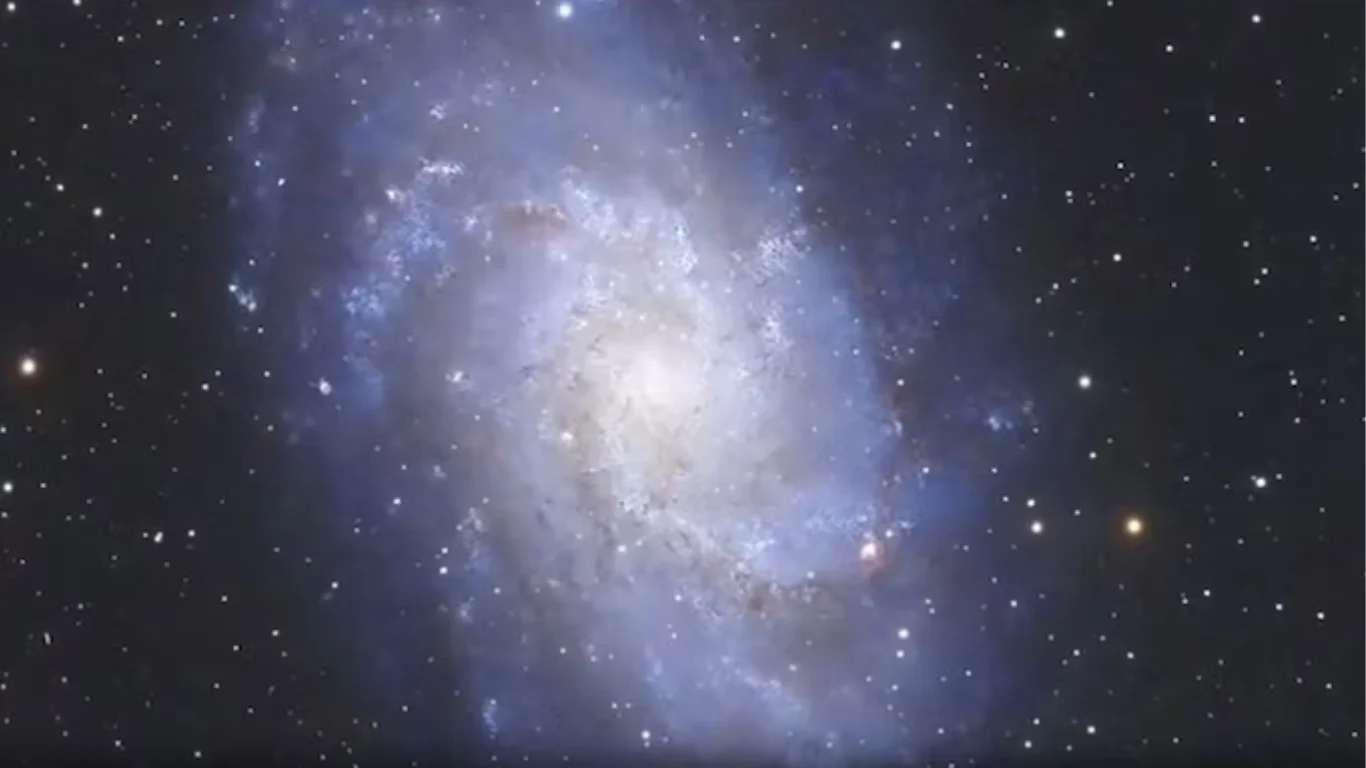
An Indian Man Photographed a Galaxy 2.7 Million Light-Years Away , From a Himalayan Village in Uttarakhand
There is something quietly stunning about the idea that a person sitting in a small village in the mountains of Uttarakhand can point a telescope at the night sky and capture light that left its source before modern humans even existed. That is not poetry. That is physics. And that is exactly what Ramesh Bhadri did.
Bhadri, an Indian astrophotographer, recently captured an image of the Triangulum Galaxy, also known as Messier 33 or M33, from a village in Uttarakhand. The galaxy sits approximately 2.7 million light-years from Earth. His photograph, which circulated widely after being featured by India Today Science, reminded a lot of people , including those who have never looked at the sky with any seriousness , that extraordinary things can happen from places that do not look extraordinary at all.
Why This Uttarakhand Galaxy Photograph Is More Than Just a Pretty Picture
This is not just a technical achievement. It is a story about access, location, and what becomes possible when you are far enough away from city lights.
Light pollution is the invisible thief of the night sky. In most Indian cities, the glow of streetlights, screens, and buildings drowns out everything but the brightest stars. The Triangulum Galaxy, despite being one of the closest galaxies to our Milky Way, is notoriously faint and diffuse. It looks almost transparent, like a water spot on a window, even to experienced observers.
In Uttarakhand, remote areas like Benital and Jadung have become Dark Sky Parks where the Bortle Scale , the standard measure of night sky brightness , registers near Level 1, the darkest possible sky on Earth. That kind of darkness is rare. And Bhadri had access to it, right there, from a village.
Read More: UAE Quits OPEC Amid Iran War – Impact on Global Oil Markets & Prices
What Is the Triangulum Galaxy, and Why Does It Matter?
Think of our galaxy, the Milky Way, as a city. The Andromeda Galaxy is the nearest major galaxy to ours, about 2.2 million light-years away. The Triangulum Galaxy is the next closest large spiral galaxy , slightly farther, at 2.7 million light-years , and it is part of what astronomers call the Local Group, a gravitationally bound collection of more than 50 galaxies that includes both the Milky Way and Andromeda.
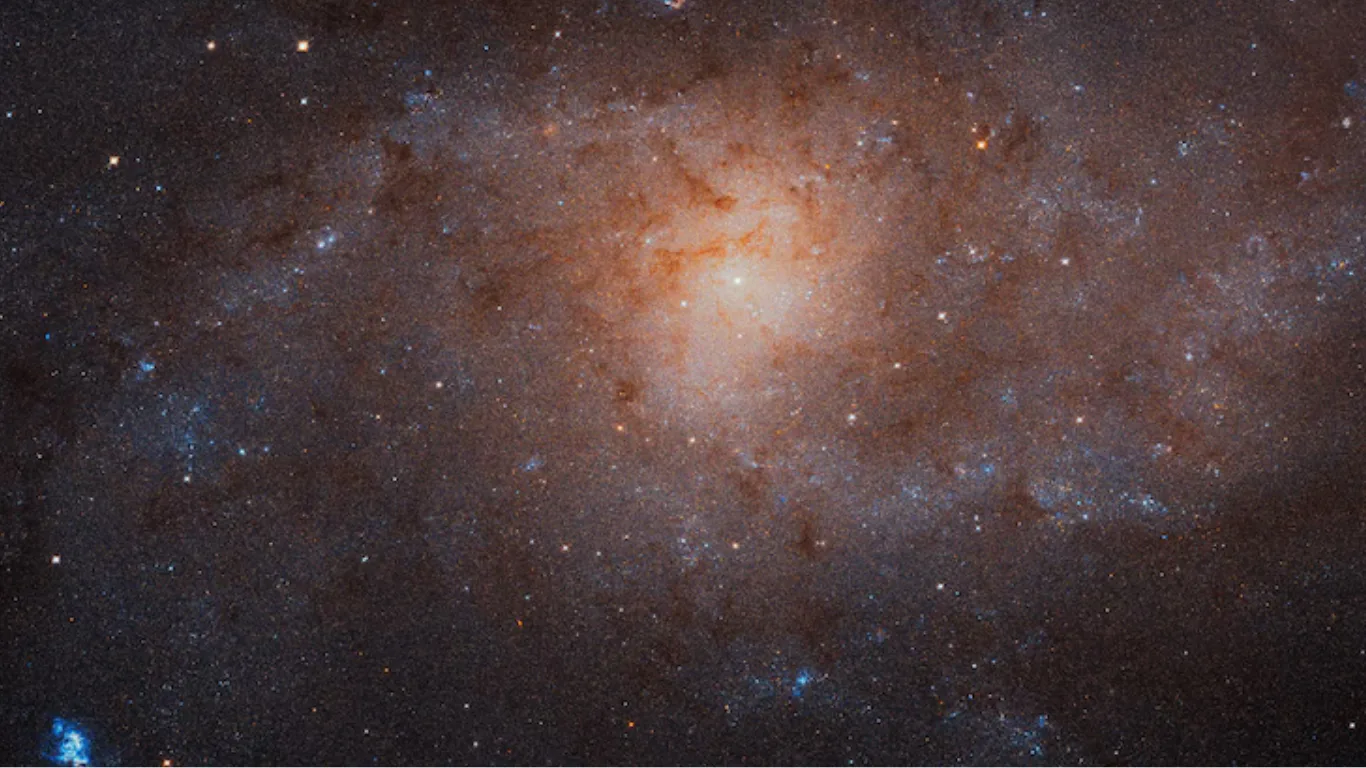
The Triangulum galaxy has a diameter of about 60,000 light-years, roughly 60 per cent that of our Milky Way, and is thought to contain around 40 billion stars. Our Milky Way has somewhere between 100 and 400 billion stars by comparison, so M33 is the smaller sibling , still vast beyond comprehension, but compact in cosmic terms.
M33 lacks a central bulge, and there is no evidence of a supermassive black hole at its core, which is unusual since most large spiral galaxies have one. Galaxies with this kind of structure are called "pure disk galaxies." It is also a star-forming powerhouse. M33 forms stars at a rate 10 times higher than the average of its neighbour, the Andromeda galaxy.
What Bhadri captured from Uttarakhand, then, was not just a fuzzy patch of light. It was a galaxy actively giving birth to new stars, a cosmic nursery embedded in the same gravitational neighbourhood as our own home.
Read More: Easy Healthy Lunch Recipes for Busy Weekdays (Ready in 20 Minutes)
How Astrophotographers Capture Objects Like the Triangulum Galaxy
The process is not as simple as pointing and shooting. Deep-sky astrophotography requires a telescope with a wide field of view, a camera that can handle long exposures in low light, and software to stack multiple images and reduce noise. The Triangulum Galaxy is actually considered a beginner-friendly deep-sky target precisely because of its size and proximity, but capturing fine detail in it takes patience.
For deep-sky objects like faraway galaxies and distant nebulae, you need a telescope , not just a regular DSLR camera, which works well for capturing the Milky Way or star trails. Bhadri's ability to produce a clear image of M33 from a Himalayan village setting speaks to both his technical skill and the quality of his dark sky location.
The Uttarakhand Himalayas have become one of India's most valued regions for this kind of work. Typical destinations for astrophotographers in India include Himalayan towns in Uttarakhand, Himachal Pradesh, and Kashmir, with Ladakh's Hanle being the most well-known location. But Uttarakhand's villages, especially those at altitude and far from major towns, are increasingly being sought out precisely because of how dark and stable their skies are.
The Bigger Picture: India Is Quietly Becoming an Astrophotography Nation
What Ramesh Bhadri did is part of a much larger, quietly growing movement. Across India, hobbyists and enthusiasts are turning to night sky photography, driven by better and cheaper equipment, growing awareness of dark sky sites, and a deep human instinct to look upward and wonder.
M33 has a relatively bright apparent magnitude of 5.7, making it one of the most distant objects that keen-eyed observers can view with the naked eye under exceptionally clear and dark skies. The key phrase there is "exceptionally clear and dark." Bhadri found exactly that, in the hills of Uttarakhand, and turned it into something the rest of the country could see.
There is also a scientific note worth sitting with. The Triangulum Galaxy is a suspected gravitational companion to Andromeda, and both galaxies are moving toward our own Milky Way. M33 could become involved in the impending collision between the Andromeda and Milky Way galaxies, expected more than 4 billion years from now. The galaxy Bhadri photographed is, in a very long timeline, heading toward us.
Closing Thoughts
There is a particular kind of humility that comes from looking at something like this. A man in a mountain village in India points his telescope at a patch of sky and pulls back light that has been travelling for 2.7 million years. The image lands on a sensor. It gets processed. And suddenly, people who have never thought about galaxies are thinking about them.
That is what good science communication does. And sometimes, it wears the face of a photograph taken from a quiet hillside in Uttarakhand.
Disclaimer: This article is based on information available across the web. Parchar Manch does not take responsibility for its complete accuracy, as the content could not be fully verified.
Read More: When Fashion Became a Museum Piece: Inside the 2026 Met Gala's "Costume Art" Night
FAQs
What is the Triangulum Galaxy?
The Triangulum Galaxy, also known as Messier 33 or M33, is a spiral galaxy located approximately 2.7 million light-years from Earth. It is the third-largest member of our Local Group of galaxies and one of the closest galaxies visible to the naked eye under dark skies.
Who is Ramesh Bhadri?
Ramesh Bhadri is an Indian astrophotographer who captured a detailed image of the Triangulum Galaxy from a village in Uttarakhand, India. His photograph drew widespread attention after being featured in science reporting.
Why is Uttarakhand good for astrophotography?
Uttarakhand has several high-altitude locations with minimal light pollution. Some areas in the state register near the darkest level on the Bortle Scale, making them ideal for observing and photographing faint deep-sky objects like distant galaxies.
Can the Triangulum Galaxy be seen without a telescope?
Under exceptionally dark skies, M33 can technically be glimpsed with the naked eye, but it appears very faint and diffuse. Binoculars improve the view, and a telescope with a wide field of view gives the best results for seeing its spiral structure.
What equipment is needed for deep-sky astrophotography?
A telescope, a camera capable of long exposures, a tracking mount to follow the sky's movement, and image-stacking software are the core requirements. The quality of the dark sky location matters as much as the equipment.