
UAE Quits OPEC Amid Iran War – Impact on Global Oil Markets & Prices
Something shifted quietly on Tuesday, April 28, 2026 — and not many people fully understood what they were watching.
The United Arab Emirates, one of the world's most significant oil producers, announced it would formally exit OPEC and the wider OPEC+ alliance, effective May 1. Two days' notice. Decades of membership, gone. The move stunned analysts, rattled markets already frayed by weeks of war, and raised one uncomfortable question that nobody seems to have a clean answer to yet: Is OPEC, as a functioning institution, finally breaking apart?
To understand why this matters, you need to understand what the last two months have actually looked like for the global energy sector.
The Iran War Energy Shock: A Crisis Unlike Anything Since the 1970s
On February 28, 2026, U.S. and Israeli military operations against Iran began. Within days, Iran's Revolutionary Guard Corps effectively closed the Strait of Hormuz a narrow waterway between Iran and Oman through which roughly 20 to 27 per cent of the world's seaborne crude oil and liquefied natural gas (LNG) typically flows.
The International Energy Agency called it the "largest supply disruption in the history of the global oil market." That is not a casual statement.
Brent crude oil prices surpassed $100 per barrel by early March, something that hadn't happened in four years. They peaked at $126 per barrel. The Dallas Federal Reserve estimated that the closure alone could raise West Texas Intermediate (WTI) crude prices to around $98 per barrel and shave nearly 3 percentage points off global GDP growth in a single quarter. Some Wall Street analysts began quietly modelling scenarios where oil hits $170 or even $200 a barrel if the strait stays closed into summer.
Iraq and Kuwait started curtailing production almost immediately because, with storage filling up and no export route, what else could they do? Approximately 11 million barrels per day of crude production were taken offline across the region. The global market began drawing on reserves at roughly 6 million barrels per day.
And ordinary people felt it. Gas prices in the U.S. rose about 27 per cent since the war began, hitting $4.10 per gallon. Jet fuel spiked nearly 95 per cent. Airlines added surcharges. Amazon and FedEx added fuel surcharges. The Philippines instituted a temporary four-day working week to cut fuel demand. Europe, already sitting on gas storage levels at just 30 per cent capacity after a brutal winter, began sliding toward an energy crisis echoing 2022.
This is the world in which the UAE made its decision.
Why the UAE Really Left OPEC — And Why the Timing Is Deliberate
The UAE's Energy Minister Suhail Al Mazrouei was candid with CNN about something that might seem counterintuitive. Why leave now, in the middle of a war? His answer: "Timing is right because it will not significantly impact the market and the price because the Strait of Hormuz is closed and restricted."
In other words, the UAE chose the one moment when its exit wouldn't immediately destabilise global oil supply — because the strait is already destabilising it far more than any OPEC departure could.
The UAE's official statement, carried by state media, said the decision reflected "the UAE's long-term strategic and economic vision and evolving energy profile." They also noted, with a certain diplomatic candour: "During our time in the organisation, we made significant contributions and even greater sacrifices for the benefit of all. However, the time has come to focus our efforts on what our national interest dictates."
That last sentence carries a lot of weight. The UAE had been a member of OPEC since 1967, initially through the emirate of Abu Dhabi, and then as its own sovereign nation from 1971. Fifty-five years of membership. Gone in a press release.
Read More: I Could Be Wrong, But Not All 7": Raghav Chadha Explains His Shock Move From AAP to BJP
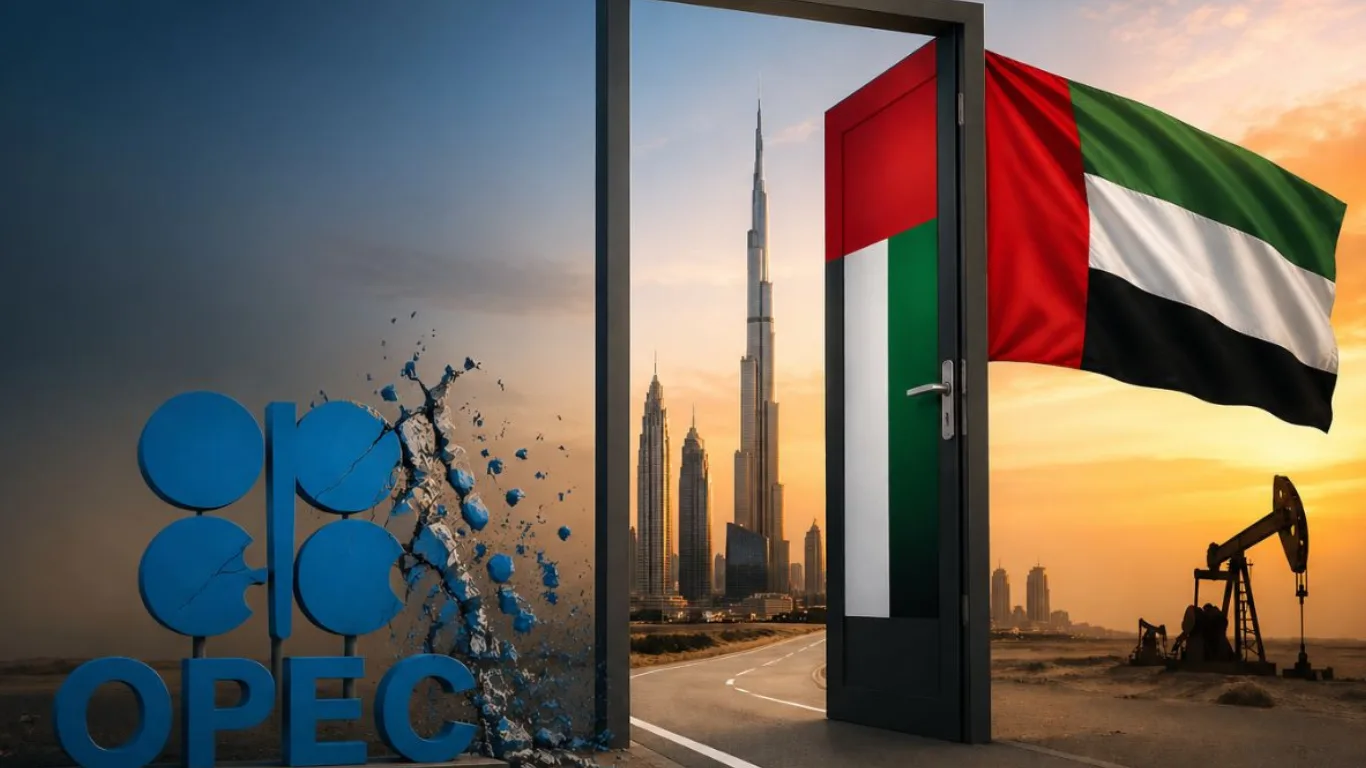
The deeper drivers are not hard to find. For years, the UAE has chafed under OPEC production quotas that limited how much oil it could pump, even as it invested billions in expanding its production capacity. The UAE currently holds roughly 4.8 million barrels per day of production capacity — the third largest in OPEC — and has long wanted to do more with it. OPEC kept saying no, or at least not yet. Saudi Arabia, the group's dominant voice, and the UAE have also been in an increasingly tense rivalry, clashing over Yemen policy, Red Sea politics, and economic influence across the Gulf region.
Leaving OPEC frees the UAE to eventually pump more, free of the consortium's restrictions.
What Leaving OPEC Actually Means (and What It Does Not)
Here is where it is worth slowing down, because the news headlines make this sound simpler than it is.
The UAE's immediate ability to increase oil production is constrained right now. The Strait of Hormuz is effectively closed. While the UAE has an alternative export route through a pipeline to the port of Fujairah, that route is already operating near capacity — exporting roughly 1.5 million barrels per day. So the freedom to produce more does not immediately translate into more oil reaching global markets.
Rystad Energy analyst Jorge Leon put it clearly: "While near-term effects may be muted given ongoing disruptions in the Strait of Hormuz, the longer-term implication is a structurally weaker OPEC."
That phrase — structurally weaker OPEC — is the part that matters.
The UAE was responsible for roughly $77 billion of OPEC's $455 billion in annual oil sales. It is the group's second-largest producer by some estimates. Losing a member of that size does not just hurt OPEC financially; it signals to every other restless member — and there are several — that the exit door is real and usable.
David Oxley, chief climate and commodities economist at Capital Economics, said it plainly: "The ties binding OPEC members together have loosened."
Who Wins, Who Loses, and Why Consumers Should Pay Attention
In the long run, fewer OPEC restrictions on UAE production should mean more oil in global markets. More supply, holding other things equal, means downward pressure on oil prices. That is good for consumers in most countries.
For the United States, the picture is more complicated. The U.S. produces more oil than it consumes — it is technically energy independent in the aggregate — but it still imports about a third of its oil from overseas because the type of crude it drills is better for gasoline than for heavier fuels. Lower global oil prices, while helpful at the pump, could squeeze profits for American oil companies.
For Asian economies — China, India, Japan, South Korea — which received about 75 per cent of Gulf oil and 59 per cent of Gulf LNG exports before the war, the immediate crisis is severe. Many of these countries are either drawing down strategic reserves or scrambling for alternative suppliers from Russia, the U.S., and West Africa.
For the UAE itself, independence from OPEC gives it room to build its own energy relationships, price its oil outside the cartel's framework, and position itself as a more direct partner for global buyers. The UAE has already been rerouting oil through Fujairah and has made no secret of its ambitions to become a global energy trading hub.
Read More: Narendra Modi Addresses Vijay Sankalp Sabha in Mathurapur: Impact on West Bengal Election 2026
The Bigger Picture: Is OPEC Finished?
Probably not finished. But meaningfully diminished — and for the first time in a long while, visibly so.
OPEC has been under pressure for years. U.S. shale production eroded the cartel's pricing power through the 2010s. The 2020 pandemic price crash exposed deep fissures between members. And throughout 2024 and 2025, internal arguments about production levels — particularly between the UAE and Saudi Arabia — were barely concealed.
The Iran war has acted as a catalyst, compressing years of slow fracture into a few weeks of open rupture. Iran, itself an OPEC member, is responsible for the crisis that has made OPEC's collective output controls essentially irrelevant in the short term. Saudi Arabia and the UAE have been on opposite sides of multiple regional conflicts. The cartel that once spoke with one voice on global energy markets is now a twelve-nation group with one fewer member and several more asking quiet questions.
What happens after the Strait reopens — whenever that is — will determine whether OPEC can reconstitute its relevance or whether the UAE's departure is the beginning of a longer unravelling.
What Should Ordinary People Watching This Understand
Most people are not oil traders. They are people paying more at the pump, watching their grocery bills climb because fertiliser prices are up, and wondering why their airline ticket suddenly costs 40 per cent more than it did in January.
The connection is real. The Strait of Hormuz is not an abstract geopolitical concern. It is the physical channel through which a fifth of the world's oil and a significant portion of its natural gas passes. When it closes, the ripple effects reach every economy that runs on petroleum, which is still essentially all of them.
The UAE quitting OPEC does not fix any of that in the near term. What it does is begin reshaping the longer-term architecture of how oil is produced, priced, and traded in a world where the Middle East is less stable and more fragmented than it was even six months ago.
That is the quieter shift to watch — not the drama of the departure itself, but what it signals about where power over global energy is moving, and who will hold it next.
Disclaimer: This article is based on information available across the web. Parchar Manch does not take responsibility for its complete accuracy, as the content could not be fully verified.
FAQs
What is OPEC and why does it matter?
OPEC, the Organisation of the Petroleum Exporting Countries, is a cartel of oil-producing nations that coordinates production levels to influence global oil prices. When its members agree to produce less oil, prices tend to rise. When they pump more, prices tend to fall. It matters because oil prices affect the cost of fuel, food, manufacturing, and transportation everywhere in the world.
Why did the UAE leave OPEC now?
The UAE has wanted more production freedom for years. It has been quietly at odds with Saudi Arabia over quotas, regional policy, and economic competition. The UAE's Energy Minister acknowledged that the timing was partly strategic — with the Strait of Hormuz already closed due to the Iran war, the market impact of the exit is more limited than it would be in normal conditions.
Will the UAE's leaving OPEC lower oil prices?
Not immediately. The Strait of Hormuz closure is the dominant factor in oil prices right now, not OPEC's production ceilings. In the longer term, once the Strait reopens, the UAE will have the freedom to increase production, which could put downward pressure on prices.
How serious is the Strait of Hormuz crisis?
Very serious. The International Energy Agency has described it as the "greatest global energy security challenge in history." About 20 per cent of the world's oil and significant LNG volumes normally pass through the strait. Its effective closure has caused Brent crude to spike above $120 per barrel, triggered fuel shortages in multiple countries, and contributed to food price increases due to disrupted fertiliser supply chains.
Could other OPEC members follow the UAE?
It is a real concern. The UAE was one of OPEC's largest and most important members. Its exit demonstrates that departure is viable. Several other members — particularly those with their own production ambitions or Saudi Arabia tensions — may reassess their membership in the months ahead. OPEC's ability to present a unified front will be tested significantly.
What does this mean for India and other Asian oil importers?
Countries like India, China, Japan, and South Korea were among the biggest recipients of Gulf oil exports. The Hormuz closure has hit them hardest. India, in particular, has been scrambling for alternative suppliers. A long-term UAE outside OPEC could eventually mean more flexible bilateral deals with Asian buyers, but for now, the physical supply disruption remains the dominant problem.