
ChatGPT Work and GPT-5.6: OpenAI's Biggest Product Shakeup Yet, Explained
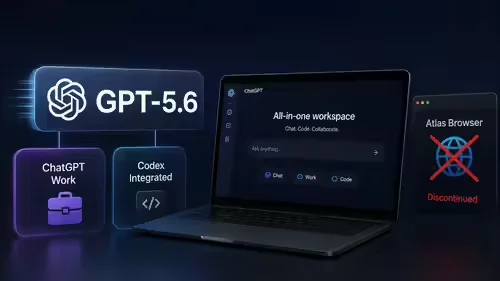
Forty minutes. That's roughly how long OpenAI's livestream took to go from "here's a new model" to "actually, we've restructured the entire product." The ChatGPT Work GPT-5.6 launch on Thursday wasn't just another incremental model update, the kind we've all gotten used to seeing every few months. This one folded Codex directly into ChatGPT, introduced a completely new work-focused AI agent, and quietly discontinued a browser product that never quite found its footing. A lot happened. Let's slow down and actually walk through it.
If you use ChatGPT for anything beyond casual chatting, this update touches you more than you'd expect.
Why This Actually Matters
Here's the honest truth about AI model releases, most people's eyes glaze over at version numbers. GPT-5.6 sounds like a minor bump, doesn't it. It isn't. This release bundles three distinct models, each aimed at a different kind of task, alongside a new agent called ChatGPT Work designed specifically to handle real workplace tasks, documents, spreadsheets, presentations, pulling context from your connected apps and files rather than waiting for you to explain everything from scratch.
For anyone running a business, managing a team, or just drowning in repetitive digital busywork, that shift from "chatbot that answers questions" to "agent that actually does the work across your files and tools" is the kind of change worth paying attention to, not skimming past.
Read More: NASA's Swift Observatory Rescue Mission: Inside the Daring Plan to Save a Falling Telescope
What GPT-5.6 Really Is, Explained Simply
Picture hiring three different assistants, each suited to a different kind of task. One is your top performer, the person you hand your hardest, most complex problems to. One is your reliable everyday generalist, fast and capable for most regular tasks. And one is your speed specialist, built for high volume, lower cost work where perfection matters less than throughput.
That's essentially the GPT-5.6 family. Sol is the flagship, OpenAI's most capable model, aimed at complex reasoning, coding, and cybersecurity work. Terra sits in the middle, a balanced option for everyday enterprise use. Luna is the fast, cost efficient option, built for high volume deployments where speed and price matter more than raw power. OpenAI introduced a naming convention here too, the version number marks the generation, while Sol, Terra, and Luna represent capability tiers that can evolve independently going forward.
How the New System Works, Step by Step
Here's the practical breakdown of what actually changed and how to access it.
- ChatGPT Work launched as a new agent available on web, mobile, and desktop, capable of gathering context across your connected apps and files to actually build documents, spreadsheets, presentations, and more, rather than just answering isolated prompts.
- The standalone Codex app has been folded directly into a unified ChatGPT desktop app, which now includes three distinct modes, Chat for regular conversation, Work for broad multi-step tasks, and Codex for coding specifically.
- Free and Go tier users get access to GPT-5.6 Terra, while Plus, Pro, Business, and Enterprise users can choose between Sol, Terra, and Luna depending on the task at hand.
- A new reasoning mode called "max" is available to all users with GPT-5.6 access in Work and Codex, while "ultra" mode, which coordinates four AI agents working in parallel, is available to Pro and Enterprise users in Work, and Plus and higher plans in Codex.
Read More: Anti-Ageing Skincare Routine 2026: How to Reduce Wrinkles and Fine Lines Naturally
- OpenAI also introduced GPT-Live, a new voice model built with full duplex architecture, meaning it can listen and speak simultaneously rather than waiting for its turn, a genuinely different feel from the older back and forth voice experience.
- Developers get access through the OpenAI API, priced per million tokens, Sol at 5 dollars input and 30 dollars output, Terra at 2.50 and 15 dollars, and Luna at 1 dollar and 6 dollars respectively.
Each tier exists so organizations can route different workloads to whichever model actually fits the job, rather than paying premium prices for tasks that don't need premium reasoning power.
Read More: Iran-Israel War LIVE: Middle East Tensions & Global Stability
Real-World Examples That Make This Click
Think about a marketing manager who needs a campaign tracker built quickly. With the new Sites feature, that output can become a shareable, live updating web app directly inside ChatGPT, no separate developer needed. Or picture an operations lead who wants a recurring weekly report generated automatically. Scheduled Tasks inside ChatGPT Work can keep that workflow running even after you've closed the app and moved on to something else.
On the technical side, OpenAI reported that GPT-5.6 Sol scored 53.6 on a benchmark called Agents' Last Exam, which measures long running professional workflows, while achieving that result at meaningfully lower computing cost than competing frontier models. CEO Sam Altman told CNBC the model is roughly 54 percent more token efficient on agentic coding tasks specifically, a detail that matters enormously to enterprises watching their AI spending closely.
Mistakes People Keep Making With Updates Like This
A common mistake is assuming a bigger version number automatically means better results for every single task. It doesn't quite work that way here. Early testers have actually been split, some praising GPT-5.6 for reliability on everyday tasks, while others note that Anthropic's Claude Fable 5, released around the same period, shows different strengths depending on the workload, one commentator comparing GPT-5.6 to a dependable sports car and Fable to something built for longer, more demanding journeys. Neither framing is universally right, the better fit really depends on what you're actually trying to accomplish.
Another mistake is overlooking the merged app structure. If you were used to a separate Codex app for coding, that product has now been folded into the main ChatGPT desktop app, so updating your existing Codex install will transform it into the new unified experience rather than leaving two separate apps running side by side.
Read More: NASA Swift Telescope Rescue Mission: The Wild Plan to Grab a Falling Observatory Before It Burns Up
Pro Tips That Actually Help
If you're managing costs across a team, match the model tier to the task complexity rather than defaulting everyone to Sol. Luna and Terra handle a large share of everyday work at a fraction of the cost, saving Sol specifically for genuinely complex reasoning or coding problems.
It's also worth exploring ChatGPT Work's integrations with tools like Microsoft 365, Google Drive, Slack, and Notion early, since the value of an agent like this compounds the more of your actual workflow it can see and act on directly, rather than being fed information manually each time.
Closing Thoughts
There's something almost telling about a company choosing to bury a genuinely significant model release inside a broader product reorganization rather than leading with it. The ChatGPT Work GPT-5.6 launch reads less like an incremental update and more like OpenAI quietly admitting that the chatbot era of AI is giving way to something closer to an actual coworker, one that opens your files, drafts your documents, and keeps working long after you've stopped watching. Whether that shift genuinely changes how people work, or simply adds another tool competing for attention, is something only the next few months of actual daily use will answer honestly.
Read More: Alia Bhatt Alpha Spy Thriller Finally Hits Theatres, But the Numbers Tell a Complicated Story
Disclaimer: This article is based on information available across the web. Parchar Manch does not take responsibility for its complete accuracy, as the content could not be fully verified.
FAQs
What is ChatGPT Work?
It's a new AI agent from OpenAI that can gather context across connected apps and files to create documents, spreadsheets, presentations, and other work products across web, mobile, and desktop.
What are the differences between GPT-5.6 Sol, Terra, and Luna?
Sol is the flagship model for complex reasoning and coding, Terra is a balanced option for everyday enterprise tasks, and Luna is a fast, cost efficient model designed for high volume use.
Did OpenAI shut down any existing products with this launch?
Yes, OpenAI confirmed it is shuttering its ChatGPT Atlas browser as part of this broader product restructuring.
How much does GPT-5.6 cost through the API?
Sol is priced at 5 dollars per million input tokens and 30 dollars per million output tokens, with Terra and Luna offering progressively lower pricing.
What happened to the standalone Codex app?
It has been merged into a unified ChatGPT desktop app, which now includes Chat, Work, and Codex modes in one interface.
Is GPT-5.6 available to free users?
Yes, free and Go tier users have access to GPT-5.6 Terra, while paid tiers can choose among Sol, Terra, and Luna.