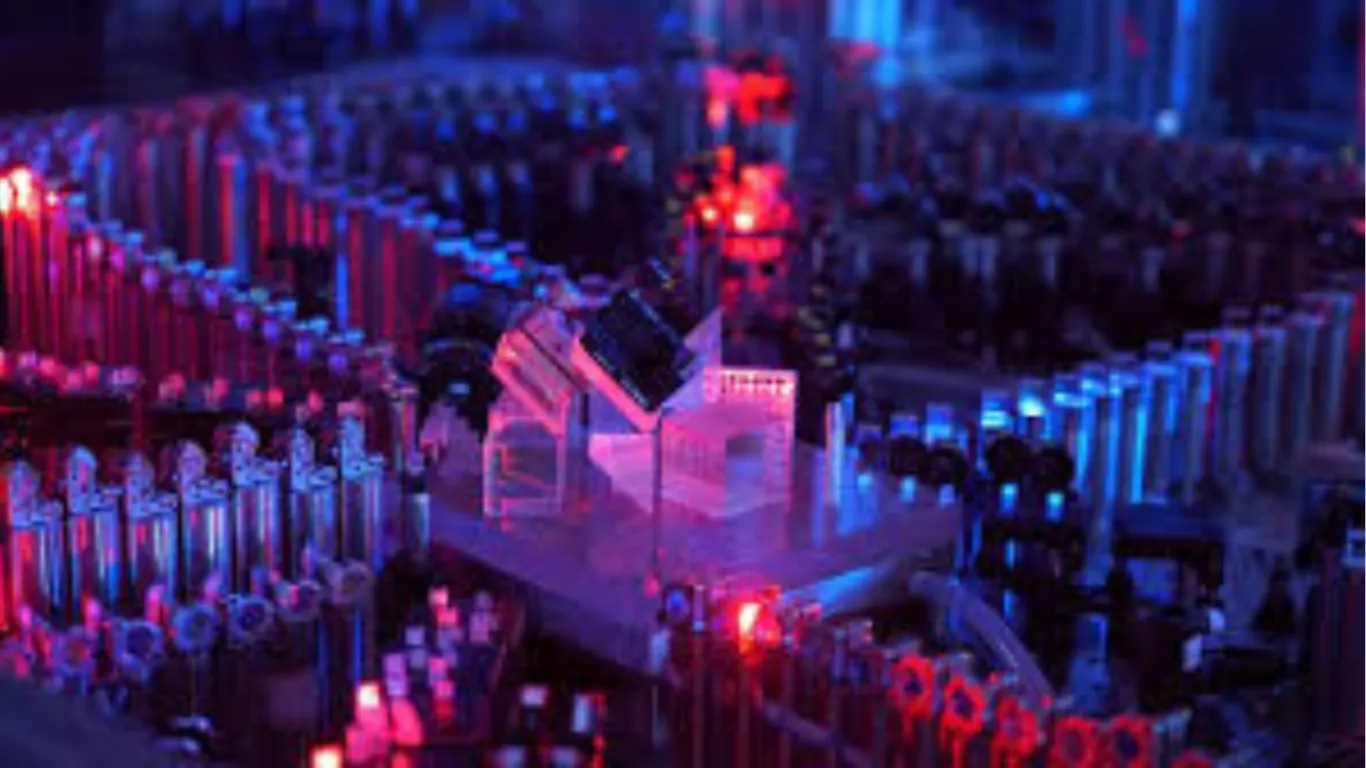
China's Jiuzhang 4.0 Just Shattered a Quantum Computing World Record , And It Happened in 25 Microseconds
Jiuzhang 4.0, China's latest quantum computing prototype, has done something that quietly rewrites what we thought was possible. Published May 14, 2026, in the journal Nature, the results are not subtle. The machine, built by researchers at the University of Science and Technology of China (USTC), solved a specific computational problem at a speed more than 10 to the power of 54 times faster than the world's most powerful supercomputer. That number is so large it barely fits inside a human thought. The most advanced classical machine on Earth would need more than 10 to the 42nd power years to match what Jiuzhang 4.0 did in 25 microseconds. For reference, the universe is roughly 13.8 billion years old.
This is not incremental progress. This is a different category of machine entirely.
Why the Jiuzhang 4.0 World Record Actually Matters Beyond the Headlines
Most people hear "quantum computing" and feel a familiar fog settle in. That's understandable. But what happened here is worth slowing down for, because the implications reach further than a lab in China.
Quantum computational advantage, which is the term scientists use when a quantum machine outpaces any classical computer on a given task, has been claimed before. Google did it in 2019. IBM has been pushing boundaries for years. But Jiuzhang 4.0 takes the photonic approach, meaning it uses particles of light rather than superconducting circuits cooled to near absolute zero. That matters because photonic systems are fundamentally different in how they handle and process information. Less infrastructure. Different constraints. And potentially, different ceilings.
The race for quantum supremacy is not just academic bragging rights. It has direct consequences for drug discovery, materials science, financial modelling, cryptography, and the security of systems that billions of people depend on every day.
Read More: Why China’s Wang Yi Is Skipping the BRICS Delhi Meet — And What It Signals for Global Diplomacy
What Is Jiuzhang 4.0 and How Does Photonic Quantum Computing Actually Work
Think of a regular computer as a machine that processes information using tiny switches, called bits, that are either on or off. A quantum computer uses quantum bits, or qubits, that can be both on and off simultaneously, a property called superposition. It can also link qubits together so that the state of one instantly influences another, no matter the distance. That is called quantum entanglement.
Jiuzhang works differently from most quantum machines. Instead of using electrons or ions, it encodes its qubits using photons, which are individual particles of light. The team at USTC built a system that integrates 1,024 high-efficiency squeezed-state optical fields into an 8,176-mode spatiotemporally hybrid-coded circuit. The result: the ability to manipulate and detect quantum states of up to 3,050 photons. The previous version, Jiuzhang 3.0, managed 255. That leap is not linear. The computational complexity scales exponentially with photon count, which is exactly why the speed comparison with classical supercomputers becomes almost comical.
The task the machine was tested on is called Gaussian boson sampling. It is a specific type of computational problem that classical computers struggle with enormously, but that photonic quantum systems handle naturally. It is not a general-purpose calculation, and that distinction matters.
How Jiuzhang 4.0 Was Built: The Technical Leap Explained Simply
Professor Lu Chaoyang, who led the research team, described developing a high-efficiency optical parametric oscillator light source and a spatiotemporally hybrid-coded interferometer. Those are dense terms, but the core idea is this: the team engineered a way to generate, route, and detect photons with far less loss than previous systems. Fewer losses mean more photons reach their destination intact, which means more complex calculations become possible.
The circuit they built handles 8,176 modes. A mode, in this context, is essentially a distinct path or channel a photon can travel through. More modes mean more possible states, and more possible states mean the system can tackle exponentially harder problems.
The most complex data sample the machine generates takes only 25 microseconds. That is less time than it takes a human eye to blink. Classical machines would need aeons.
Read More: BlackRock's Larry Fink Calls the AI Bubble Theory Dead Wrong — "We Have a Severe Shortage, Not a Surplus
The Jiuzhang Series: A Timeline of Quiet Progress
It is worth understanding that Jiuzhang 4.0 did not appear overnight. The series began in 2020, when the original prototype was first constructed and demonstrated quantum advantage for the first time in optical quantum computing. Each subsequent upgrade has not just improved performance but expanded the fundamental architecture.
Jiuzhang 3.0 achieved 255-photon manipulation. Jiuzhang 4.0 reaches 3,050. That is not just more of the same. The team has fundamentally rethought how the optical components interact, which is what makes this a record-breaking result and not just a refined one.
The broader context is that current mainstream quantum computing routes include superconducting systems (used by Google and IBM), ion trap systems, neutral atom platforms, and photonic systems. Each has different strengths, weaknesses, and long-term potential. China's sustained investment in the photonic path is a deliberate bet that light-based processors may offer advantages at scale that other approaches cannot match.
What This Means for the Future of Fault-Tolerant Quantum Computing
Professor Lu was careful to note what comes next. The results from Jiuzhang 4.0 open up new possibilities for building what researchers call trillion-qubit-mode three-dimensional cluster states. That phrase points directly at the long-term goal: fault-tolerant quantum computing, systems capable of correcting their own errors in real time, making them reliable enough for real-world deployment.
Today's quantum machines, including this one, are not yet fault-tolerant. They are extremely powerful at specific tasks, but they make errors, and those errors compound. The path from where we are now to a stable, fault-tolerant quantum computer is still long, and no one should pretend otherwise.
But what Jiuzhang 4.0 does is demonstrate that the photonic route, the approach of using light to carry quantum information, is viable at a scale that was genuinely uncertain before this week.
That is not a minor thing. It reshapes what the next decade of research looks like.
Read More: Google's REPLIQA Program: How Quantum AI and Life Sciences Are About to Change Medicine Forever
What Most People Get Wrong About Quantum Computing Progress
One common mistake is treating every quantum milestone as if it means quantum computers are about to replace laptops. They are not, and probably will not for a very long time, if ever, in that direct sense. Quantum computers are specialised. They excel at specific classes of problems: optimisation, simulation, sampling, and cryptography-related tasks. For everything else, classical computers remain faster, cheaper, and more practical.
Another mistake is assuming that one country's breakthrough makes everyone else irrelevant. Quantum computing is genuinely a field where multiple approaches are advancing simultaneously. Google, IBM, IonQ, and dozens of university labs are working on superconducting and ion-trap systems that have their own remarkable milestones. The Jiuzhang result is significant, but it does not mean the photonic approach has "won."
What it does mean is that the field is moving faster than most timelines predicted five years ago.
Closing Thoughts
There is something quietly striking about a machine solving a problem in 25 microseconds that would otherwise take longer than the age of the universe. Not because it immediately changes daily life, but because it signals something about the direction things are going. The gap between what classical machines can do and what quantum machines can do is widening faster than many expected.
Jiuzhang 4.0 is a research prototype. It will not be available for download. But the science behind it, published openly in Nature, will feed into the next generation of systems built everywhere from Shanghai to San Francisco. That is how progress usually works: quietly, in journals, years before anyone outside a lab feels the effect.
Disclaimer: This article is based on information available across the web. Parchar Manch does not take responsibility for its complete accuracy, as the content could not be fully verified.
FAQs
What is Jiuzhang 4.0?
Jiuzhang 4.0 is a photonic quantum computing prototype developed by researchers at the University of Science and Technology of China (USTC). It uses particles of light, called photons, to perform quantum computations and has set a new world record in optical quantum information technology.
What is Gaussian boson sampling and why does it matter?
Gaussian boson sampling is a specific type of mathematical problem that is extremely difficult for classical computers but naturally suited to photonic quantum systems. While it is not a general-purpose computation, demonstrating speed advantage on this problem is considered a meaningful benchmark for quantum computational advantage.
How does Jiuzhang 4.0 compare to previous versions?
Jiuzhang 3.0 could manipulate up to 255 photons. Jiuzhang 4.0 handles up to 3,050, a more than tenfold increase. Because computational complexity scales exponentially with photon count, the performance gap between the two is far larger than that number suggests.
Can Jiuzhang 4.0 break encryption or replace regular computers?
No. The machine is specialised for specific computational tasks, primarily sampling problems. It cannot perform general computation and is not currently capable of breaking modern encryption. Fault-tolerant quantum computers, which could theoretically do that, remain a future goal, not a present reality.
What is quantum computational advantage?
It is the point at which a quantum computer can solve a specific problem faster than any classical computer can, regardless of how much time is given. Jiuzhang 4.0's result is one of the clearest demonstrations of this advantage recorded to date.
Where was the research published?
The study was published on May 14, 2026, in the journal Nature, one of the most respected peer-reviewed scientific publications in the world.