
CM Vijay Shuts 717 TASMAC Liquor Shops in Tamil Nadu: What the Order Means, Why It Matters, and What Happens Next
Tamil Nadu CM Vijay orders closure of 717 TASMAC liquor shops — and he did it on day one. Not week three, not after settling into the chair. Day one.
That detail alone tells you something about how C. Joseph Vijay, the actor-turned-politician who took oath as Tamil Nadu's Chief Minister on May 10, 2026, intends to run the state. His first significant executive order was not about infrastructure, not about some bureaucratic reshuffle. It was about liquor shops. Specifically, the 717 TASMAC outlets operating within 500 metres of temples, mosques, churches, schools, colleges, and bus stands across Tamil Nadu.
The order demands that all 717 shops shut down within two weeks.
Why This Decision Carries Real Weight
Tamil Nadu's alcohol situation is complicated. The state government runs liquor sales through TASMAC, the Tamil Nadu State Marketing Corporation, which holds a monopoly over retail alcohol. This is not a private business being told to close. The government is essentially ordering itself to give up revenue.
That is not a small thing. TASMAC generates thousands of crores in annual revenue for the state. Closing 717 shops, even if they are a fraction of the total outlets, will have a measurable fiscal impact. The fact that Vijay chose to do this anyway, and immediately, signals that this is a promise he intended to keep from the start — not something to be conveniently forgotten post-election.
His party, TVK (Tamilaga Vettri Kazhagam), had campaigned on social reform, and curbing alcohol access near sensitive areas was a central pledge.
What Exactly Was Ordered, and Where
The directive targets TASMAC liquor outlets that fall within a 500-metre radius of the following locations: places of religious worship (temples, mosques, churches), educational institutions including schools and colleges, and bus stands.
The logic here is not hard to follow. These are spaces where families gather, where children move daily, and where communities observe religious practice. Having a government-run liquor shop within walking distance of a school gate or a temple entrance is the kind of arrangement that generates quiet, persistent community resentment. Parents have complained about it for years across Tamil Nadu. The order acknowledges that reality directly.
Two weeks. That is the implementation deadline Vijay has set.
Read More: Russia Launches Progress MS-34 Cargo Ship to the ISS, Delivering Over 2.5 Tonnes of Vital Supplies
The TASMAC System: Why Closing Shops Is More Complex Than It Sounds
People unfamiliar with Tamil Nadu's governance structure sometimes assume that shutting a liquor shop is straightforward. It is not when TASMAC is involved.
TASMAC outlets employ thousands of workers directly. Each closure means displaced staff who need reassignment. Beyond employment, the corporation's revenue feeds into the state's social welfare programs. There is a quiet financial tension embedded in every liquor reform promise made by Tamil Nadu politicians.
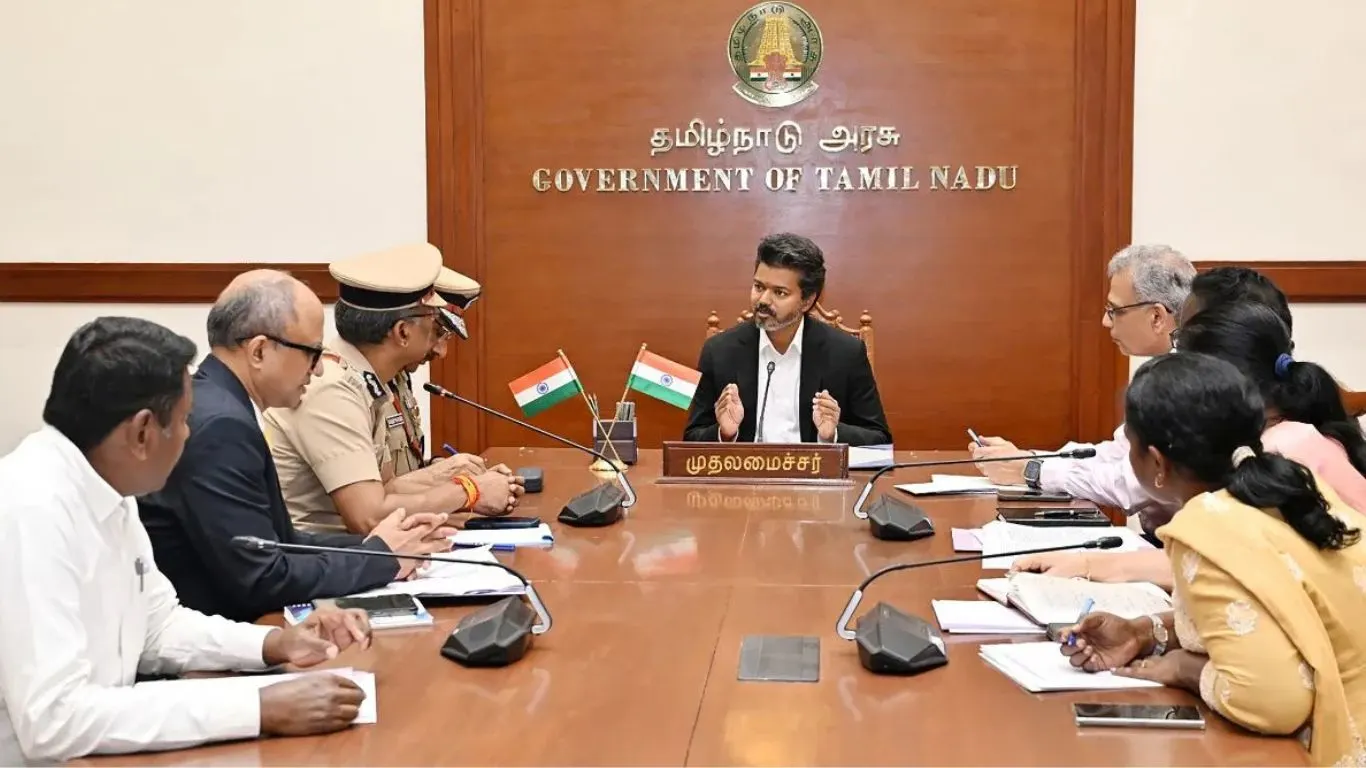
Previous governments have attempted similar actions with varying degrees of follow-through. The DMK and AIADMK both made gestures toward alcohol reform over the years. What makes this order notable is the specificity 717 identified shops, a clear 500-metre rule, and a public two-week deadline. It is harder to quietly walk back when the numbers are this concrete.
Vijay's First Day in Office: A Statement Beyond Just Liquor
CM Vijay's broader first-day agenda reportedly also included approving 200 units of free electricity for households. Taken together, these two decisions sketch a clear opening message: social welfare and community protection first.
The liquor shop closure near religious places and schools fits into a larger pattern of populist governance that Tamil Nadu voters have come to expect from their leaders the kind of visible, immediate action that tells ordinary citizens they were heard.
Whether the closures actually happen within the two-week window, whether the affected workers are absorbed elsewhere, and whether TASMAC compensates through operational changes at other outlets those are the questions that will define whether this is policy or performance.
Read More: Raghav Chadha and Six Other AAP MPs Join BJP: What It Means for Indian Politics
What This Means for People Living Near These Locations
For families living near any of the 717 affected outlets, the change is tangible. A temple street with a liquor shop at its entrance is a daily friction point for many residents. The same goes for school zones, where students walk past these outlets every morning.
Community groups and women's organisations in Tamil Nadu have long pushed for exactly this kind of geographic restriction. Today, at least on paper, they have it.
For people who rely on these shops for access to alcohol, the distance to the next TASMAC outlet becomes the immediate practical question. Tamil Nadu is not implementing prohibition. Liquor remains legal and government-sold. This is a repositioning, not a ban.
What Usually Goes Wrong With Orders Like This
The biggest failure mode for decisions like this is the gap between announcement and execution. Tamil Nadu has seen alcohol-related reform promises stall at the implementation stage before. Shop owners may contest closure notices. TASMAC staff unions may raise objections. Legal challenges are possible.
The two-week deadline is ambitious. Government machinery, especially when it involves property, livelihoods, and legal notices, tends to move slowly. Vijay's administration will face its first real test of political will in seeing this through not just announcing it.
Watch for whether all 717 shops are actually shuttered by the end of May 2026, or whether the number quietly settles at something lower.
Closing Thoughts
Something is striking about a Chief Minister who begins his tenure with an act that costs his own government money. It does not prove good governance by itself. Implementation matters more than announcements. But it sets a tone that is hard to fake on day one.
Tamil Nadu is watching. So, frankly, is the rest of India.
FAQs
What exactly did CM Vijay order regarding TASMAC liquor shops?
CM Vijay ordered the closure of 717 TASMAC-run liquor outlets that are located within 500 metres of religious places, educational institutions (schools and colleges), and bus stands across Tamil Nadu. The shops are required to shut within two weeks of the order.
What is TASMAC?
TASMAC stands for Tamil Nadu State Marketing Corporation. It is the state government's agency that holds a monopoly over retail alcohol sales in Tamil Nadu. All government-run liquor shops in the state are operated by TASMAC.
Does this mean Tamil Nadu is going dry or implementing prohibition?
No. This is not a prohibition order. Alcohol remains legal and is still sold by TASMAC. The closure order only affects shops that fall within 500 metres of sensitive locations like temples, schools, and bus stands. Other TASMAC outlets continue to operate.
When does CM Vijay's order take effect?
The order requires implementation within two weeks. This means all 717 identified outlets should be closed by approximately late May 2026.
Will this affect TASMAC employees?
Yes, potentially. The closure of 717 outlets will affect the workers assigned to those shops. Whether they are reassigned to other TASMAC outlets or face other arrangements depends on how the state government manages the transition.