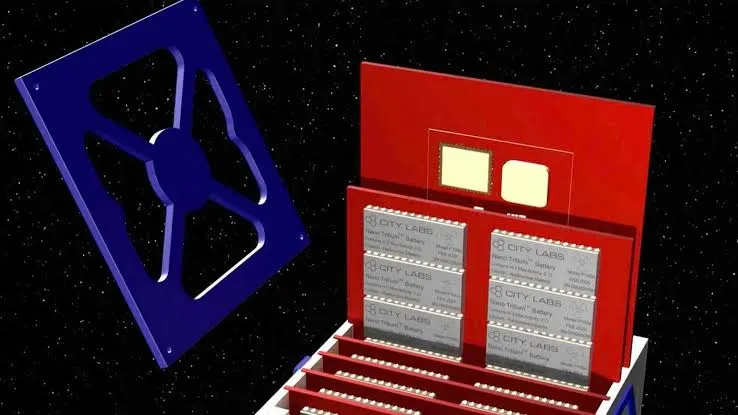
City Labs Nuclear-Powered Satellite: Meet BOHR, the Softball-Sized Machine Rewriting Space Power Rules
A satellite the size of a softball just did something governments spent seventy years keeping to themselves. On July 7, a Miami company called City Labs put a nuclear battery into orbit, and for the first time ever, it was not NASA or the military behind it. It was a private company. The City Labs nuclear-powered satellite, officially named BOHR, rode to space aboard a SpaceX Falcon 9 as part of the Transporter-17 rideshare mission, sharing the ride with eighty other payloads.
It sounds almost too small to matter, a device producing power measured in microwatts, less than what your phone draws while idle. But the story behind the City Labs nuclear-powered satellite is not about raw power. It is about who gets to fly nuclear technology in space, and that rulebook just changed.
Why the City Labs Nuclear-Powered Satellite Actually Matters
Here is the problem solar panels have always had. They work beautifully in sunlight, and then a satellite drifts into Earth's shadow, or into a permanently dark lunar crater, or out toward deep space, and suddenly those panels are useless. Batteries can bridge the gap for a while, but batteries die. The City Labs nuclear-powered satellite exists specifically to answer that gap, using a technology that keeps producing electricity regardless of sunlight, for years, sometimes decades.
That matters right now because NASA's Artemis program is pushing toward a permanent human presence on the Moon, and lunar nights last roughly two weeks with zero sunlight. Any mission planning to survive that darkness needs power that does not care whether the sun is up.
Read More: Lawrence Bishnoi Gang Indictment: How a Jailed Gangster Ran a Global Crime Empire From His Cell
What the BOHR CubeSat Really Is, Explained Simply
Think of the BOHR CubeSat less like a nuclear reactor and more like a very patient battery. Its core technology, called NanoTritium betavoltaic technology, does not split atoms the way a power plant does. Instead, it captures beta particles thrown off naturally as tritium, a radioactive form of hydrogen, decays. A semiconductor catches those particles and turns them directly into electricity, no heat cycle, no moving parts, no meltdown risk.
Compare that to the radioisotope thermoelectric generators that have powered missions like Voyager and Perseverance for decades. Those use heat from decaying plutonium and can produce hundreds of watts. BOHR's tritium battery produces almost nothing by comparison, nanowatts to microwatts. But it is small, low risk, and built for a completely different job, running tiny sensors and payloads for years without ever needing sunlight or a fresh charge.
How the Mission Came Together, Step by Step
- Regulatory approval first. Before BOHR could fly, City Labs had to clear the FAA nuclear launch approval pathway, a framework laid out under National Security Presidential Memorandum-20. Sandia National Laboratories independently reviewed the safety case.
- FAA sign off. The FAA issued its formal payload authorization on September 30, 2025, making BOHR the first commercial mission ever to pass through that specific FAA nuclear launch approval process.
- Launch day. BOHR lifted off from Vandenberg Space Force Base at 12:10 a.m. Pacific Time on July 7, riding aboard SpaceX's Transporter-17 mission alongside eighty other payloads.
Read More: Modi Albanese Meeting: Why This Melbourne Handshake Could Reshape India's Energy Future

- Orbit insertion. The CubeSat settled into a sun-synchronous orbit roughly 350 to 400 miles up and is now being prepared for commissioning.
- Dual power system. BOHR uses ordinary solar panels to run its main satellite functions, while the NanoTritium battery powers and validates the actual payload demonstration during the SpaceX Transporter-17 flight.
Real World Examples of Where This Technology Could Go
Picture a science instrument sitting inside a permanently shadowed lunar crater, the kind NASA is eyeing for water ice extraction. Solar panels cannot survive there. A tritium betavoltaic battery could. Or picture a distributed sensor network scattered across a stretch of deep space, quietly reporting data for a decade without anyone needing to visit and swap a battery. City Labs' CEO Peter Cabauy has said the company is already working on related heat sources for NASA's lunar payload programs, extending the same NanoTritium betavoltaic technology proven on the SpaceX Transporter-17 flight toward exactly these kinds of long, dark missions.
Read More: Ramayana Trailer Launch: Why Nitesh Tiwari Is Turning a Movie Preview Into a National Event
Mistakes People Keep Making When Reading This Story
A common mistake is assuming the City Labs nuclear-powered satellite is a nuclear reactor in space, something that could fail catastrophically like the Soviet Kosmos 954 incident decades ago. It is not. There is no fission happening, no enriched uranium core, nothing resembling a reactor at all. The tritium involved sits at a low end of the radiation scale and is engineered specifically for safe handling in ordinary commercial launch environments. Another mistake is assuming this satellite is powerful. It is not meant to be. BOHR is a proof of concept, a pathfinder mission testing whether the hardware survives launch and whether the technology can pass regulatory scrutiny, not a workhorse power source.
Pro Tips for Understanding What Comes Next
If you want to follow where the City Labs nuclear-powered satellite story goes next, watch two things. First, whether other companies start using the same FAA approval pathway City Labs just proved out, since Cabauy himself has said the goal is opening this path for others, not keeping it exclusive. Second, watch NASA's parallel efforts around lunar surface power, since a separate 100 kilowatt fission reactor is already planned for the Moon by 2030, and betavoltaic devices like BOHR's could end up powering the smaller instruments surrounding that larger system.
Closing Thoughts
There is something quietly significant about a company most people have never heard of doing something only two superpowers had ever managed before. The City Labs nuclear-powered satellite relies on NanoTritium betavoltaic technology that will not power a moon base or run a rover. It barely produces enough electricity to matter on paper. But it proved the regulatory door can open for private companies, and once a door like that opens, it rarely closes again. What happens over the next decade in deep space and on the lunar surface may trace back to this one modest, softball-sized experiment.
Read More: Elder Scrolls Online Layoffs: Inside the Cuts That Just Gutted One of Xbox's Biggest MMOs
Disclaimer: This article is based on information available across the web. Parchar Manch does not take responsibility for its complete accuracy, as the content could not be fully verified.
FAQs
What is the City Labs nuclear-powered satellite called?
The City Labs nuclear-powered satellite is named BOHR, short for Betavoltaic Orbital High-Reliability, and it launched on July 7, 2026.
How does the BOHR CubeSat generate power?
The BOHR CubeSat uses a NanoTritium betavoltaic battery, which converts beta particles from decaying tritium directly into electricity using a semiconductor, without any nuclear fission involved.
Which rocket carried this satellite into orbit?
BOHR launched aboard SpaceX's Transporter-17 rideshare mission from Vandenberg Space Force Base, sharing the flight with eighty other payloads. The SpaceX Transporter-17 mission carried a total of eighty one payloads that day.
Is this satellite dangerous because it uses nuclear material?
No. The tritium technology operates at very low radiation levels, involves no fission or plutonium, and was specifically approved through the FAA nuclear launch approval process after independent review by Sandia National Laboratories.
Why does this milestone matter for future space missions?
It demonstrates that private companies can now build and fly nuclear power sources for missions needing continuous energy in places solar panels cannot reach, including deep space and permanently shadowed lunar regions.
Who funded the BOHR mission?
The mission was backed in part by the Department of War, NASA, and the Air Force Research Laboratory, alongside years of private investment by City Labs.