Difference Between Lok Sabha and Rajya Sabha: Complete Comparison
The majority of people have heard about Lok Sabha and Rajya Sabha several times on the news. However, if someone asks what the real difference between Lok Sabha and the Rajya Sabha is, many people remain silent. That's normal. Both houses sound alike, and both are part of the Parliamentary system, but they operate in different ways. This article provides the entire subject in plain language that anyone can comprehend easily, even without prior understanding.
Why This Topic Matters To You
All laws in India, such as taxes on income, regulations, rules for education, and agricultural rules, and so on, must pass through the two houses before they can be considered legal. If you are aware of the way the Lok Sabha and Rajya Sabha operate, you can understand how the nation is managed. It helps you understand news, elections and the government's decisions more effectively. If you're trying to pass an exam, are a new voter, or would like to keep track of the news in a proper manner and effectively, this information is valuable in everyday life.
What Is the difference between Lok Sabha and the Rajya Sabha, In Simple Words
India has the benefit of a bicameral legislative system. This basically means that the Parliament is composed of two houses instead of one. This system is in place to ensure that laws are inspected twice before being finalised: at least once by representatives of the people and then by representatives of the states.
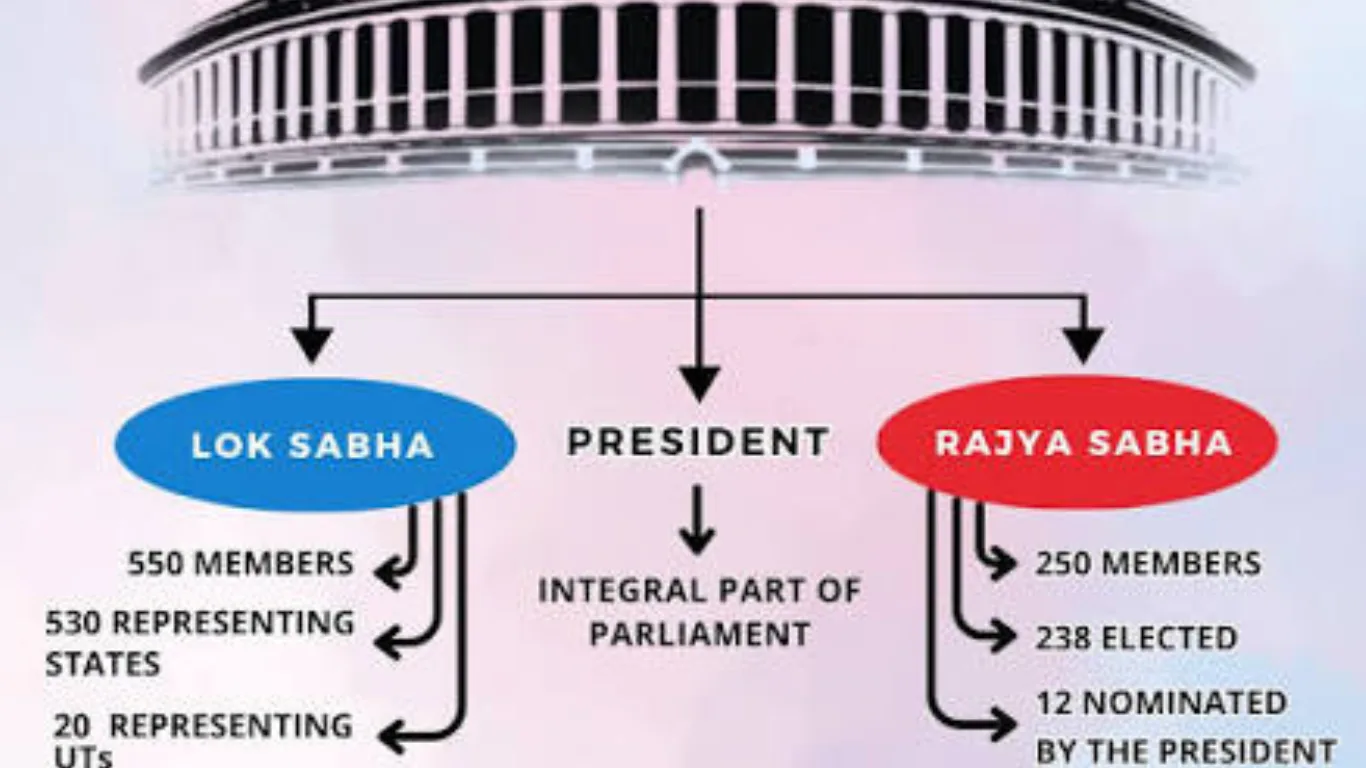
Lok Sabha (Lower House)
- Also known as the House of the People
- Members are elected directly by the general public, through a vote.
- Every 5 years, elections are held.
- Total members: 543
- Represents the Indian population. India
- Presided over by the Speaker
Rajya Sabha (Upper House)
- Also referred to as the Council of States
- Members are not directly elected by the public.
- The MLAs are the elected members of the Assembly. (State Assembly Members)
- A handful of members are selected by the President.
- Total members: 250 or more
- Represents all states in India
- The Vice-President of India
Simple method to keep in mind: Lok Sabha equals people. Rajya Sabha equals states.
How Lok Sabha and Rajya Sabha Work, Step by Step
1. Terms (How long Members stay):
Lok Sabha members serve for five years. Following that, elections are held across the nation. If the government fails to win majority support, then it is possible that the Lok Sabha can also be removed before it has completed the term.
It is believed that the Rajya Sabha members' tenure is six years. However, the Rajya Sabha never fully dissolves. Every two years, three members retire, and new members are added. The house is kept running constantly, which is why it is often referred to as a permanent house.
2. Money Bills:
Any bill related to the Lok Sabha, like tax laws or spending by government agencies, is only valid in the Lok Sabha. It can't begin in the Rajya Sabha, and this policy is clearly outlined in the Constitution.
When it is decided that the Lok Sabha passes a money bill, it's sent to the Rajya Sabha, but the upper house has only 14 days to examine the bill and make suggestions for changes. Lok Sabha can accept or refuse the suggestions completely. If the Rajya Sabha does not respond within 14 days, the bill will be taken into consideration as having been passed without delay. This is a sign that financial power remains mainly in the Lok Sabha.
3. Ordinary laws (Ordinary bills):
Both houses have to approve normal bills before they can become law. Bills can be presented in both houses first, but unlike money bills.
If both houses are unable to agree on a normal bill, a joint sitting is called, in which members from both houses vote jointly. Because the Lok Sabha has more members, it is the most likely winner during a joint sitting.
4. Government Control:
The Lok Sabha can bring a No Confidence Motion against both the Prime Minister and the Council of Ministers. If the motion is approved and the government resigns, it must do so. Rajya Sabha does not have the power to do this at all.
This is among the most significant the difference between Lok Sabha and the Rajya Sabha
powers and helps to explain how the state is directly accountable before the Lok Sabha. Lok Sabha, not the Rajya Sabha.
5. Amendments to the Constitution:
To amend the Constitution, the two houses have the same power. Both houses must vote on the amendment bill with the support of a specific majority. This is one of the areas where the two houses are on the same footing.
Read more: 20 Rebel TMC MPs Merge With NCPI to Back NDA: The Political Gamble Reshaping Bengal's Power Equation
Real Life Examples
- GST Bill (2017) GST Bill (2017) mainly was passed in the Lok Sabha because it involved the tax system and financial matters and demonstrates how the law on financial matters relies heavily upon the lower house.
- Famous individuals such as writers, scientists or sportspeople are often nominated as members of the Rajya Sabha without contesting elections. This is a way to bring experts and diverse perspectives to the Parliament, something elections can't always do.
- If a Prime Minister is unable to win majority support, the news media discuss the possibility of a No Confidence Motion. This can be seen only in the Lok Sabha, never in the Rajya Sabha.
Common Mistakes People Make
1. Assuming that both houses have equal power. Reality: Lok Sabha has more power, particularly in financial matters as well as government control.
2. You think that the Rajya Sabha can be dissolved like the Lok Sabha. The truth is that the Rajya Sabha is never fully dissolved. There are a few members who quit every two years, which keeps it ongoing.
3. People who think they are voting directly on behalf of Rajya Sabha members. Truth: MLAs choose Rajya Sabha members, not the general public directly.
4. The idea that any bill can begin in any house. Truth: Money-related bills can only begin in the Lok Sabha, while ordinary bills can be started in either house.
5. The idea that Rajya Sabha has no real significance. The truth: Rajya Sabha plays an important part in ensuring that laws are reviewed carefully and also bringing issues of state concern to national discussion.
Simple Tips To Remember Easily
- Lok Sabha equals People, Money, and Government Control
- Rajya Sabha equals States, Continuity and Expert Voices
- If a bill concerns taxes or spending by the government, Lok Sabha has the final decision
- Rajya Sabha changes slowly because only a tiny portion changes every two years.
- Monitoring Rajya Sabha elections will inform you about the changes at the state level
- Constitutional amendments require each house equally, which means neither of them can dominate there.
Conclusion:
Both houses are equally important, but they were constructed for different reasons. Lok Sabha moves fast and directly represents the citizens and gives them an opportunity to directly vote on their own government.
Rajya Sabha moves slowly and represents states that have more stability in their governance, and brings consistency and experience to the system. Once you grasp this fundamental distinction, the whole system becomes easier to understand, and the news concerning Parliament's sessions starts making much more sense.
Read more: TMC MPs Join BJP: Inside The Kolkata Defection That Just Reshaped West Bengal's Rajya Sabha Math
FAQs
Is the Rajya Sabha less powerful than the Lok Sabha?
Yes, particularly in the area of money bills and control by the government. However, it plays crucial roles in examining and enhancing laws.
Do you think the Rajya Sabha should be dissolved completely?
It is a permanent institution. A third of its members leave every two years.
Who can introduce a cash bill?
Only members of the Lok Sabha can introduce a cash bill, with permission from the President.
What is the procedure for Rajya Sabha members being elected?
Through MLAs of state assemblies, and the President. A few members are nominated by the President to demonstrate their knowledge.
What is the outcome if the Lok Sabha and Rajya Sabha are not in agreement on the measure?
A joint session is held, and the decision of the Lok Sabha generally prevails because they have more votes.
What is the reason why India has two Houses of Parliament?
It's because India has a bicameral legislature system, which means that laws are checked twice, first by representatives of the people and then by state officials.
It's because India has a bicameral legislature system, which means that laws are checked twice, first by representatives of the people and then by state officials.
The Speaker is the one who has the helm of the Lok Sabha, while the Vice President of India is in charge of the Rajya Sabha.