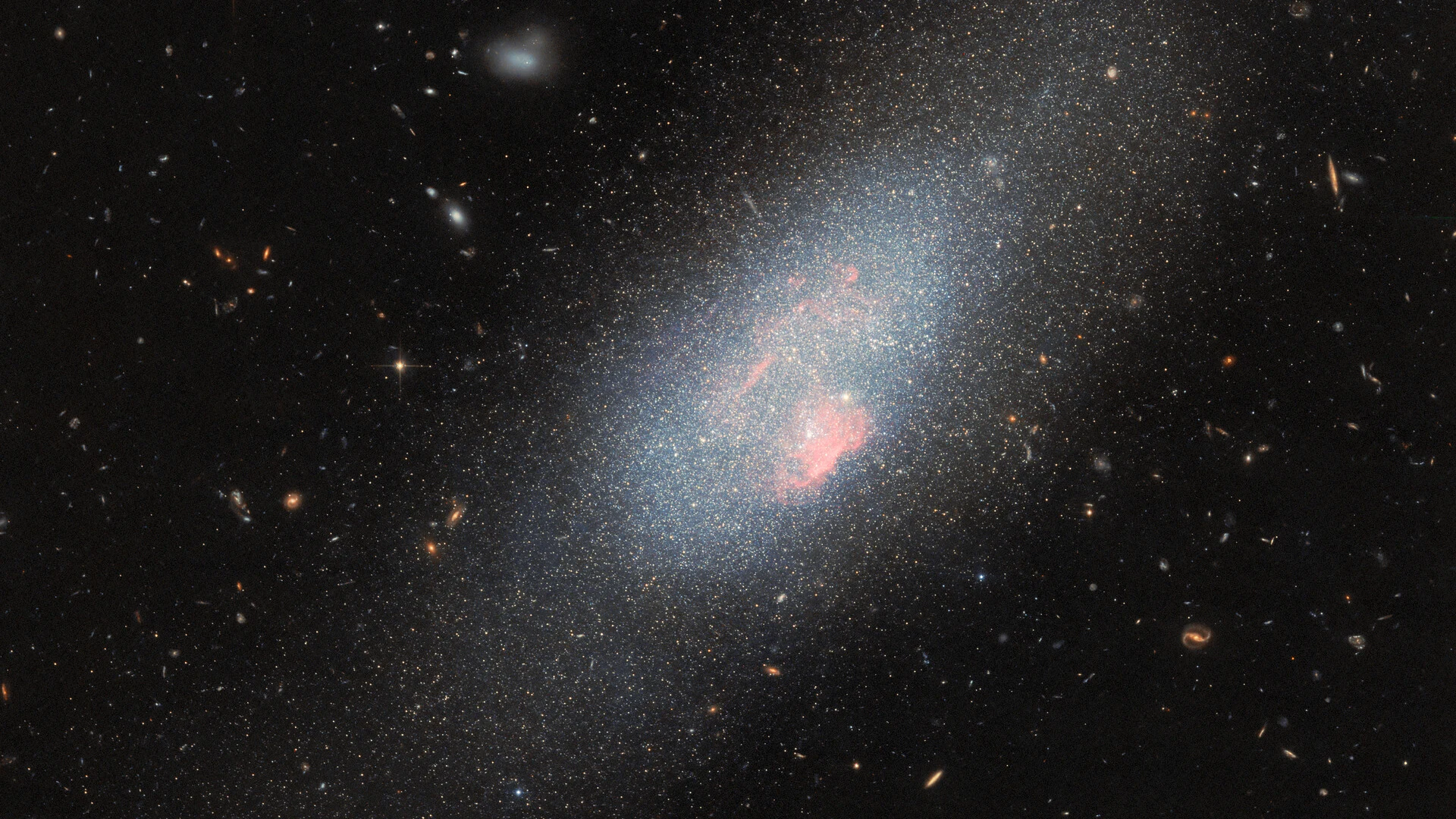
ESA's Arrakihs Mission: The Dark Matter-Hunting Telescope That Could Rewrite How We Understand Galaxies
There is something quietly unsettling about building a space telescope specifically to study things that are, by definition, invisible. That is exactly what the ESA Arrakihs mission plans to do. On June 10 and 11, 2026, the European Space Agency's Science Programme Committee met at the Instituto de Astrofísica de Canarias in Tenerife and formally adopted Arrakihs, clearing it to move from design to full construction. The launch target is the end of 2030.
What the Arrakihs Mission Is and Why Scientists Have Been Waiting for It
With the mission now officially adopted, ESA has moved beyond the study and feasibility stage and committed to full-scale development. The next phase will focus on designing, building, integrating, and rigorously testing the spacecraft and its scientific instruments before launch. Adoption marks a major milestone, confirming that the mission's scientific goals and technical requirements have been successfully validated.
The mission's name, Arrakihs, stands for Analysis of Resolved Remnants of Accreted Galaxies as a Key Instrument for Halo Surveys. While the acronym is complex, the mission's objective is straightforward: to study some of the faintest and most overlooked structures in the universe.
Galaxies such as the Milky Way are surrounded by vast stellar halos made up of ancient stars, dwarf galaxies, and the remnants of smaller galaxies that were absorbed over billions of years. These faint structures act like cosmic archaeological records, preserving evidence of galaxy mergers, dark matter distribution, and the processes that have shaped galaxies throughout their history. Because these halos are extremely dim, they remain difficult to observe with existing telescopes and surveys.
Arrakihs is being specifically designed to detect and analyse these low-brightness structures in unprecedented detail. By mapping these elusive stellar halos, scientists hope to gain new insights into how galaxies formed, evolved, and interacted across cosmic time, helping answer some of astronomy's most important questions about the history of the universe.
Understanding Dark Matter: The Core Question Driving This Mission
Most people have heard of dark matter without fully understanding what it is. Simply put: it is matter that does not emit, absorb, or reflect light. We cannot see it. But we can see what it does.
According to different cosmological observables, dark matter could be up to five times more abundant than ordinary matter. Due to its properties, its direct detection is very complex and, for now, we are only aware of its existence through its gravitational effects. It is these effects on satellites orbiting in the halo of galaxies like our Milky Way that Arrakihs will be able to discover and characterise in order to reveal the nature of dark matter.
Think of it as trying to map an invisible city by watching how traffic moves through its streets. You cannot see the buildings. But the way vehicles slow, turn, and cluster around certain areas tells you exactly where the structures must be.
How Arrakihs Will Actually Work
Arrakihs's plan calls for it to examine 75 different galaxies for 150 hours each. It will not look at those galaxies' bright centres. Instead, it will examine their outer rims, studying things like the dwarf galaxies that orbit the target galaxies as satellites, yet still reside within those dark matter halos. In doing so, astronomers hope they can learn more about all these halos and compare their observations to computational models.
The spacecraft carries two iSIM170 cameras, each with a focal length of 1,500mm, sensitive to wavelengths from 280 to 900nm in the visible range and 900 to 1,600nm in the near-infrared. The spacecraft mass is approximately 600kg, with a payload mass of 160kg.
The mission aims to test the Lambda-Cold Dark Matter model by analysing discrepancies between theoretical predictions and observations of small-scale structures, such as tidal stellar streams and dwarf satellite galaxies.
Spain's Historic Role in Leading This ESA Mission
Arrakihs is the first mission of the ESA Science Programme led by Spain. The research team is led by Rafael Guzmán, a research professor at the Institute of Physics of Cantabria, a joint centre of the Spanish National Research Council and the University of Cantabria.
Core consortium partners include Switzerland, Austria, Belgium, Norway, Portugal and Sweden. This is a genuinely international scientific effort, but Spain's leadership is notable and historically significant for European space science.
Why the 2030 Launch Timeline Matters
Arrakihs is the second fast, or F-class, mission of ESA's Cosmic Vision programme, needing less than ten years from its selection in November 2022 until launch. F-class missions are designed to move quickly, adapting existing technologies for new science goals rather than spending decades building entirely new systems from scratch.
Arrakihs will join ESA's fleet of Cosmic Observers, addressing two top-level science themes of ESA's Cosmic Vision 2015 to 2025: what are the fundamental physical laws of the Universe, and how did the Universe originate and what is it made of?
Those questions are not idle philosophical curiosity. The answers shape our understanding of whether the universe we observe matches the universe our physics predicts. Right now, there are gaps. Significant ones.
What Arrakihs Could Change
The international Arrakihs consortium has already made substantial progress ahead of the mission’s full implementation. This includes the development of high-resolution cosmological simulations and advanced galaxy models, the design of key subsystems for the flight instrument, and the establishment of initial ground-based infrastructure for scientific data processing and analysis. The team has also operated a ground demonstrator camera installed at the Javalambre Astrophysical Observatory, helping validate techniques that will be essential for the mission’s success in space.
With ESA’s formal adoption of the mission, this groundwork now transitions into the implementation phase. What was previously a collaborative research and development effort becomes a fully committed programme, with the objective of completing the spacecraft and preparing it for launch.
For many astrophysicists, Arrakihs represents the culmination of decades of theoretical and observational work. Questions about how galaxies form and evolve, how stellar halos are structured, and how dark matter shapes large-scale cosmic systems have long been limited by the sensitivity of existing telescopes. These faint, diffuse structures remain difficult to observe with precision, leaving key gaps in our understanding of galaxy formation.
Arrakihs is designed specifically to address this limitation. Its goal is to observe these extremely low-surface-brightness stellar halos in unprecedented detail, potentially revealing new information about the history and evolution of galaxies. Whether it succeeds will ultimately depend on what these elusive structures reveal once they can finally be seen clearly for the first time.
Read More: Ebola Is Back and Spreading Fast: Everything You Need to Know About the 2026 Outbreak
Disclaimer: This article is based on information available across the web. Parchar Manch does not take responsibility for its complete accuracy, as the content could not be fully verified.
FAQs
What is the ESA Arrakihs mission?
Arrakihs stands for Analysis of Resolved Remnants of Accreted galaxies as a Key Instrument for Halo Surveys. It is an ESA F-class space mission designed to study the faint stellar halos of nearby galaxies to better understand dark matter and galaxy formation.
When is Arrakihs expected to launch?
ESA has confirmed the target launch date as the end of 2030. The mission was formally adopted by the ESA Science Programme Committee in June 2026, clearing it to enter the construction and development phase.
Which country is leading the Arrakihs mission?
Spain is leading the mission, making Arrakihs the first ESA Science Programme mission led by Spain. The principal research centre is the Institute of Physics of Cantabria. Other consortium members include Switzerland, Austria, Belgium, Norway, Portugal and Sweden.
What exactly will Arrakihs observe?
The spacecraft will study the outer halos of 75 nearby galaxies, spending approximately 150 hours observing each one. It focuses on the extremely faint stellar structures, dwarf satellite galaxies, and tidal stellar streams that exist in these halos rather than the bright centres of the galaxies themselves.
How does Arrakihs connect to dark matter research?
Dark matter is thought to form massive, invisible halos around galaxies. By studying how visible stars and satellite galaxies are distributed within these halos, Arrakihs will help scientists test existing dark matter models and identify where current theories break down.
What is an F-class ESA mission?
F stands for Fast. F-class missions are designed to go from selection to launch in under ten years by adapting existing technology for new science goals, rather than requiring entirely new instrumentation to be developed from the ground up.