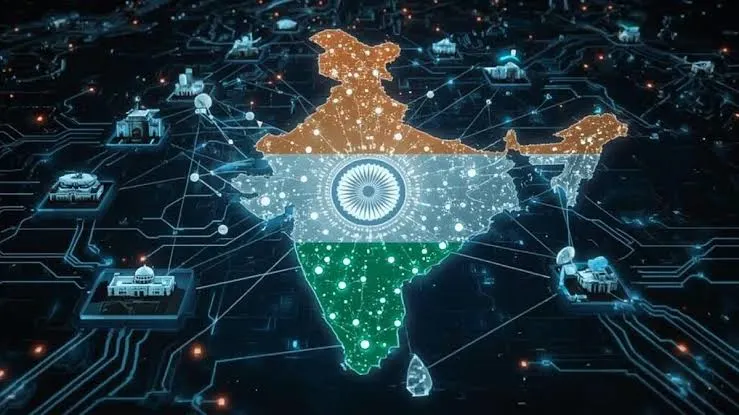
India's AI Ambitions: The Sovereign Push That's Racing Ahead of Its Own Workforce
Only 25 percent. That's the share of Indian organisations that actually believe their workforce is ready to handle AI tools, according to Kyndryl's latest People Readiness Report. And here's the part that stings a little more, that number dropped 12 percentage points from last year. India's AI ambitions are genuinely massive right now, government backed, well funded, loudly proclaimed on global stages, and yet the country is quietly discovering that infrastructure alone doesn't make you AI ready. No, that's not quite the full picture either, let me rephrase. It's that infrastructure is racing ahead of the people meant to use it.
Here's the scale we're talking about. The IndiaAI Mission, cleared by the Union Cabinet back in March 2024, carries a total outlay of over Rs 10,371 crore. More than 38,000 GPUs have already been onboarded into the national compute program, offered to researchers and startups at a subsidised rate of roughly Rs 65 per hour. The government has even taken equity, through compulsorily convertible debentures rather than cash, in Bengaluru based Sarvam AI, receiving a 1 to 2 percent stake in exchange for providing critical GPU infrastructure including 4,096 Nvidia H100 chips.
Why India's AI Ambitions Actually Matter Right Now
If you work in tech, education, or honestly any white collar profession in India, this affects you more directly than it might seem. AI could add more than 500 billion dollars to India's economy by 2030, according to a joint IBM and IndiaAI study, and four in five business leaders surveyed said AI investment would directly shape the country's GDP growth. That's the upside case. But the same study found India's current AI literacy rate among employees sits at just 30 percent, and executives say that figure needs to nearly double by 2030, with about 57 percent of the country's 600 million person workforce needing to become AI literate to support adoption at real scale.
That gap between ambition and readiness isn't abstract policy talk, it's the actual difference between India capturing this economic opportunity or watching it slip toward countries better prepared to use the infrastructure everyone is racing to build.
Read More: Chandrayaan-3 Landing Site Meteorite Match Just Rewrote a Small Piece of Moon History
What Sovereign AI Really Means for India, Explained Simply
Think of sovereign AI like wanting to grow your own food instead of depending entirely on imports. Right now, India imports roughly 85 to 90 percent of its chip needs, with more than 60 percent coming from China alone. That's a real vulnerability, especially with international export restrictions on advanced foreign models becoming more common. So the government's push toward sovereign compute, sovereign foundation models, sovereign everything really, isn't just national pride, it's practical risk management. If access to foreign AI models or chips can be revoked from abroad, a workforce trained only to call those tools through an API doesn't actually hold durable capability.
The IndiaAI Mission's foundation models pillar reflects exactly this thinking, funding development of large multimodal models built on Indian data and languages. More than 500 proposals came in, and twelve startups were eventually selected across two phases, including names like Sarvam AI, Soket AI, and the IIT Bombay led BharatGen consortium.
Read More: 2026 FIFA World Cup Round of 16 Bracket Is Set, and the Matchups Are Brutal
How India's AI Push Is Structured, Step by Step
- The IndiaAI Mission operates through eight key pillars, spanning compute access, application development, foundation models, future skills, and safe AI governance.
- Over 38,000 GPUs have been onboarded nationally, with a target of adding thousands more through public private partnerships.
- Twelve startups have been selected to build indigenous foundation models trained on Indian languages and data.

- The Future Skills pillar supports 500 PhD fellows, 5,000 postgraduate students, and 8,000 undergraduate students, alongside 31 Data and AI Labs launched in Tier 2 and Tier 3 cities.
- India plans to introduce AI education starting from Class 3 in the 2026-27 academic year, with CBSE preparing the curriculum.
- The India Semiconductor Mission's roughly 9.1 billion dollar commitment has catalysed about 18.2 billion dollars in investment, though mostly in packaging and legacy chip nodes rather than advanced AI chips.
Reading that list end to end, it's genuinely an impressive amount of scaffolding built in a short window. The question, and it's the one that keeps surfacing, is whether the people meant to stand on that scaffolding are ready.
Read More: Govinda's Lock Upp 2 Entry: Comic Timing Meets a Genuinely Tense Family Moment
Real World Example: Lenovo's Puducherry Gamble
Private industry is stepping in too, not just government. Lenovo has begun manufacturing AI servers in Puducherry, targeting production of 50,000 AI rack servers and 2,400 GPU servers annually. It's a genuinely concrete example of India's AI ambitions translating into actual factory floor activity, not just policy documents. Still, GPU shortages, high costs, and long lead times remain real constraints, particularly for smaller startups that can't absorb the upfront capital expenditure larger players can.
Mistakes People Keep Making About India's AI Ambitions
The easiest mistake, understandably, is treating GPU count and funding announcements as the whole story. They're genuinely impressive numbers, but only 15 percent of teachers are considered AI fluent right now, and around 65 percent of schools even have computers, with just 58 percent of those being functional. Building compute capacity is the visible, fundable part of this ambition. Building classroom readiness, teacher training, and mid-career reskilling is slower, less glamorous, and consistently underfunded relative to infrastructure spending.
Read More: France World Cup Semifinal Run Continues: How Mbappe and Dembele Ended Morocco's Dream Again
Pro Tips for Understanding Where India's AI Story Actually Stands
Track workforce readiness metrics alongside infrastructure announcements, not instead of them, since one without the other tells an incomplete story. Pay attention to semiconductor fabrication timelines specifically, McKinsey has noted India is targeting chip fabrication above 14 nanometres by 2030, while genuinely advanced sub-10-nanometre technology remains years further out. And watch how government equity stakes in AI startups, like the Sarvam AI arrangement, evolve, since these hybrid funding models are still relatively untested territory for Indian policy.
Closing Thoughts
There's a quiet tension sitting underneath every headline about India's AI ambitions, genuine excitement about what's being built, alongside honest uncertainty about who will actually be equipped to use it. The IMF's AI Preparedness Index currently ranks India 72nd out of 174 economies, trailing not just the US but also Singapore and even Indonesia. That's not a verdict, it's a snapshot, and snapshots change. Whether sovereign AI becomes India's next great growth story or simply an impressive technological achievement waiting for enough trained talent to unlock it, that answer is still being written.
Disclaimer: This article is based on information available across the web. Parchar Manch does not take responsibility for its complete accuracy, as the content could not be fully verified.
FAQs
What is the IndiaAI Mission?
It's a government initiative approved in March 2024 with an outlay of over Rs 10,371 crore, aimed at building compute infrastructure, foundation models, and AI skills nationwide.
How many GPUs has India onboarded so far?
More than 38,000 GPUs have been onboarded into the national compute program, offered at a subsidised rate to researchers and startups.
Why is workforce readiness a concern for India's AI ambitions?
Only 25 percent of Indian organisations believe their workforce is adequately prepared for AI, and current AI literacy among employees stands at just 30 percent.
What does sovereign AI mean for India?
It refers to reducing dependence on foreign chips and models by building indigenous compute infrastructure, foundation models, and semiconductor capacity.
What does sovereign AI mean for India?
It refers to reducing dependence on foreign chips and models by building indigenous compute infrastructure, foundation models, and semiconductor capacity.
Is India investing in AI education for students?
Yes, AI education is planned from Class 3 starting the 2026-27 academic year, though school infrastructure readiness varies significantly across regions.
How does India rank globally on AI readiness?
India ranks 72nd out of 174 economies on the IMF's AI Preparedness Index, trailing countries like the US, Singapore, and China.