NASA's Psyche Spacecraft Is About to Use Mars as a Cosmic Slingshot — Here's Why That's Brilliant
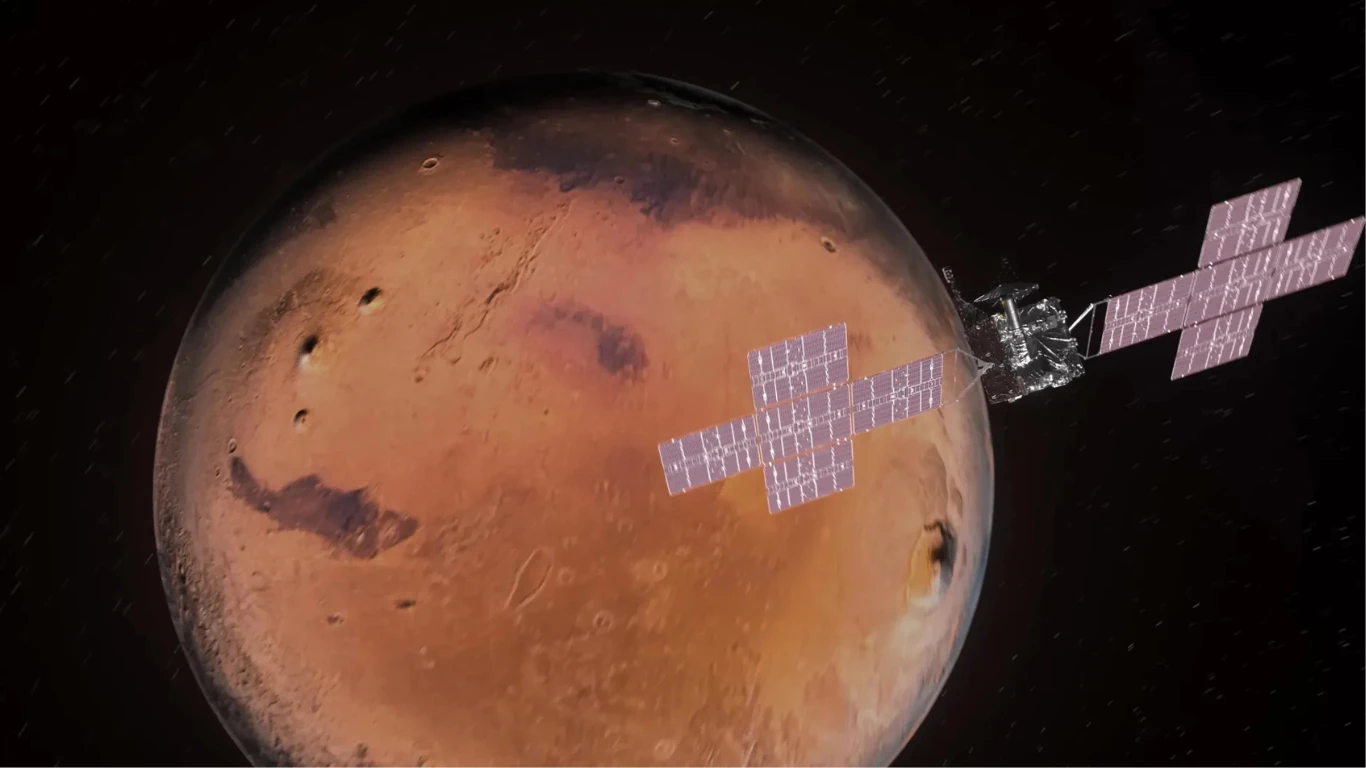
There is something quietly stunning happening in deep space right now. A spacecraft the size of a tennis court is closing in on Mars at over 12,000 miles per hour, not to land, not even to slow down but to steal a little momentum from the planet and keep going.
That is the NASA Psyche Mars gravity assist, scheduled for May 15, 2026. And if you have never heard of a gravitational slingshot before, stick around. This is one of those concepts that sounds like science fiction until someone explains it simply and then it seems almost obvious.
Why a Spacecraft Would "Borrow" Mars to Go Somewhere Else
The Psyche mission was launched on October 13, 2023, aboard a SpaceX Falcon Heavy rocket from Kennedy Space Centre in Florida. Its destination is not Mars. Its destination is an asteroid also named Psyche sitting in the main asteroid belt between Mars and Jupiter, roughly 2.2 billion miles from Earth.
Here is the problem. Getting something that far out into the solar system takes an enormous amount of energy. Burning more fuel is the obvious answer, but fuel has mass, and mass makes launch costs explode. So engineers at NASA's Jet Propulsion Laboratory came up with a smarter solution: use Mars.
The Psyche spacecraft's Mars flyby on May 15 is what mission planners call a gravity assist manoeuvre, sometimes called a gravitational slingshot. The spacecraft swoops close to Mars, lets the planet's gravity grab it for a moment, and exits that interaction faster and on a different trajectory than it entered. No extra fuel burned. Physics is just doing its job.
What Is a Gravity Assist, Exactly?
Think of it this way. Imagine rolling a ball toward a spinning carousel. If the ball passes close enough on the right side, the spinning platform flings the ball outward with extra speed. The carousel loses almost nothing it is far too massive to notice but the ball walks away faster than it arrived.
That is what Mars does for Psyche. The planet's gravity grabs the spacecraft, whips it around, and releases it with a higher velocity and a corrected orbital plane. The "orbital plane" part matters a lot here. The asteroid Psyche does not orbit the Sun on the same flat level that most planets do. To reach it, the spacecraft needs to tilt its path. Doing that with rocket engines alone would cost enormous amounts of propellant. Doing it with a Mars gravity assist costs almost nothing.
On May 15, the Psyche spacecraft will pass just 2,800 miles above the Martian surface, travelling at approximately 12,333 miles per hour. It will not stop. It will not say hello. It will swing around Mars and continue outward toward the asteroid belt, arriving at its destination in late 2029.
Read More: Born After 2008? You Can Never Legally Buy a Cigarette in the UK. Here Is What That Actually Means
The Spacecraft Has Already Photographed Mars and the Image Is Stunning
Before the flyby even happens, the mission team has been testing the spacecraft's instruments. On May 3, 2026, the Psyche multispectral imager captured an image of Mars from about 3 million miles away. The planet appeared not as the familiar reddish disk most people know from textbook photos, but as a thin, glowing crescent because the spacecraft is approaching from the planet's night side, with sunlight catching only a sliver.
The image looks almost like a crescent moon. Sunlight scattered and reflected by dust in the Martian atmosphere gave the crescent an extended, hazy glow. From May 7, raw, unprocessed images began appearing on the mission's public website a starfield, with Mars a small bright point, growing closer.
Read More:Vijay's Tamil Nadu Power Bid: What Is Really Happening and Why This Political Drama Is Far From Over
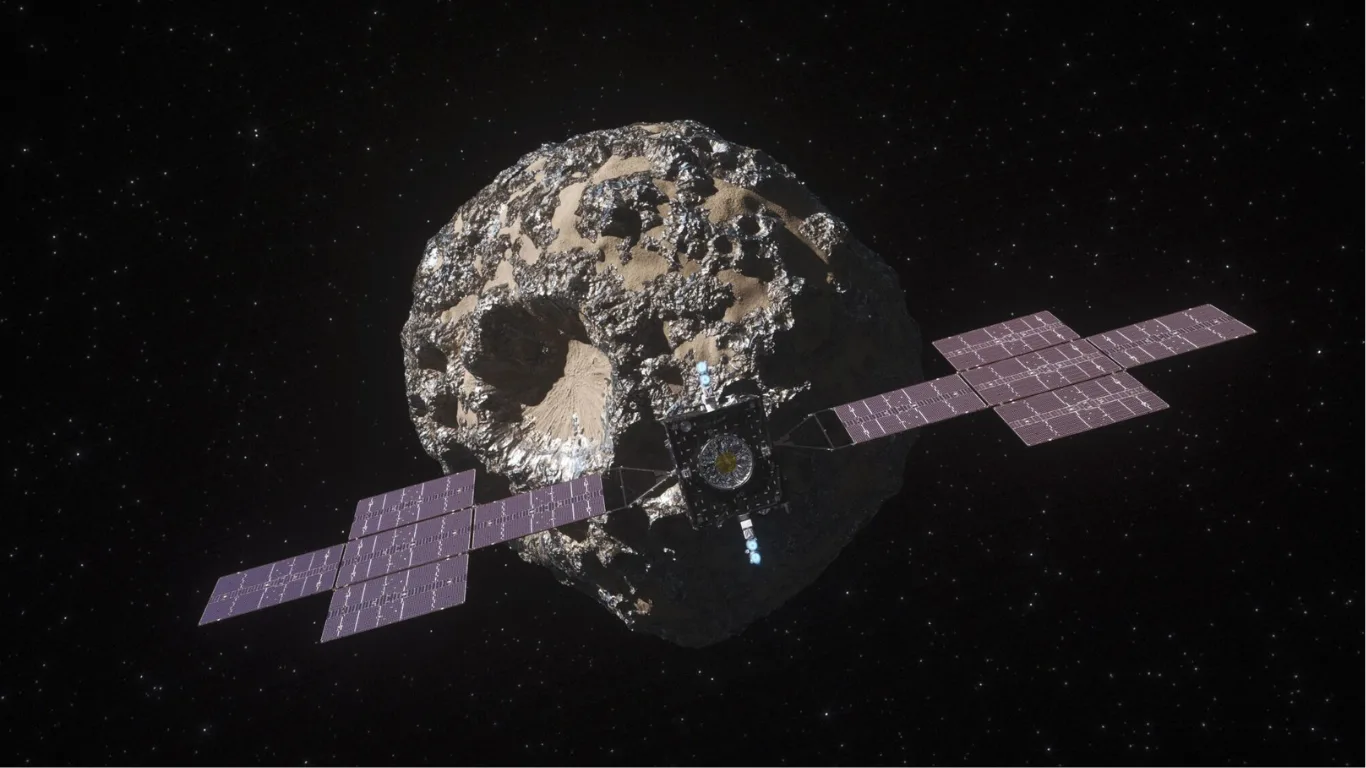
The team plans to capture thousands of observations during the Psyche Mars close approach, some pointing at Mars itself, some looking around the planet for a faint ring of dust that may orbit it material thrown off the surfaces of its two small moons, Phobos and Deimos, by micrometeorite strikes.
This Flyby Is Not Just About Speed. It Is About Testing Everything.
When Psyche arrives at the asteroid in 2029, it will be entering orbit around a world no spacecraft has ever visited. There will be no second chances, no opportunity to recalibrate on the ground. Every instrument reading the mission returns will depend on how well-tuned the cameras and sensors are right now, years before arrival.
Mars is one of the most thoroughly studied planets in the solar system. NASA and ESA orbiters circle it constantly. Rovers are on its surface. There is a rich library of data to compare against.
So when Psyche's multispectral imager photographs Mars during the flyby, engineers can cross-check what the camera sees against what orbiting spacecraft have measured in exacting detail. If there is a drift in the camera's response if colours are slightly off, if brightness is skewed the team finds out now, not in 2029 when they are staring at an unknown metallic world.
The spacecraft's magnetometer will also be active during the flyby. Mars lacks a global magnetic field, but charged particles from the Sun interact with the planet in measurable ways. Passing through that environment gives the magnetometer a real workout. The gamma-ray and neutron spectrometer will monitor changes in cosmic ray flux highly energetic particles from interstellar space during the close passage.
"The only reason for this flyby is to get a little help from Mars to speed us up and tilt our trajectory," said Lindy Elkins-Tanton, the mission's principal investigator. "But if all our instruments are powered up, and we can do important testing and calibration that would be the icing on the cake.
Read More: West Bengal Post-Poll Violence Explained: What Is Happening on the Ground and Why It Refuses to Stop
What Is Asteroid Psyche, and Why Is NASA Chasing It?
This is the part that makes the whole mission genuinely fascinating. Asteroid Psyche, the target, is not a typical rocky or icy body. Scientists believe it is the exposed metallic core of an ancient protoplanet a world that was forming billions of years ago when violent collisions stripped away its outer rock layers, leaving only the iron-nickel interior.
If that theory is correct, Psyche would offer a direct look at something humans will never otherwise see: the interior of a planet. Earth has an iron core too, but it sits 4,000 miles beneath the surface. Nobody is drilling that deep anytime soon.
The metal-rich asteroid Psyche could therefore answer fundamental questions about how planets form, how cores develop, and what the inside of a rocky world actually looks like up close.
It is an unusual mission for an unusual object. And getting there requires using the solar system itself as infrastructure a Mars slingshot first, then a 2.2-billion-mile cruise through space.
How Solar-Electric Propulsion Makes This Journey Possible
The Psyche spacecraft does not burn conventional rocket fuel after launch. It uses solar-electric propulsion, generating electricity from its large solar panels, then using that electricity to ionise xenon gas and expel it as thrust. The thrust is tiny compared to a chemical rocket, but it is continuous.
Over months and years, that gentle, unceasing push builds speed that a brief rocket burn could never sustain efficiently. To prepare for the Mars encounter specifically, the operations team fired the spacecraft's thrusters for 12 continuous hours on February 23, 2026, in what is called a trajectory correction manoeuvre, fine-tuning the approach geometry.
The Psyche deep space mission is, in a sense, a masterclass in patience. There is no dramatic sprint. Just a quiet, relentless accumulation of velocity, with a borrowed boost from Mars at the halfway point.
What Happens After May 15?
After the flyby, Psyche enters what mission planners call Cruise 2. The thrusters restart. The spacecraft resumes its slow, steady push toward the outer asteroid belt. If all goes to plan, asteroid Psyche's gravity will capture the spacecraft in late July 2029. The science campaign begins in August of that year.
For the mission team, the flyby is also a moment of confidence. The spacecraft will have flown exactly as planned, the instruments will have been tested against a known world, and the team will know before they arrive at something no one has ever seen that their tools are sharp.
That matters more than it might seem. Deep space is unforgiving. Hardware ages in ways that are difficult to predict. A calibration opportunity like this Mars flyby may be the difference between success and ambiguity at the asteroid.
Closing Thoughts
There is something quietly moving about the idea that Mars a planet humans have studied for centuries, that rovers crawl across today, that generations of astronomers have sketched and mapped and speculated about is now being used as a stepping stone toward something even stranger.
A metallic world that might be a planetary core. A destination no human instrument has ever reached. And a spacecraft that had to wait, carefully, for Earth and Mars to align just right, before it could borrow a little gravity and keep going.
The flyby happens on May 15. Then the long, patient journey continues.
Disclaimer: This article is based on information available across the web. Parchar Manch does not take responsibility for its complete accuracy, as the content could not be fully verified.
Read More: Supreme Court's Solid Waste Management Order 2026: What It Means for India's Tourist and Pilgrim Sites
FAQs
What is the NASA Psyche spacecraft's mission?
Psyche is a NASA mission to study a metal-rich asteroid named Psyche in the main asteroid belt. Scientists believe the asteroid may be the exposed iron-nickel core of an ancient protoplanet, offering a rare chance to examine the kind of interior that rocky planets like Earth keep hidden deep underground.
What is a gravity assist manoeuvre?
A gravity assist, also called a gravitational slingshot, is when a spacecraft uses a planet's gravity to increase its speed and change direction without burning extra fuel. The spacecraft flies close to the planet, gets pulled by gravity, and exits the encounter faster and on a different trajectory — saving enormous amounts of propellant.
When will Psyche reach asteroid Psyche?
The spacecraft is expected to be captured by the asteroid's gravity in late July 2029, with the primary science mission beginning in August 2029. The total journey covers approximately 2.2 billion miles.
Why was Mars specifically chosen for the gravity assist?
The timing of Earth and Mars orbits aligned in a way that made a Mars flyby the most fuel-efficient path to the asteroid. Mars also happens to be ideal for instrument calibration, since it is one of the most well-studied planets in the solar system, giving engineers reliable reference data to check against.
What instruments will Psyche use during the Mars flyby?
The spacecraft will use its multispectral imager to capture thousands of observations of Mars. It will also use its magnetometer, gamma-ray and neutron spectrometer to gather environmental data — all primarily as calibration tests before the spacecraft arrives at the asteroid.
How fast will Psyche travel during the Mars flyby?
The spacecraft will pass approximately 2,800 miles above the Martian surface at around 12,333 miles per hour during the closest approach on May 15, 2026.