Operation Sindoor: One Year On, Here Is What Really Happened and Why It Changed India Forever
On the night of May 6, going into May 7, 2025, something shifted in how India responds to terrorism. Not a speech. Not a resolution. Missiles.
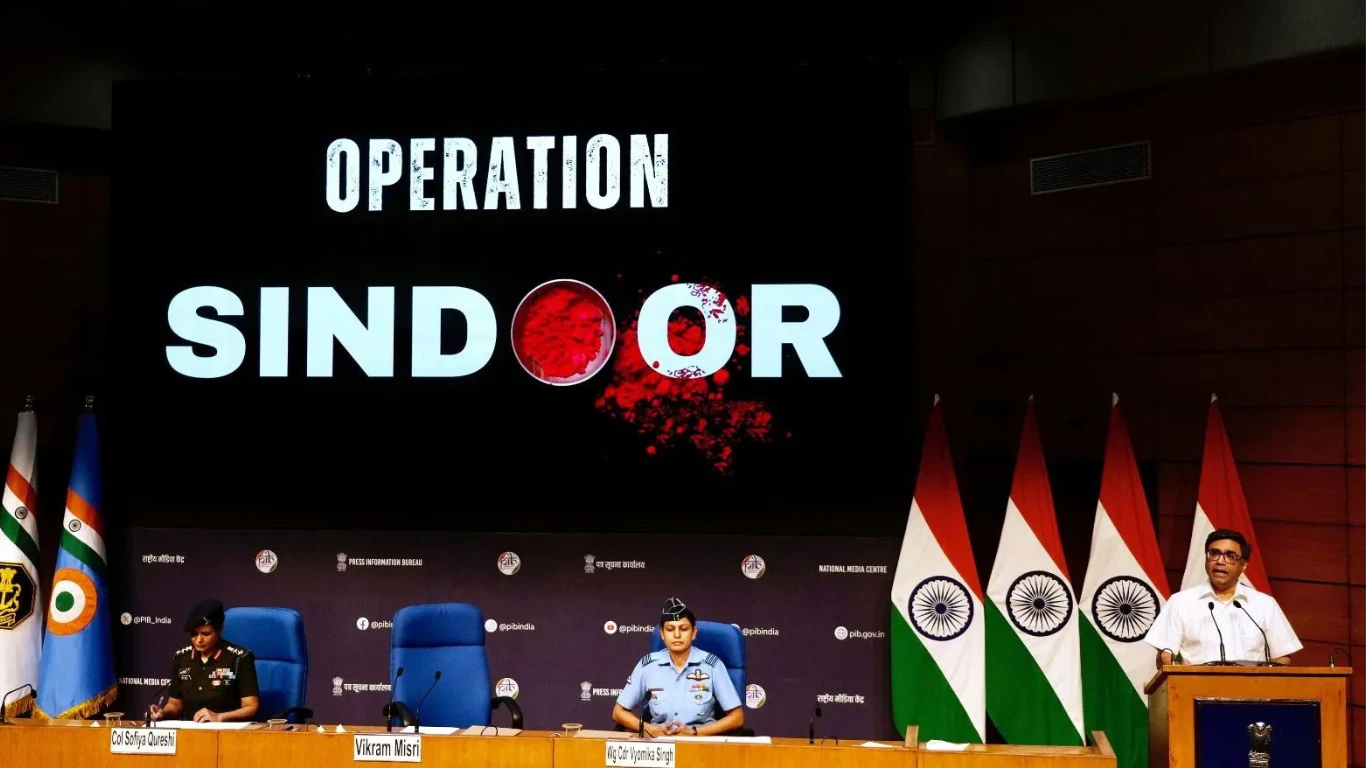
Operation Sindoor was launched in the early hours of May 7, 2025, and in roughly 23 minutes, the Indian Armed Forces struck nine terrorist camps across Pakistan and Pakistan-occupied Kashmir. The operation was India's direct military response to the Pahalgam terror attack on April 22, 2025, in which 26 people , mostly tourists from across India , were massacred in the Baisaran Valley of Jammu and Kashmir.
As the first anniversary of Operation Sindoor approaches on May 7, 2026, the Indian Army has already posted on its official channels: "Operation Sindoor continues." Defence Minister Rajnath Singh has said India stopped voluntarily, on its own terms, fully prepared for a longer engagement if needed. A Swiss military think tank has published a detailed analysis calling India's air superiority the decisive factor in the outcome.
This is the full, honest account of what happened, why it mattered, and what has changed in the year since.
The Pahalgam Attack That Started Everything
To understand Operation Sindoor, you have to start at Pahalgam. April 22, 2025. Baisaran Valley , a high-altitude meadow that locals describe as a patch of Switzerland inside Kashmir.
Lashkar-e-Taiba gunmen attacked tourists there with a brutality that stunned even a country that has grown sadly familiar with terrorist violence. Twenty-five tourists and one local pony-ride operator, Adil Shah, were killed. The attackers reportedly selected victims based on religious identity. The killings were intimate, deliberate, and designed to cause maximum psychological damage to the idea of Kashmir as a safe, open place.
The nation reacted with grief and then, quickly, with demand for accountability. Prime Minister Modi stated the attackers would be chased to the ends of the earth. The Cabinet Committee on Security announced the Indus Waters Treaty would be put in abeyance until Pakistan ended support for cross-border terrorism , a step with no precedent even across three previous India-Pakistan wars.
Read More: Sun Pharma's $11.75 Billion Organon Acquisition: India's Biggest Pharma Bet Explained
What Operation Sindoor Actually Did , The Full Picture
Fifteen days after Pahalgam, India acted.
On the night of May 6-7, the Indian Air Force executed precision strikes on nine sites linked to Jaish-e-Mohammed, Lashkar-e-Taiba, and Hizbul Mujahideen. The targets included Markaz Subhan Allah in Bahawalpur , the headquarters of Jaish-e-Mohammed, where the group's chief, Maulana Masood Azhar, later confirmed that 10 members of his family and four close aides were killed.
India described the operation as "focused, measured, and non-escalatory." Pakistan called the strikes an act of unprovoked aggression, claimed civilian areas, including mosques, were hit, and announced retaliatory drone and missile attacks on Indian military bases, including Srinagar, Jammu, and Pathankot.
What followed was four days of aerial engagement that military analysts are still studying. Over 114 aircraft , 72 from the Indian Air Force and 42 from the Pakistani Air Force , were involved in what has been described as the largest beyond-visual-range air battle in the subcontinent's history. Neither side's aircraft crossed the international border; the engagement was conducted entirely at standoff distances, sometimes over 100 km from the border.
India carried out retaliatory strikes on Pakistani airbases and radar installations, including facilities at Chaklala, Sargodha, and Rahimyar Khan. On May 10, Pakistan's Director General of Military Operations reached out to his Indian counterpart. A ceasefire took effect at 5 PM IST on May 10, 2025, lasting 88 hours of active military conflict.
Read More: Modi's Matua Gambit: The One Speech That Could Decide West Bengal's 2026 Election
Why the Swiss Military Report Matters
In January 2026, the Centre d'Histoire et de Prospective Militaires , a respected Swiss defence think tank founded in 1969 , published a detailed analysis of India's air campaign during Operation Sindoor.
The report, authored by retired Swiss Air Force Major General Adrien Fontanellaz, concluded that India retained escalation dominance throughout the conflict, protected its air defence assets from May 7 to 10, and demonstrated deep-strike capability without crossing nuclear thresholds. The report's core finding: India's air superiority coerced Pakistan into accepting a ceasefire.

That assessment from a neutral European military institution carries weight that no Indian official statement can replicate. It also raised uncomfortable questions internationally , the report noted that the reported downing of an Indian Rafale by a Pakistani air-defence system using Chinese J-10C aircraft had significant implications for Western military technology procurement.
Read More: I Could Be Wrong, But Not All 7": Raghav Chadha Explains His Shock Move From AAP to BJP
What Changed After Operation Sindoor: A New Doctrine
The operation was not just a military event. It was a doctrine shift.
Before Pahalgam, India's response to terrorist attacks linked to Pakistan had followed a familiar script: diplomatic condemnation, troop mobilisation as pressure, and occasional limited strikes , Uri 2016, Balakot 2019. These responses were real but deniable, calibrated to stay below the threshold of formal war.
Operation Sindoor crossed that line deliberately. India openly named the operation, listed the targets, published casualty figures, and declared it a tri-service military campaign involving the Army, Navy, and Air Force operating under one joint plan. The Indian Navy simultaneously deployed a carrier battle group in the North Arabian Sea. The message was clear: the three services now fight together, and the next terrorist attack would be treated in the same framework.
Prime Minister Modi described the operation as proof that India would no longer merely react to terrorism with diplomatic statements. The phrase "terror and talks cannot go together" became the defining framing of India's foreign policy stance toward Pakistan.
What Remains Unresolved One Year Later
The ceasefire has held in the most basic sense. But several questions remain genuinely open.
The Indus Waters Treaty remains in abeyance. Pakistan's airspace remains closed to Indian aircraft. Trade between the two countries has been suspended since May 2025. Diplomatic missions in both capitals operate with reduced staff.
The perpetrators of the Pahalgam attack itself were neutralised in July 2025 through Operation Mahadev , a counter-terror operation that tracked and killed all three attackers. That closure is real. But the structural conditions that produce cross-border terrorism have not changed.
The Indian Army's message on the first anniversary of Pahalgam said simply: "Operation Sindoor continues." That phrase is deliberate. It signals a posture, not just a completed campaign , an assertion that India's tolerance threshold has permanently moved.
Closing Thoughts
A year later, what stays is the weight of April 22. Twenty-six people went to see a meadow and did not come home.
Operation Sindoor answered that. Whether it solved anything in the longer sense is a question that geopolitics will keep answering for years. What is not in question is that May 7, 2025, marked a genuine before-and-after in how India positions itself against terrorism. The doctrine is different. The response ceiling is higher. And the signals sent , to Pakistan, to China watching the air battle data, to Western arms buyers reassessing equipment , will take years to fully understand.
The Army says it continues. That is worth taking seriously.
Disclaimer: This article is based on information available across the web. Parchar Manch does not take responsibility for its complete accuracy, as the content could not be fully verified.
Read More: Modi's Matua Gambit: The One Speech That Could Decide West Bengal's 2026 Election
FAQs
What was Operation Sindoor, and when did it happen?
Operation Sindoor was a tri-service Indian military operation launched on the night of May 6-7, 2025. It involved precision missiles and air strikes on nine terrorist camps in Pakistan and Pakistan-occupied Kashmir, targeting infrastructure linked to Jaish-e-Mohammed, Lashkar-e-Taiba, and Hizbul Mujahideen. It was launched in response to the April 22 Pahalgam terror attack.
How long did Operation Sindoor last?
The active military conflict lasted approximately 88 hours, from May 7 to May 10, 2025, when a ceasefire agreement came into effect at 5 PM IST.
How many terrorists were killed in Operation Sindoor?
Indian government and military sources stated that over 100 terrorists, including handlers and trainers, were killed in the strikes. Jaish-e-Mohammed chief Masood Azhar confirmed 14 deaths from within his own family and inner circle.
Did India cross the Line of Control during Operation Sindoor?
Indian and Pakistani aircraft did not cross the international border. The aerial engagement was conducted as a standoff conflict, with aircraft engaging at distances of over 100 km from the border. India's missile strikes did cross into Pakistani territory, targeting designated terrorist infrastructure.
What happened to the Pahalgam attack perpetrators?
The three gunmen who carried out the Pahalgam attack were tracked and neutralised in July 2025 through Operation Mahadev, a counter-terror operation described as one of the most extensive in recent Indian military history.