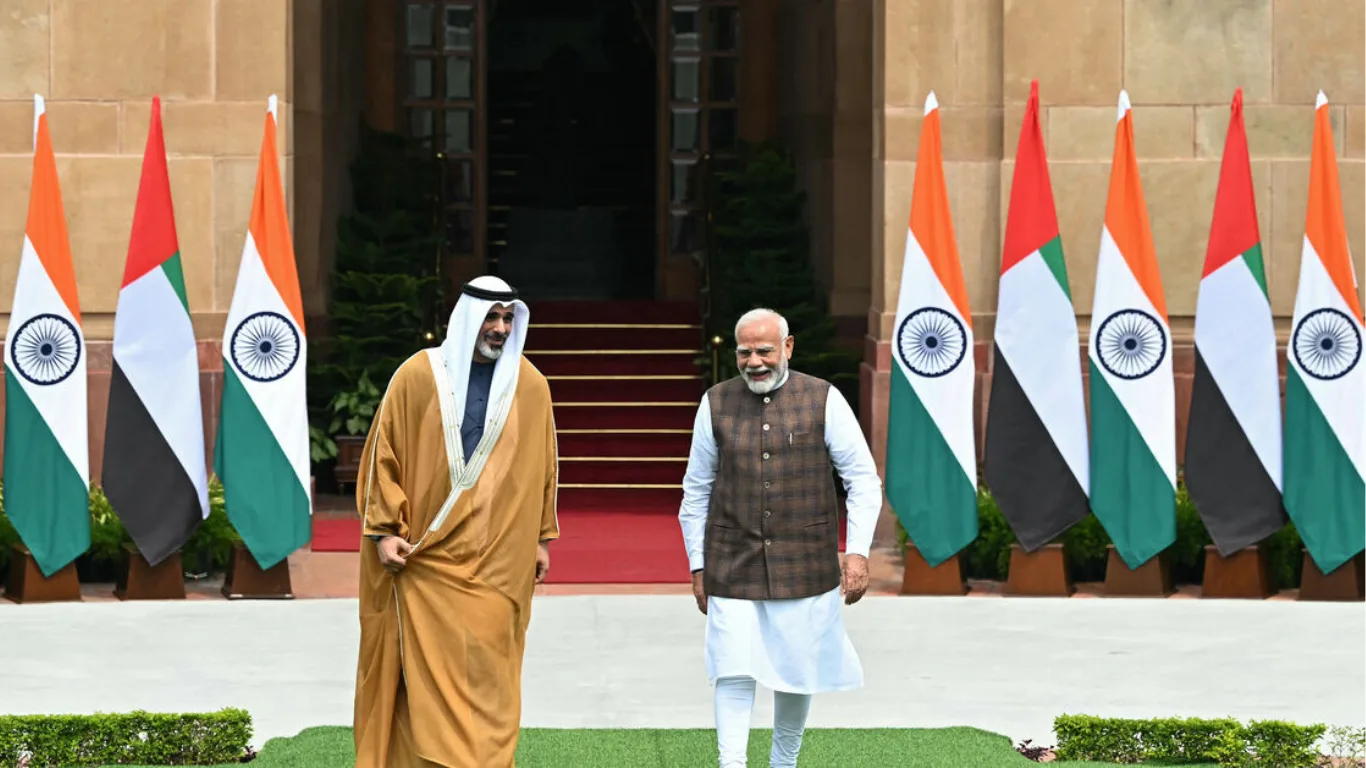
PM Modi's Abu Dhabi Visit: India and UAE Sign Game-Changing Deals on Defence, Energy, and a $5 Billion Investment Surge
PM Modi's visit to Abu Dhabi on May 15, 2026, was short. Just a few hours on the ground. And yet, by the time his aircraft lifted off from the UAE capital this time escorted out by the same F-16 fighter jets that had welcomed it in India and the UAE had signed agreements that could reshape the energy security map and defence architecture of both nations for years to come.
That is the kind of quiet urgency that defines modern diplomacy. Blink, and you miss the handshake. But the consequences linger far longer.
Why PM Modi's Abu Dhabi Visit Matters More Than It Looks
The timing of this visit was not accidental. The India-UAE strategic partnership has been building steadily since 2017, when Modi first visited the UAE. But the world in May 2026 is a different place — tensions stemming from the Iran conflict have rattled energy supply chains, raised alarm over the Strait of Hormuz (the narrow waterway through which a massive share of the world's oil passes), and pushed every major energy-importing nation to think more carefully about where its next barrel of crude comes from.
India imports roughly 87 per cent of its crude oil requirements. That number alone tells you everything about why India-UAE energy cooperation is not just a diplomatic nicety. It is a structural necessity.
Add to this that the UAE is India's third-largest trading partner and has been among the top sources of foreign investment into India over the last 25 years. The relationship was already substantial. What Modi's visit did was deepen it sharply, deliberately, across multiple sectors simultaneously.
What Actually Happened in Abu Dhabi: The Key Agreements
Here is where things get specific, and specifics are what matter.
PM Modi met UAE President Sheikh Mohammed bin Zayed Al Nahyan — widely referred to as MbZ — for wide-ranging delegation-level talks. The two leaders oversaw the signing of several agreements, and their scope was genuinely striking for a visit of just a few hours.
Strategic Petroleum Reserves MoU: This is perhaps the most significant deal. India and the UAE signed a Memorandum of Understanding on strategic petroleum reserves, under which the UAE's Abu Dhabi National Oil Company (ADNOC) will store 30 million barrels of crude oil in India's underground strategic reserves. ADNOC is already the only foreign entity permitted to store crude in India's reserves — this new agreement deepens and expands that arrangement considerably. For India, having ally-held crude stored on home soil is a powerful buffer against global supply shocks.
LPG Supply Agreement: Signed between Indian Oil Corporation (IOCL) and ADNOC, this deal secures long-term, prioritised supply of Liquefied Petroleum Gas to India. The UAE already meets close to 40 per cent of India's domestic LPG demand. This agreement locks in that supply chain, shielding Indian households from the volatility that hits international fuel prices without much warning.
Framework for Strategic Defence Partnership: This one carries long-term strategic weight. India and the UAE agreed on a framework that goes well beyond routine military exchanges. It covers joint defence technology development, intelligence sharing, counter-terrorism cooperation, maritime security, cyber defence, and secure communications. The language is explicit: both sides want to co-produce advanced defence technologies, not merely buy and sell hardware.
Read More: Easy Healthy Lunch Recipes for Busy Weekdays (Ready in 20 Minutes)
Ship Repair Cluster at Vadinar: An MoU was signed for establishing a ship repair cluster at Vadinar in Gujarat. This positions India as a potential maritime services hub in the region — part of a broader push to build out India's coastal and port infrastructure.
$5 Billion UAE Investment in India: The UAE announced investments worth five billion US dollars targeting Indian infrastructure projects, credit expansion through RBL Bank, and capital infusion into housing financier Sammaan Capital. The Indian business community in the UAE reportedly welcomed this as a kind of CEPA 2.0 moment — CEPA being the Comprehensive Economic Partnership Agreement that the two countries signed in 2022.
The Geopolitical Context: West Asia Is Burning, and India Is Walking a Careful Line
Modi did not ignore the elephant in the room. Speaking during his talks with MbZ, he acknowledged that the impact of the West Asia conflict is being felt globally. He also described the UAE as having been "unfairly targeted" amid the Iran tensions a strong signal of solidarity.
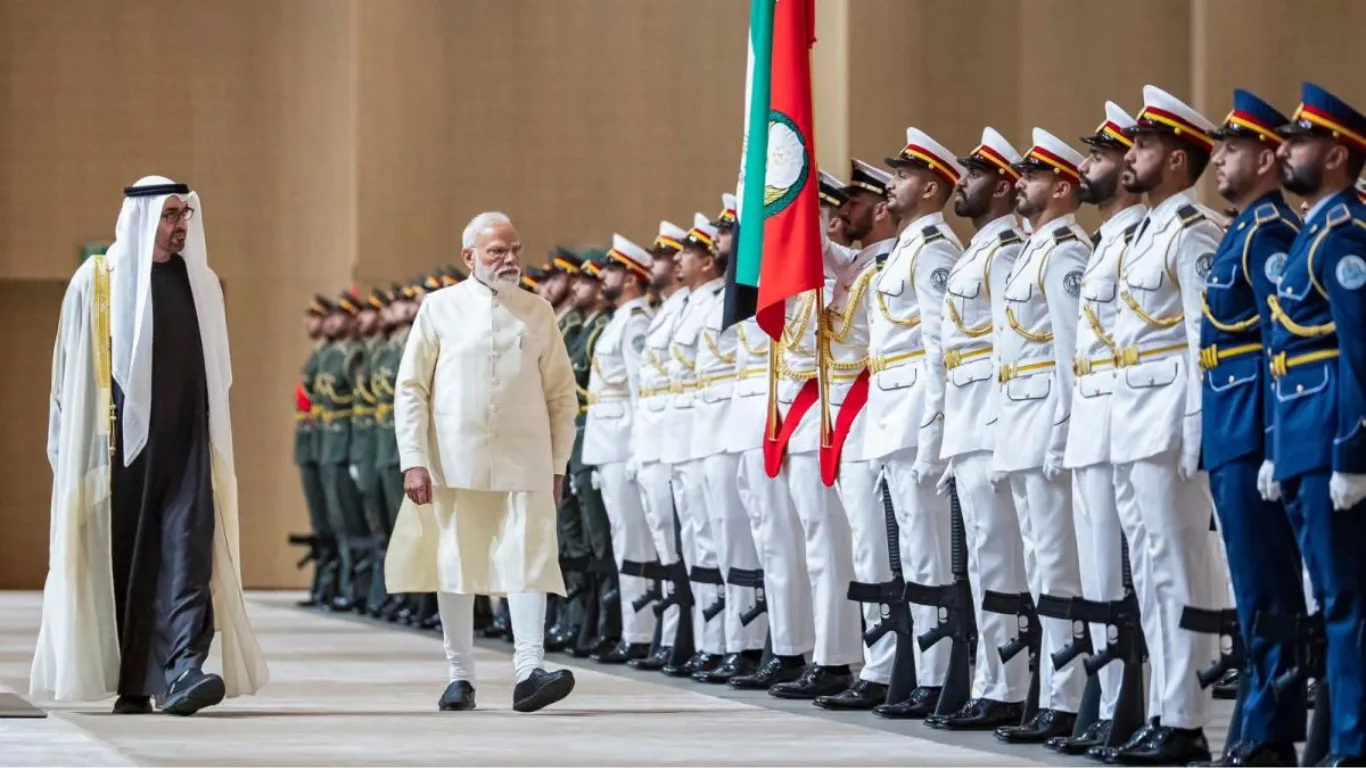
India's position here is layered. It has historically maintained ties with both Iran and Arab Gulf states, which is not easy, and gets harder when the region is in active conflict. By visiting Abu Dhabi at this moment, signing defence pacts, and explicitly affirming the UAE's strategic importance, India is making a calibrated choice about where its partnerships deepen.
Free passage through the Strait of Hormuz was also raised by Modi during the visit a pointed reference to the anxiety that any blockade or conflict escalation in that waterway creates for oil-importing nations worldwide, India very much among them.
Read More: One Year of Operation Sindoor: How India Rewrote the Rules of War with Pakistan
The Indian Diaspora Factor
Approximately 3.5 million Indians are living in the UAE. They are not just a community they are an economic bridge, contributing through remittances, trade networks, and professional ties. Every major diplomatic visit by an Indian PM to the Gulf carries this human dimension. The business community's "CEPA 2.0" framing of Modi's visit tells you how that diaspora reads these moments not as abstract geopolitics, but as signals that affect their lives and livelihoods directly.
What This Means Going Forward
One visit does not transform a relationship. But this visit accelerated several things that were already in motion. The defence partnership framework moves India-UAE ties into territory that most Gulf relationships have not reached. The energy deals hedge India's supply risk at a time when that risk is very real. And the investment announcement signals continued Gulf capital confidence in India's growth story.
The broader five-nation tour that included this Abu Dhabi stop with the Netherlands as the next leg suggests India's diplomatic calendar is intensifying. There is a deliberate push to secure relationships across energy, defence, and technology simultaneously. Abu Dhabi was a strong opening act.
The deals signed in those few hours will take time to unfold. Some will face implementation challenges. But the direction is clear. India and the UAE are building something more durable than a trading relationship. They are building strategic interdependence — the kind that holds even when the neighbourhood is unsettled.
Disclaimer: This article is based on information available across the web. Parchar Manch does not take responsibility for its complete accuracy, as the content could not be fully verified.
Read More: When Fashion Becomes Living Art: 2026 Met Gala “Costume Art” Theme Explained
FAQs
What was the main purpose of PM Modi's Abu Dhabi visit in May 2026?
Modi's visit focused on deepening India-UAE ties across energy security, defence cooperation, and investment. The two sides signed multiple agreements, including deals on strategic petroleum reserves, LPG supply, a strategic defence partnership framework, and a ship repair cluster project, alongside a USD 5 billion UAE investment announcement.
What is the India-UAE strategic petroleum reserve deal about?
Under the new MoU, ADNOC will store 30 million barrels of crude oil in India's underground strategic petroleum reserves. This arrangement strengthens India's energy security by ensuring ally-held crude is available domestically during supply disruptions or global price shocks. ADNOC is already the only foreign company allowed to store crude in India's reserves.
How does the Iran conflict affect India's visit to the UAE?
The ongoing conflict involving Iran has raised fears about disruptions to oil supply through the Strait of Hormuz, a critical global shipping lane. With India importing the bulk of its crude oil, energy supply security was a central concern during Modi's talks with MbZ. India reaffirmed its support for free maritime passage and expressed solidarity with the UAE.
What defence agreements did India and the UAE sign during this visit?
The two countries signed a Framework for Strategic Defence Partnership covering joint development of advanced defence technologies, intelligence sharing, counter-terrorism cooperation, maritime security, cyber defence, and joint military exercises — marking a significant elevation of their bilateral defence ties.
Why is the UAE important to India economically?
The UAE is India's third-largest trading partner and one of the top sources of foreign direct investment into India over the past 25 years. Around 3.5 million Indians live in the UAE, making the Indian diaspora a significant economic and cultural connector between the two nations.
What is CEPA, and why did the business community call this a "CEPA 2.0 moment"?
CEPA stands for the Comprehensive Economic Partnership Agreement, signed between India and the UAE in 2022 to boost bilateral trade. The business community used "CEPA 2.0" to describe Modi's 2026 visit because the new deals particularly the $5 billion investment announcement felt like the next major leap forward in economic integration between the two nations.