
One Year of Operation Sindoor: How India Rewrote the Rules of War with Pakistan
It started with tourists. On April 22, 2025, gunmen entered Baisaran Valley near Pahalgam in Kashmir and asked potential victims their religion before opening fire, killing at least 26 tourists , all but one of them Hindu. It was a carefully planned act of terror. And it set in motion a chain of events that, one year later, has fundamentally altered the security landscape of South Asia.
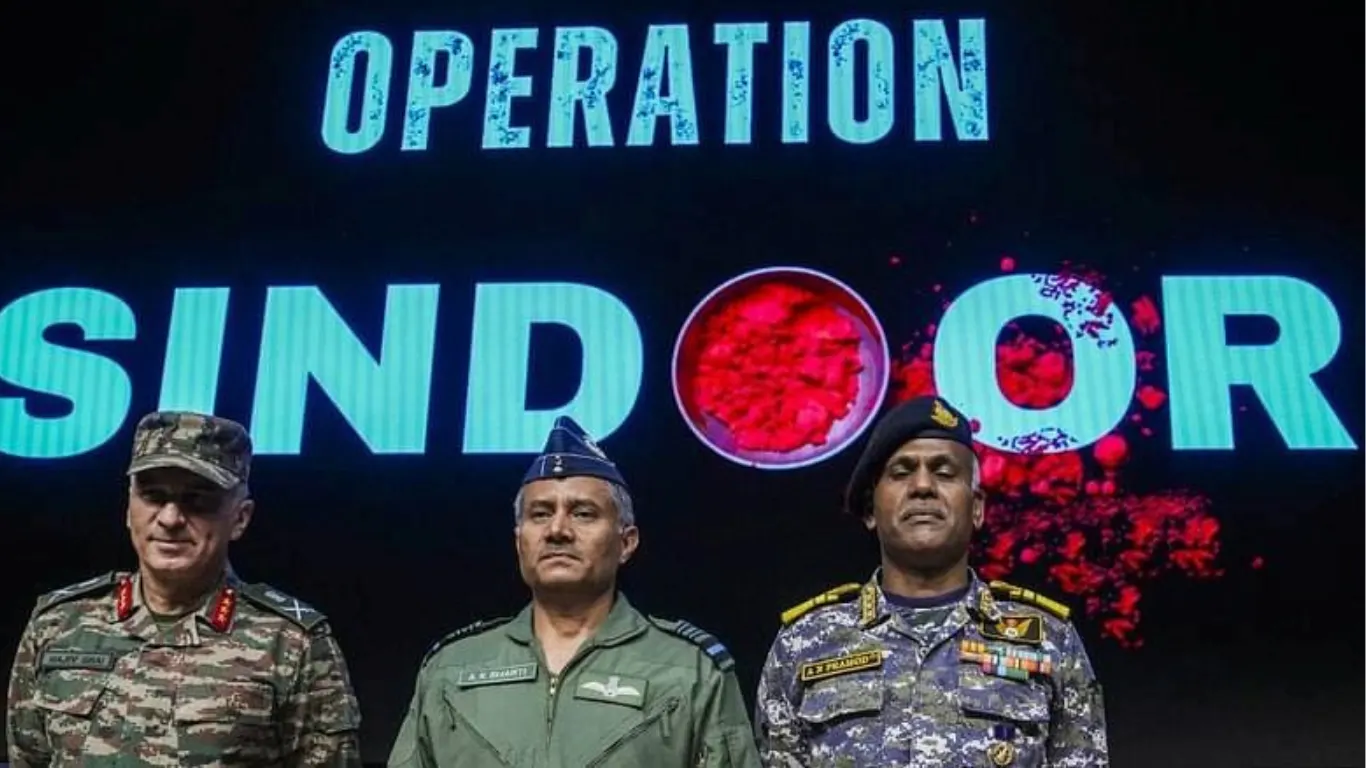
Nineteen days after the Pahalgam massacre, India launched Operation Sindoor , a name that carries enormous cultural weight in a country where sindoor, the red vermilion powder, is worn by married Hindu women as a sacred mark. The choice was deliberate. The message was personal. And what followed was the most consequential military action India had taken since 1971.
A year on, the question is not just what happened. It is what it means , for India, for Pakistan, for the region, and for anyone paying attention to how nuclear-armed neighbours manage rage.
What Operation Sindoor Actually Was
Strip away the political framing from both sides, and here is the shape of what happened.
On May 7, India launched missile and air strikes targeting nine sites across Pakistan-administered Azad Kashmir and Pakistan's Punjab province , infrastructure linked to the militant groups Lashkar-e-Taiba, Jaish-e-Mohammed, and Hizbul Mujahideen. India maintained the strikes were "focused, measured, and non-escalatory," and that no Pakistani military facilities were targeted.
Pakistan disagreed. Strongly.
Pakistan retaliated on May 7 by launching mortar shells on Jammu, particularly Poonch, killing civilians and damaging homes and religious sites. Over the next three days, both countries launched strikes on each other's air bases , including Nur Khan, Rafiqi, and Murid on the Pakistani side, and Udhampur, Pathankot, and Adampur on the Indian side.
More than 114 aircraft were involved in what became the largest beyond-visual-range aerial engagement on the India-Pakistan border in history. Neither air force crossed into the other's territory , they fought at distances of over 100 kilometres. A stand-off war, carried out at speed, with enormous consequences on the ground.
A ceasefire was announced on May 10, 2025, following a hotline communication between the Directors General of Military Operations of both countries. Four days. And nothing was the same after it.
Read More: Russia Launches Progress MS-34 Cargo Ship to the ISS, Delivering Over 2.5 Tonnes of Vital Supplies
Why This Was Different From Every Crisis Before
India and Pakistan have fought multiple wars. They have conducted surgical strikes. They have shelled each other across the Line of Control for decades. But Operation Sindoor crossed lines that had never been crossed before.
By striking Pakistan's Punjab province , where most of the country's political and military leadership is drawn , India demonstrated a doctrinal shift, pushing the conventional envelope deeper than ever before. In 2016, India had struck near the LoC. In 2019, it struck Balakot inside Pakistani territory. In May 2025, it struck the strategic heartland.
Operation Sindoor was described as the deepest and most extensive military campaign India had executed since the 1971 war , a tri-service operation that also targeted several critical facilities of the Pakistani military.
The implications of that fact are still being processed by analysts and strategists across the world.
How the Diplomatic Fallout Unfolded
The ceasefire did not bring normalcy. It brought a new kind of cold.
India suspended the Indus Waters Treaty , a 1960 agreement that has survived three wars between the two countries , placing it in abeyance as of March 20, 2026. The Attari Integrated Check Post was shut. Pakistani nationals were barred from travelling to India under SAARC visas. Military advisers at the Pakistan High Commission were declared persona non grata.
Pakistan retaliated in kind. Islamabad closed the Wagah border, ordered Indian citizens to leave within 48 hours, suspended visas, reduced Indian diplomatic staff, and closed its airspace to Indian aircraft , a closure that remained in effect as of late May 2026.
Two neighbours. No trade. No flights. No diplomats. Families were split across a border that had briefly turned into a battlefield.
And then there was the question of who ended the war.
Read More: WhatsApp Ending Support for Older Android Phones in September 2026: Is Your Device on the List?
Donald Trump has claimed more than 90 times that he halted the conflict, and Pakistan even nominated him for the 2026 Nobel Peace Prize for his diplomatic intervention. India, for its part, firmly rejected any suggestion of third-party mediation , a narrative battle that has proved almost as consequential as the military one.
What India Learned From the War
The strategic analysis that emerged in the months after Operation Sindoor revealed several key takeaways , and they explain why India's posture has shifted so dramatically.
First, New Delhi concluded that it can fight a conventional war below the nuclear threshold. Second, it developed a preference for "non-contact" warfare. Third, it has begun identifying and remedying gaps in its military capabilities. Fourth, it has reassessed the China-Pakistan threat. Fifth, it reaffirmed its strategic ties with Russia.
The seamless integration of the army, navy, and air force under the Chief of Defence Staff suggested India is capable of orchestrating complex, multi-domain operations under pressure , something often doubted given historical inter-service coordination issues.
On the weapons side, the BrahMos missile , co-developed with Russia , enabled India to strike military bases inside Pakistan at a price of almost $5 million per missile. Pakistan currently cannot defend itself against this missile. India is now expanding BrahMos production and exploring export to countries like Indonesia and Vietnam.
What Pakistan Did After the War
Domestically, Pakistan's response to the conflict was striking. A Gallup poll showed that 93 per cent of Pakistani respondents viewed the military positively after the war, with 96 per cent believing Pakistan had won the conflict. The army chief was given the title of Field Marshal.
And then came the 27th Amendment. The constitutional amendment consolidated military command over the civilian government, restructured inter-service dynamics, and granted the army sole authority over nuclear command and control , a development that experts say risks destabilising South Asia by reducing civilian restraint over potential nuclear use.That is not a footnote. That is arguably the most serious structural development to come out of the entire crisis.
The Common Mistakes in Reading This Conflict
Most people watching from the outside made one of two errors.
The first was treating Operation Sindoor as just another India-Pakistan flare-up , the kind that happens, creates headlines for a week, and fades. It did not fade. The Indus Waters Treaty is still suspended. The airspace is still closed. The ceasefire holds, but the underlying structure has changed.
The second mistake was taking at face value the claims of either side about who "won." Both countries declared victory. Both countries suffered losses. The honest answer is that the conflict was a test of doctrine, of weapons, of political will , and both sides learned from it in ways that will shape the next crisis, whenever it comes.
Where Things Stand Today , One Year Later
India's decision to put the Indus Waters Treaty in abeyance has been described by Pakistan as posing an existential threat to its population, which depends on the Indus, Chenab, and Jhelum rivers. Analysts are not optimistic that this will be resolved anytime soon.
India's approach toward Pakistan has become more coherent , moving toward a framework where engagement is clearly conditioned by behaviour. By linking domains like water and connectivity to the broader security context, New Delhi has signalled that the costs of supporting proxy violence will be multidimensional.
That is diplomatic language for a long game.
What has replaced rivalry is strategic indifference , a deliberate choice to deter, punish, and disengage rather than negotiate. Whether that posture holds the next crisis at bay, or simply determines how it unfolds, is the open question that both South Asia watchers and ordinary citizens on both sides of the border are quietly living with.
One year after Operation Sindoor, the guns are silent. The tensions are not.
Disclaimer: This article is based on information available across the web. Parchar Manch does not take responsibility for its complete accuracy, as the content could not be fully verified.
Read More: UAE Quits OPEC Amid Iran War – Impact on Global Oil Markets & Prices
FAQs
What was Operation Sindoor?
Operation Sindoor was a military campaign launched by India on May 7, 2025, in response to the Pahalgam terrorist attack that killed 26 civilians in Kashmir. India targeted nine sites linked to Pakistan-based militant groups across Azad Kashmir and Pakistan's Punjab province.
How long did the India-Pakistan conflict last?
The active military conflict lasted four days, from May 7 to May 10, 2025, ending with a ceasefire agreed upon through direct military-to-military communication.
What happened to the Indus Waters Treaty after Operation Sindoor?
India suspended the Indus Waters Treaty , which had survived three India-Pakistan wars since 1960 , placing it in abeyance. As of 2026, it remains suspended, which Pakistan considers an existential threat to its water security.
Did the US mediate the ceasefire?
Donald Trump claimed credit for brokering the ceasefire more than 90 times. India rejected the suggestion of third-party mediation, maintaining that the ceasefire was a direct military-to-military decision.
What is the current status of India-Pakistan relations?
Relations remain severely strained. Trade is halted, airspace remains closed, diplomatic staff are reduced, and border crossings are shut. India has adopted a posture of strategic disengagement rather than active diplomacy with Pakistan.