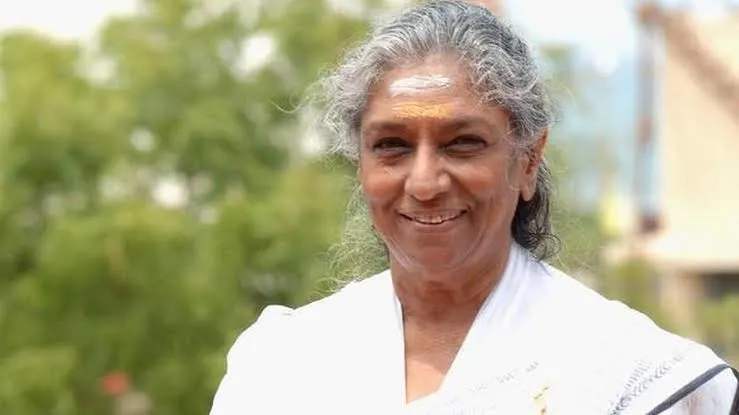
S Janaki Dies at 88: The Voice Behind 48,000 Songs Falls Silent in Mysuru
Forty eight thousand songs. Twenty languages. Six decades. Read that back slowly, because honestly, numbers like that rarely belong to one single voice. S Janaki dies at 88, passing away in Mysuru, Karnataka, and with her goes something genuinely irreplaceable in Indian film music, a voice so many people grew up with without necessarily knowing her name, just knowing the songs.
She died on July 11, 2026, at a private hospital in Mysuru, reportedly due to age-related ailments, with some accounts noting she had also suffered a heart attack in her final hours. Her granddaughter, Apsara Vydula, confirmed the news in an emotional Instagram post, writing that Janaki left peacefully, surrounded by family, and that despite the heavy hearts, there was also deep gratitude for the extraordinary life she lived.
Why S Janaki's Passing Actually Matters Beyond the Headlines
If you've ever hummed a Tamil, Telugu, Kannada, or Malayalam film song without quite knowing who sang it, there's a real chance it was her. S Janaki, affectionately called Janaki Amma, and widely known as the Nightingale of South India, wasn't just prolific, she was foundational to how South Indian film music actually sounds and feels even today. Her passing isn't simply the loss of one artist, it's the closing of a chapter that shaped six decades of cinema across an entire subcontinent's worth of languages.
President Droupadi Murmu called her passing a loss of a musical icon whose extraordinary singing enthralled generations. That's not exaggerated praise, honestly, when you consider she recorded songs in roughly 20 languages, including Hindi, Odia, Tulu, Urdu, Punjabi, and Bengali, alongside her core work in Tamil, Telugu, Kannada, and Malayalam.
Who S Janaki Really Was, Explained Simply
Born Sistla Sreeramamurthy Janaki on April 23, 1938, she moved to Chennai in her twenties on her uncle's advice, working with composer R Sudarsanam at AVM Studios. Think of her career almost like a bridge, connecting classical vocal discipline with the evolving, genre spanning demands of commercial film music across an entire region of India. She debuted as a playback singer in the 1957 Tamil film Vidhiyin Vilayattu, and remarkably, recorded songs in six different languages that very same year. That kind of linguistic range, mastering pronunciation and emotional nuance across languages she didn't grow up speaking, is genuinely rare even among celebrated playback singers.
She sang the most songs of her career in Kannada, developing legendary duet partnerships with singers like P B Srinivas, S P Balasubrahmanyam, and actor-singer Dr Rajkumar. She also collaborated extensively with some of India's most celebrated composers, including Ilaiyaraaja, M S Viswanathan, and later A R Rahman, cementing her presence across multiple generations of Indian film music rather than just one era.
Read More: Pokemon Go 10th Anniversary: How Times Square Turned Into A Real-Life Battle Against Mewtwo
How Her Six Decade Career Unfolded, Step by Step
- She began her playback singing career in 1957 with the Tamil film Vidhiyin Vilayattu, recording in six languages that same year.
- Throughout the 1960s and 70s, she became one of the most in-demand female playback voices across Tamil, Telugu, Kannada, and Malayalam cinema.
- She won her first National Film Award for Best Female Playback Singer in 1981 for the Malayalam song Ettumanoorambalathil, eventually winning the National Award four times total.
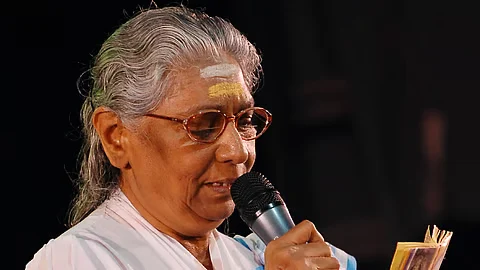
- She continued delivering hits through the 1980s and 90s, working extensively with composers like Ilaiyaraaja and building an enormous discography across two decades.
- She announced her retirement from singing for films and stage appearances in 2016, choosing the Malayalam lullaby Amma Poovinum as her swansong.
- She briefly returned in 2018 to sing for the Tamil film Pannaadi, showing that even in retirement, the voice hadn't quite let go.
- She was honored with the Kalaimamani award from the Tamil Nadu government, the Rajyotsava Prashasti from Karnataka, and an honorary doctorate from the University of Mysore.
That return in 2018, brief as it was, tells you something about how deeply singing was woven into who she actually was, not simply a job she retired from cleanly.
Read More: Avinash Narne Arrest: Inside the Bellevue Murder Case That Took Eight Months to Charge
Real World Examples of Her Musical Range
Consider the sheer creative range packed into her catalog. She sang the Tamil song Kanna Nee Engey entirely in a child's voice, a technical and emotional feat she also repeated with Mummy Mummy in Malayalam and Thayiya Thandeya in Kannada. She once described the Kannada song Shiva Shiva Ennada Naaligeyeke, composed in two different ragas by L Vaidyanathan, as the toughest piece of her entire career. These weren't just performances, they were genuine vocal experiments that required years of discipline to execute convincingly.
Mistakes People Keep Making When Remembering S Janaki's Legacy
It's easy, understandably, to reduce a legacy this vast down to a single well known song or one regional industry, Tamil listeners might primarily remember her Tamil hits, Kannada audiences her Kannada catalog, and so on. But that narrows a genuinely pan-Indian legacy into something smaller than it actually was. Her true achievement lived precisely in that range, mastering the emotional and linguistic nuance of roughly 20 languages, not excelling in just one.
Read More: Israel Warns of New Iranian Plot to Assassinate Trump: What We Actually Know So Far
Pro Tips for Exploring Her Discography
Start with her National Award winning songs first, they represent some of her most technically and emotionally demanding work across Malayalam, Tamil, and Telugu cinema. From there, branch into her Kannada duets with S P Balasubrahmanyam and Dr Rajkumar, since that partnership produced some of her most enduring, beloved recordings. And don't skip her children's voice performances, they showcase a dimension of her versatility that often gets overlooked next to her more famous romantic and dramatic ballads.
Closing Thoughts
There's a particular kind of grief that settles in when a voice this woven into a culture's memory finally goes quiet, not loud mourning, but something quieter, the realization that an entire soundscape millions of people grew up inside now belongs only to recordings. S Janaki's last rites were held in Mysuru, honoring her own expressed wish, with tight security arrangements and public tributes organized by local authorities. Her songs, though, aren't going anywhere. Forty eight thousand of them remain, waiting in old film reels and worn cassette memories, for anyone willing to listen.
Read More: Pokémon GO Fest 2026 Global Begins July 11, and For the First Time Ever, It Costs Nothing to Join
Disclaimer: This article is based on information available across the web. Parchar Manch does not take responsibility for its complete accuracy, as the content could not be fully verified.
FAQs
When did S Janaki die?
She passed away on July 11, 2026, at a private hospital in Mysuru, Karnataka, at the age of 88.
How many songs did S Janaki record in her career?
She recorded an estimated 48,000 songs across roughly 20 languages over a six-decade career.
What was S Janaki known as?
She was widely known as Janaki Amma and the Nightingale of South India, celebrated for her versatility across Indian film music.
How many National Film Awards did she win?
She won the National Film Award for Best Female Playback Singer four times across her career.
When did S Janaki retire from singing?
She officially retired in 2016 with a farewell concert in Mysuru, though she briefly returned in 2018 to sing for the Tamil film Pannaadi.
Where were her last rites performed?
Her last rites were conducted in Mysuru, honoring her own expressed wish, at the Kaniyanahundi farm on HD Kote Road.