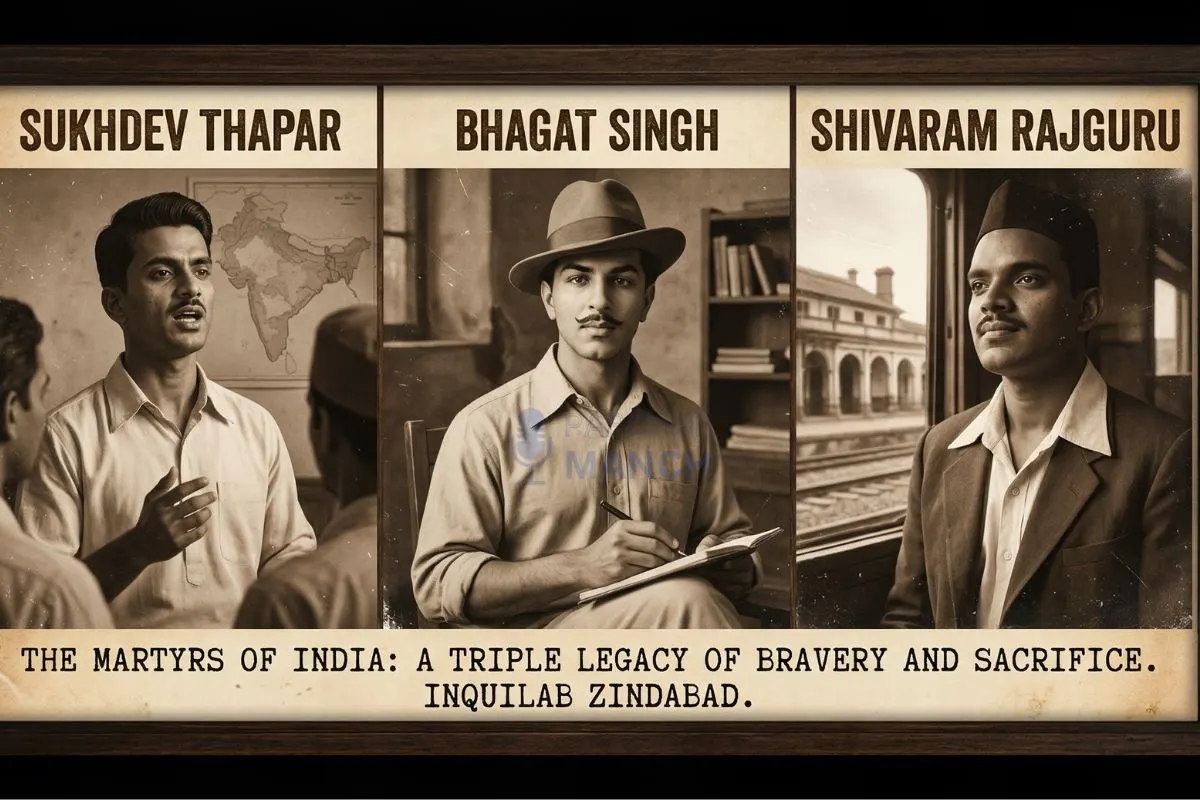
Shaheed Diwas : The Story of Bhagat Singh, Sukhdev & Rajguru
The date is March 23, and the air always feels a bit heavier today. It’s funny how a single day can hold so much silence and so much noise at the same time. We call it Shaheed Diwas, a day that isn't just a mark on a calendar but a wound that refused to heal and instead turned into a badge of honor.
It’s the Bhagat Singh death anniversary, but calling it a "death" anniversary feels wrong. Spirits like that don't really die, do they? They just sort of... dissolve into the soil.
When you think about Bhagat Singh, Sukhdev, and Rajguru, you don't think of old men with grey hair. You think of boys. That’s the thing that gets me every single time. They were in their early twenties. At twenty-three, most of us are worried about a first job or a bad breakup, but these three?
They were looking at a gallows and smiling. It’s a kind of courage that feels alien today, almost like a myth, but it was very, very real. They were the ultimate Indian freedom fighters, the ones who didn't just want the British to leave; they wanted the soul of the country to wake up.
The story really starts with a fire that wouldn't go out. After the Jallianwala Bagh massacre, something broke inside a young Bhagat Singh. Can you imagine a twelve-year-old boy collecting blood-soaked earth in a bottle?
That’s not a childhood; that’s a baptism. He, along with his brothers-in-arms Sukhdev and Rajguru, realized that "requests" and "petitions" weren't going to cut it against an Empire. They needed a shock. They needed the Inquilab Zindabad slogan to ring through the hallways where the oppressors slept.
The Assembly Bomb and the Choice to Stay
It was April 1929. The plan wasn't to kill if they wanted to kill, they could have. They threw low-grade smoke bombs into the Central Legislative Assembly. Why? To "make the deaf hear." They could have run. They had a clear exit. But they stayed.
They stood there scattering leaflets, shouting Inquilab Zindabad until the smoke cleared and the handcuffs clicked. They wanted a trial. They wanted a platform. They wanted the world to see that India wasn't just begging for crumbs anymore.
During their time in jail, they didn't just sit in the dark. They fasted. They read. Bhagat Singh was a voracious reader he was consuming Lenin, Marx, and Dickens while his body was wasting away from hunger strikes for the rights of political prisoners.
He was a philosopher with a pistol, a thinker who knew that an idea is more dangerous than a bullet. That’s why Shaheed Diwas is so significant; it’s the day the British thought they were ending a rebellion, but they were actually planting the seeds of its final victory.
The Final Walk to the Gallows
The execution was supposed to be on March 24, 1931. But the British were terrified. They saw the crowds growing outside the jail. They saw the anger. So, in a move of pure cowardice, they moved the hanging forward by eleven hours. On the evening of March 23, the three of them Bhagat, Sukhdev, and Rajguru walked toward the noose. They weren't dragging their feet. They were singing. They embraced the rope like it was a wedding garland.
People often ask why we still remember them so vividly. It’s because they represented the "restless youth." This 2026 Shaheed Diwas tribute isn't just about looking back; it’s about checking our own pulse. Are we still that brave?
Do we still care about the "common man" the way they did? For more deep dives into stories that shaped our nation and for the latest updates on how we honor our heroes, you should definitely check out Parcharmanch. It’s where the real news and the real heart of India meet.
Why Shaheed Diwas Matters Today
- Sacrifice Over Self: These men had families, dreams, and lives ahead of them, yet they chose the country over themselves.
- The Power of Youth: They proved that you don't need decades of experience to spark a revolution; you just need conviction.
- Intellectual Rebellion: They weren't just "angry young men." They were deeply well-read and had a vision for an equal, socialist India.
- Unity in Action: Coming from different backgrounds, they stood together until the very last breath, showing a version of India that was truly united.
- The Legacy of Inquilab: The slogan Inquilab Zindabad didn't end in 1947; it remains a cry against injustice everywhere.
- A Symbol of Defiance: They showed that even when you are behind bars, your mind can be free.
It’s hard to wrap your head around the fact that they were so young. When we pay our Shaheed Diwas respects, we are honoring the fact that they gave up all their "tomorrows" so that we could have our "today."
The British burned their bodies in secret on the banks of the Sutlej river, hoping to erase them. But you can't burn an idea. You can't drown a spirit.
The courage of these Indian freedom fighters is like a lighthouse. Even when the sea is calm, you need to know where the rocks are. They remind us that freedom isn't a gift it's a responsibility.
Every time we speak up against a wrong, every time we stand up for someone who can't, we are echoing that March 23 Martyr's Day spirit. It’s a heavy legacy, but it’s a beautiful one.
Conclusion
In the end, Shaheed Diwas is more than just a day of mourning; it is a day of profound awakening that reminds us of the high price paid for the air we breathe today. As we observe the Bhagat Singh death anniversary, we must realize that the bravery of Bhagat Singh, Sukhdev, and Rajguru was not a momentary spark but a steady flame meant to light the way for generations.
This 2026 Shaheed Diwas tribute serves as a bridge between their immortal sacrifice and our current duties as citizens of a free nation. By keeping the spirit of Inquilab Zindabad alive in our hearts, we ensure that their vision for a just and equitable society does not fade into the pages of history.
Let us honor these Indian freedom fighters not just with words or ceremonies, but by living with the same integrity and courage they displayed on the cold evening of March 23 Martyr's Day. Their story is our strength, and their sacrifice is our eternal debt.
Read More: Who Was Bhagat Singh? 10 Facts About the Young Hero
FAQs
Why is March 23 celebrated as Shaheed Diwas in India?
March 23 is celebrated as Shaheed Diwas to honor the ultimate sacrifice of Bhagat Singh, Sukhdev Thapar, and Shivaram Rajguru, who were hanged by the British government on this day in 1931. This day serves as a national reminder of the bravery of these young revolutionaries who gave their lives to ignite the fire of independence in the hearts of millions of Indians.
What was the main objective of Bhagat Singh and his comrades?
The main objective of Bhagat Singh and his fellow Indian freedom fighters was not just to end British rule, but to establish a society free from exploitation and injustice. They aimed to awaken the masses through symbolic acts of defiance, such as the Assembly bombing, and to spread the message of equality and total independence through their writings and slogans.
Why was the execution of the three revolutionaries moved earlier than scheduled?
The British authorities moved the execution forward by eleven hours because they were terrified of the massive public outcry and potential riots that were brewing across the country. By carrying out the hanging secretly on the evening of March 23 instead of the morning of March 24, they hoped to prevent a massive gathering of people at the jail gates.
What does the slogan "Inquilab Zindabad" signify in the freedom struggle?
The slogan Inquilab Zindabad, which translates to "Long Live the Revolution," was popularized by Bhagat Singh and became the war cry of the Indian independence movement. It signified a call for a total transformation of the social and political system, urging the youth to fight against oppression and never settle for anything less than complete freedom.
How should we observe Shaheed Diwas in the modern era?
We should observe Shaheed Diwas by reflecting on the values of selfless service and national integrity that these martyrs stood for, rather than just treating it as a public holiday. People can pay tribute by educating the younger generation about the history of March 23 Martyr's Day and by contributing to the betterment of society, which was the ultimate dream of our fallen heroes.