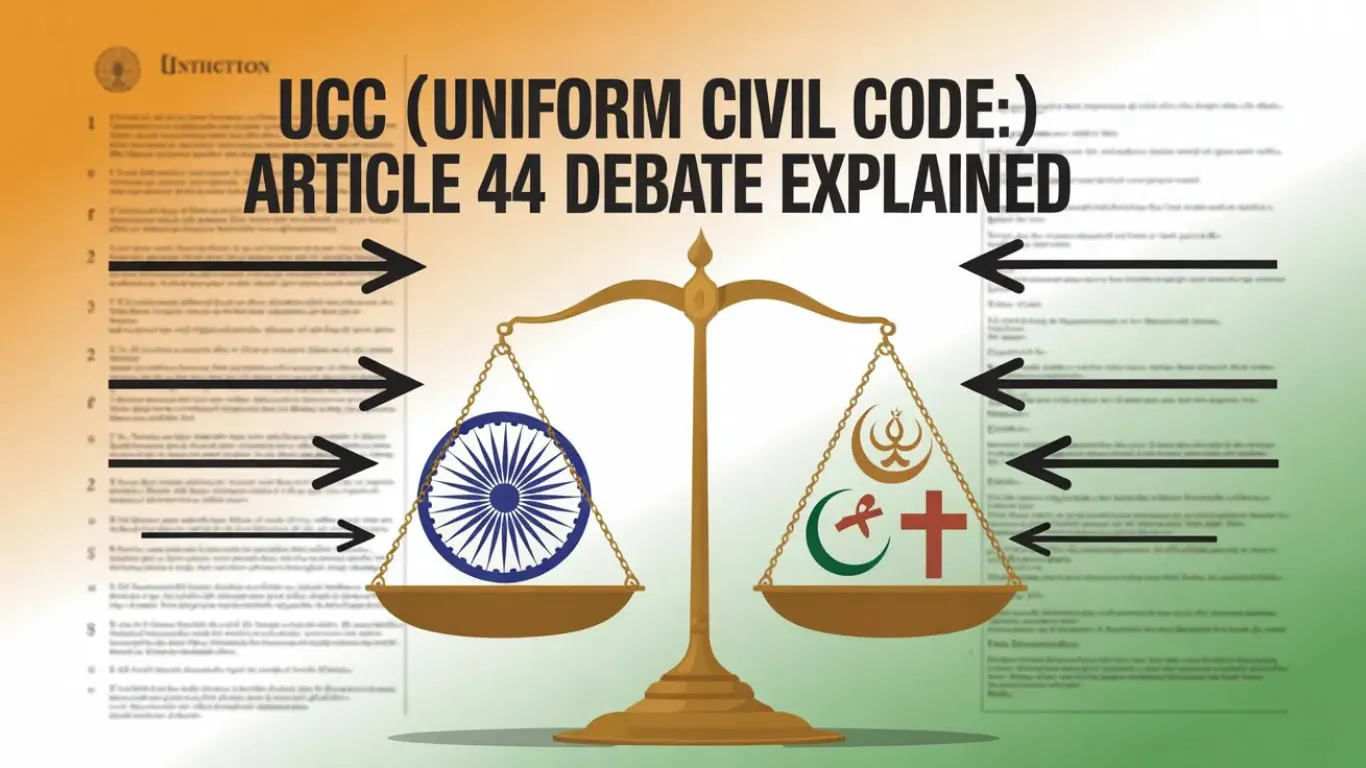
What Is the Uniform Civil Code? Meaning, History, Article 44 and the UCC Debate Explained
The issue " what is the uniform civil code" seems simple; however, the answer lies in the middle of religion, law and equality, as well as individual rights. In simplest terms, it is a Uniform Civil Code (UCC), a term used to describe having common civil rules for all citizens in areas such as divorce, marriage, inheritance, adoption, and succession, instead of distinct rules based on personal religious laws.
It sounds easy. It's not.
What Is the Uniform Civil Code and Why Does It Matter?
Then, what is the uniform civil code really trying to change?
India is currently home to a variety of personal laws that are in force in India. Different communities could be under different rules regarding particular family issues. A UCC is likely to look for common rules in such issues, regardless of religion.
The argument in favour of UCC typically focuses on consistency, equality in the law, and rights for individuals. People who support UCC believe that everyone should have the same rights to civil liberties and obligations. The opposition is concerned that a one-stop structure could impede the freedom of religion or practices, as well as community customs.
This tension is the reason why the UCC discussion in India has lasted for many years.
Article 44 Directive Principles: Where Did the Idea Begin?
The Constitutional basis of the UCC is Article 44. It states that the State must strive to create a uniform civil code for all citizens of India. Article 44 is a part of the Directive Principles of State Policy, which govern the state, but are usually not enforced in courts.
This is the reason the principles of Article 44 are essential in comprehending the matter. Article 44 does not by itself create the concept of a UCC. Instead, it sets an objective of the Constitution before the State.
The roots of the provision date back to the Constituent Assembly. The Constitution was ratified in 1948 after a long debate concerning personal laws and freedom of religion, as well as unity in the nation. The Constitution was eventually able to keep the goal but left the implementation to the future government.
If someone is asking about the standard civil code, the answer from the Constitution starts with Article 44 but doesn't end there.
Personal Laws in India and the Main Point of Difference
The expression personal law in India is a broad reference to family and personal issues. They can include divorce, marriage, as well as succession, inheritance, maintenance, adoption, and divorce.
India has numerous general civil laws. Contracts, property transactions, as well as other legal fields are not governed by religion. The UCC issue is mostly about creating a more uniform system of family and personal law.
This distinction is crucial because a commonly held belief is that the UCC could replace all laws in India. It is not.
The idea proposed is narrower than the concept of common rules in specific civil cases.
Must read: Key Features of the Indian Constitution: A Complete Overview
Goa Uniform Civil Code: The Example Often Mentioned
It is believed that the Goa Uniform Civil Code is often discussed when it is brought up. Goa has its own civil-law framework, which was developed from the legal system of its past and is widely applicable across different communities, even though the rules of Goa aren't necessarily the same as what a general UCC plan could be like.
This Goa universal civil code is therefore a valuable practical example; however, it shouldn't be regarded as a model for India.
It is also reported that the Supreme Court has referred to Goa in its discussion of the possibility of a unified civil framework.
What Is the Uniform Civil Code in Practice?
If a UCC were to be introduced nationwide, the real-world questions are more difficult than the campaign slogan.
It is necessary to establish common rules in matters like:
- Conditions for marriage and the conditions for a legally valid wedding.
- Divorce and grounds for announcing the end of a marriage.
- Financial rights and maintenance.
- Parenthood through adoption and legal recognition.
- Succession and inheritance.
- Children, spouses and other legal inheritors.
- Recording and recording important family gatherings.
The precise provisions will depend on the final law passed by Parliament or, when the constitution permits, by the states.
This is the main aspect: what the universal civil code is is not a question that can be addressed by saying "one law for everyone." The substance of that law is just as important.
Must read: Top Political Party Updates 2026: Manifestos, Leadership Changes, and Election Strategies
The UCC Debate in India: Why Is It So Controversial?
It is said that the UCC controversy in India generally has two sides. However, the truth is more complex.
Some argue that various individual laws and regulations in India could lead to uneven outcomes, specifically for women. They believe that common rules can improve the equality of women before the law and make family disputes easier to comprehend.
Opponents raise a different issue. They assert that the religious and cultural communities have always followed their own distinct customs, and a common system could limit the freedom of religion and rights of minorities if it is not designed with proper consultation.
It is also a pragmatic issue: uniformity doesn't necessarily indicate fairness. A poorly designed common law may result in new challenges.
That's where the real UCC debate in India is located, and not just in slogans and political statements.
Article 44 Directive Principles and the Constitutional Balance
The Directive Principles of Article 44 go hand-in-hand with fundamental rights as well as additional constitutional safeguards. Article 37 clarifies that the Directive Principles are not enforceable by courts; however, they are a fundamental part of governance.
This provides a vital constitutional balance. Any future UCC is required to operate in a manner that is consistent with the fundamental rights of equality, as well as religious freedom and other constitutional protections.
The Article 44 directive principles thus provide guidance but not a legal code.
What Is the Uniform Civil Code Today?
For those who are asking about the uniform civil code in the present time, the most significant development is Uttarakhand. The state adopted the Uniform Civil Code on January 20, 2025. It covers divorce, marriage, inheritance, and other civil disputes. The official framework has since been subject to changes.
This is what makes Uttarakhand significant in that the UCC has become more than just an issue of constitutional law. It is now a working legal framework at the state level.
However, an individual State UCC and a national UCC aren't the same thing.
Must read: Major State Assembly Updates 2026: Political Movements and Decisions Affecting Citizens
Common Misunderstandings About UCC
The mistake is to think that UCC is a way of prohibiting religious beliefs. It is not a requirement to restrict religious beliefs, worship or belief. Its primary concern is family and civil law.
Another mistake is to assume that the Goa Universal Civil Code is the same as a national UCC could be. It's an example, not necessarily the template for national use.
Another mistake is to treat the personal law in India as if each rule is distinct from the normal Indian law. In fact, India's legal system already has an extensive uniform civil code.
Perhaps the biggest error is to believe that what constitutes the standard civil code is a universally accepted solution. The basic principle is much more obvious than the final legal layout.
Final Thoughts
The most straightforward answer to what constitutes the universal civil code is that it's the concept behind common civil laws for all individuals in certain personal issues regardless of religious beliefs.
The more difficult problem is to determine what the general rules actually should say.
This is the reason the directives of Article 44, personal laws in India, as well as the UCC controversy in India and the Goa universal civil code, continue to be relevant. The main discussion isn't just about uniformity. It's all about the ways in which India can reconcile equality with the diversity of its citizens while keeping their rights at the centre.
FAQs
Is the UCC included within the Constitution?
Yes. Article 44 requires the State to work towards establishing the creation of a uniform code of civil procedure for all citizens.
Are the provisions of Article 44 legally enforceable?
No. It's part of the Directive Principles and is not directly enforceable in court.
Does UCC mean that one law of one religion applies to all people?
Not necessarily. The concept that is being promoted is a common framework for civil law that does not extend the law of one particular religion to all.
What is it that makes the UCC discussion in India so crucial?
Due to the fact that it combines constitutional rights: equality as well as individual rights, freedom of religion as well as legal uniformity.
What does Goa's universal civil code say about it?
It demonstrates that a widely suitable civil framework for family law can be established within the framework of an Indian state, but Goa's historic system is different from the coming national UCC.
What are the reasons individual laws from India are not being addressed in the debate?
The changing law on family matters affects the most personal aspects of divorce, marriage, as well as inheritance, adoption, and family law rights.