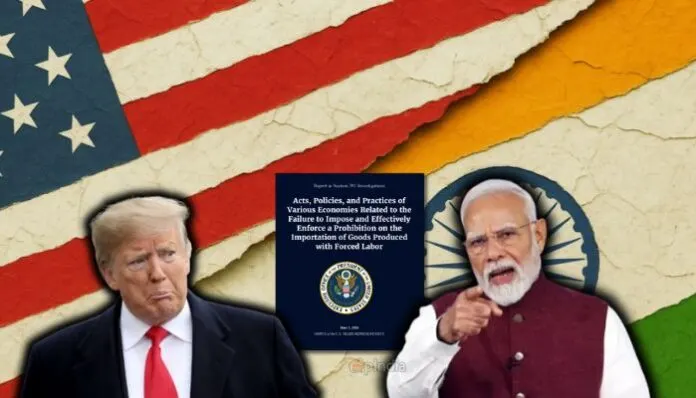
US Proposes 12.5% Tariff on India: What the Forced Labor Crackdown Really Means for Trade
US tariffs on India over forced labor just moved from a background trade concern into something much more concrete. The Office of the United States Trade Representative (USTR) has formally proposed a 12.5% additional tariff on imports from India and 53 other economies, citing their failure to ban goods made using forced labor practices. This is not a small footnote in a trade bulletin. For a country like India, which exported roughly $77 billion worth of goods to the US last year, the stakes are real.
Here is what is happening, why it matters, and what India is actually doing about it.
Why the US Is Pushing This Tariff Now
The move is being made under Section 301 of the US Trade Act of 1974, a powerful legal tool that gives the USTR authority to investigate and respond to foreign trade practices it considers unfair or harmful to American commerce. The USTR launched Section 301 investigations in March 2026 into the acts, policies, and practices of 60 economies, related to their failure to impose and effectively enforce a prohibition on the importation of goods produced with forced labor.
The core argument from Washington is straightforward: when countries allow goods made with forced or coerced labor into their supply chains and do not take steps to block such imports, they create an uneven playing field. American manufacturers, who follow labor laws, end up competing against artificially cheapened foreign goods. The USTR found that all 60 countries have failed to impose or effectively enforce a prohibition on forced labor-related imports, creating what it called an "unlevel playing field" for American workers.
That framing matters. This is not purely about what happens inside India's factories. It is about whether India has a legal system to stop goods made with coerced labor elsewhere from flowing through its borders into the US.
What the 12.5% Tariff Proposal Actually Says
The USTR proposed additional duties of 12.5% on imports from India and 53 other economies. Six economies, including Canada, Ecuador, the European Union, Indonesia, Mexico, and Pakistan, face a lower 10% rate because they have some partial regime in place to block forced labor goods. The remaining 54, including India, China, Japan, South Korea, Brazil, the United Kingdom, Switzerland, Australia, Bangladesh, Sri Lanka, Turkey, the UAE, and Vietnam, face the higher 12.5% rate.
The distinction is important. Countries that have at least partial legal frameworks to restrict forced labor imports get a discount, essentially. India, for now, is not in that group.
The USTR also proposed a textile mechanism that would allow for a certain volume of apparel and textile imports from certain economies to enter the United States at a reduced Section 301 tariff rate. This is a small but notable relief for India's massive garment export industry, which is one of the country's largest export-earning sectors.
Read More: Ram Charan's Bodyguard Kevin Kunta Goes Viral After Fan Breaches Security at Peddi Event in Vijayawada
This Is a Proposal, Not a Final Decision
This point tends to get lost in headlines. The measure remains a proposal and has not yet been finalised. Written comments can be submitted until 6 July 2026. Public hearings will be held on 7 July 2026. The USTR will consider the comments and testimony received before taking a final decision on the proposed measures.
That window matters. It gives India's government, industry associations, and trade bodies a formal opportunity to push back, present evidence, and potentially influence the final outcome.
How India Is Responding
India is not sitting still. India remains engaged with the US on the matter as part of Section 301 proceedings. Meanwhile, the chief negotiators of India and the US began a three-day round of talks in New Delhi to finalise details of a proposed interim trade agreement.
New Delhi's position is carefully worded. Officials argue that the USTR findings may be open to challenge, as the investigation focuses on import controls rather than forced labor practices within Indian exports themselves. That is a meaningful legal distinction. India is saying the USTR is not actually accusing Indian manufacturers of using forced labor. It is saying India lacks strong enough laws to block forced-labor goods from entering its own import system.
Whether that argument holds weight in the July hearings remains to be seen.
Read More: Praggnanandhaa Beats Magnus Carlsen Twice at Norway Chess 2026: What Just Happened Is Historic
What Sectors Would Feel the Hit
A blanket 12.5% additional tariff layered on top of existing duties would raise the cost of Indian goods in the American market noticeably. Sectors like textiles, pharmaceuticals, engineering goods, chemicals, and electronics components would all be exposed. The textile mechanism could soften the blow for garment exporters, but only up to a volume limit.
For Indian businesses currently negotiating long-term US supply contracts, the uncertainty alone creates friction. Buyers on the American side may hesitate to commit until the final tariff picture is clear.
The Bigger Context: India and the US Are Still Negotiating
The proposal arrives at a sensitive moment for India-US trade relations, with both sides engaged in negotiations toward a bilateral trade agreement. India has so far restrained from retaliating against US tariff actions, opting instead to pursue negotiated outcomes.
That restraint is strategic. India learned from the 2025 tariff escalation, when the US briefly imposed sweeping duties tied to India's Russian oil purchases, that engaging diplomatically works better than matching fire with fire. The February 2026 framework agreement, which removed those earlier tariffs, was the result of exactly that approach.
The forced labor tariff proposal is, in some ways, another pressure point in an ongoing negotiation rather than a final verdict.
Closing Thoughts
There is something quietly significant about the word "proposal" here. It signals that the US is not simply announcing a decision. It is opening a process, and within that process, India has a real seat at the table. The July hearings will be closely watched. What India's trade officials present, what Indian industries argue, and how the USTR weighs the diplomatic cost of alienating a major strategic partner will all feed into the outcome.
For anyone tracking India-US trade policy, this is a moment to pay close attention. Not because the tariff is inevitable, but because the conversation around it will shape trade terms for years ahead.
Disclaimer: This article is based on information available across the web. Parchar Manch does not take responsibility for its complete accuracy, as the content could not be fully verified.
Read More: The Cockroach Janta Party: India's Gen Z Turned Humiliation Into a Political Warning Shot
Disclaimer: This article is based on information available across the web. Parchar Manch does not take responsibility for its complete accuracy, as the content could not be fully verified.
FAQs
What is Section 301 of the US Trade Act?
It is a law that gives the US Trade Representative the authority to investigate foreign trade practices considered unfair or harmful to American commerce and to impose tariffs as a response. It has been used against many countries, including China and India, in different trade disputes.
Why is India being targeted specifically over forced labor?
India is not accused of running forced labor factories. The concern is that India lacks a strong legal mechanism to stop imports of goods produced with forced labor from entering its territory and then being re-exported to the US. Around 54 countries face the same issue under the same investigation.
Is the 12.5% tariff final?
No. It is a formal proposal. Written public comments are due by July 6, 2026, with hearings scheduled for July 7. The USTR will review submissions before making a final determination. India is actively engaging in this process.
Which Indian industries would be most affected if the tariff is finalized?
Textiles, pharmaceuticals, engineering goods, chemicals, and electronics components are among the most exposed sectors. The proposed textile mechanism may offer some partial relief for garment exporters, but the details of volume limits will matter significantly.
What is India doing to counter this tariff proposal?
India is engaging through formal Section 301 proceedings, challenging the factual basis of the USTR's findings, and continuing parallel bilateral trade negotiations. The two countries are also working toward an interim trade agreement, which may influence the final outcome.
Could India face even higher tariffs beyond this 12.5%?
Possibly, if negotiations break down. But India's current diplomatic approach, which favors engagement over retaliation, is aimed at preventing that. The February 2026 removal of earlier punitive tariffs shows that this approach has worked before.