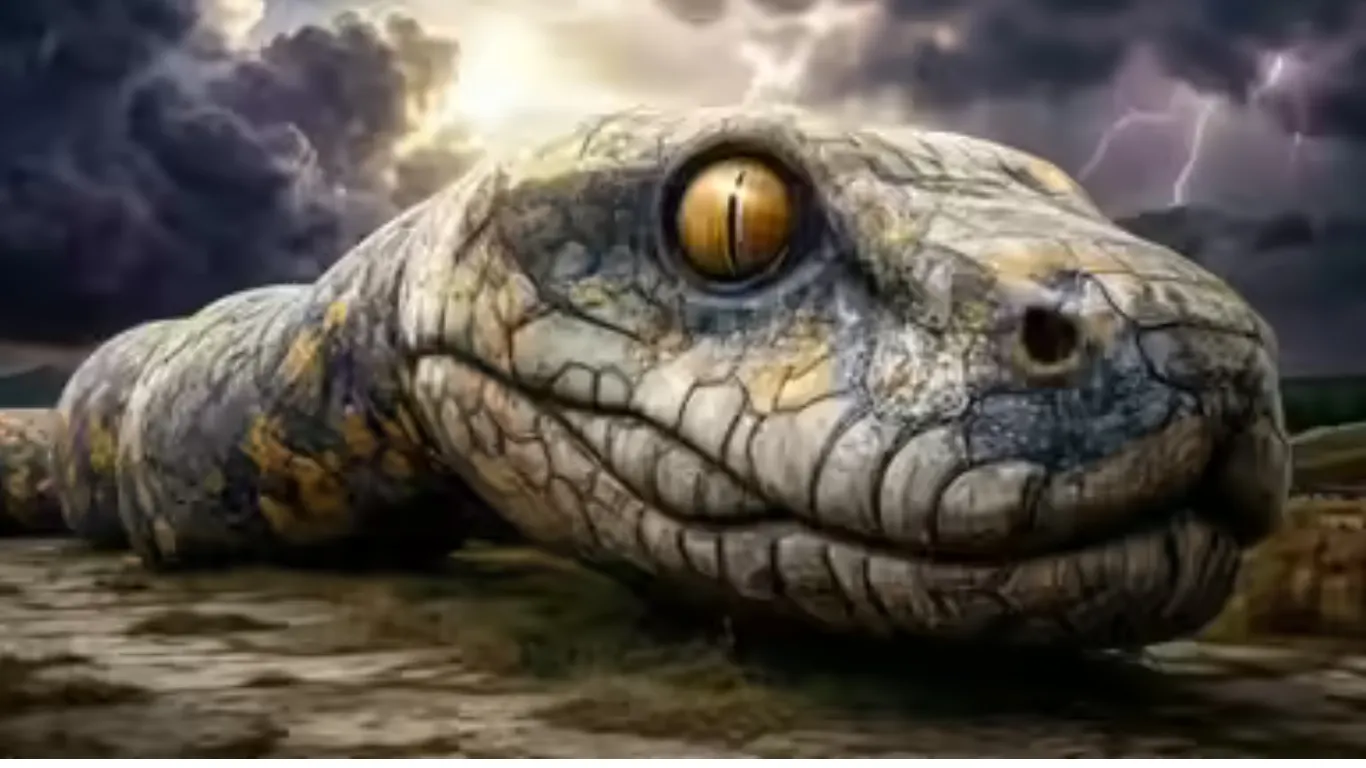
Vasuki Indicus: India’s 50-Foot Ancient Snake That Rivaled the Largest Ever
A coal mine in Gujarat just rewrote what we thought we knew about India's ancient past.
Scientists from the Indian Institute of Technology, Roorkee, have identified a new species of prehistoric snake, named Vasuki indicus, from fossilised vertebrae recovered at the Panandhro Lignite Mine in Kutch, Gujarat. The snake lived approximately 47 million years ago, during the Middle Eocene period. And it was enormous. Estimated at between 10.9 and 15.2 metres in length , that is 36 to 50 feet , it rivals what was previously considered the largest snake ever found on Earth: Titanoboa.
The study, authored by palaeontologists Debajit Datta and Sunil Bajpai, was published in the journal Scientific Reports. The name Vasuki honours the mythical serpent depicted around the neck of the Hindu deity Shiva. The species name, indicus, simply points to where it came from. India.
Why the Discovery of Vasuki Indicus Matters More Than You Think
It is easy to reduce this to a "big snake" story. It is actually something more specific than that.
Vasuki indicus is the largest known member of the extinct Madtsoiidae family , a group of snakes that existed for nearly 100 million years, from the Late Cretaceous to the Late Pleistocene. The fossil record of this family has largely come from Africa and South America. What Datta and Bajpai's research suggests is that the origin point of this family may have been India itself, during a geological period when the Indian subcontinent was still an isolated landmass drifting northward before its collision with Asia.
That is not a minor footnote. It changes the evolutionary map of large snakes on Earth. India, it turns out, was not a passive participant in the story of giant reptile evolution. It may have been the starting point.
After India collided with Asia approximately 50 million years ago, new land routes opened up. Madtsooid snakes like Vasuki's lineage appear to have used those routes to spread through southern Europe and into north Africa. The ancient world's highways were continental borders , and Vasuki's kin walked, or rather slithered, across them.
Read More: India-New Zealand Free Trade Agreement: What the Historic Deal Actually Changes for Trade, Jobs, and You
How Vasuki Indicus Was Identified From 27 Fossil Vertebrae
This is where the science gets quietly impressive. Researchers did not find a complete skeleton. They worked from 27 mostly well-preserved vertebrae, some still articulated, which means some were still connected as they would have been in the living animal.
Each vertebra measured between 37.5 and 62.7 millimetres in length, and between 62.4 and 111.4 millimetres in width. The largest single vertebra was 11 centimetres wide. These are not small bones. For reference, modern anacondas and pythons , already considered enormous by any standard , produce vertebrae far smaller than these.
From those dimensions, Datta and Bajpai used data from living snakes and known fossil records to model the animal's likely total length. The result: 10.9 to 15.2 metres. The researchers themselves note that "the body length estimates should be treated with caution", given the absence of a complete skeleton. That is the scientific honesty version of saying: yes, it could be even bigger, but we are not claiming that yet.
The body shape implied by the vertebrae , thick, cylindrical , points to a creature built more like a modern anaconda than a python. Dense, muscular, wide rather than elongated. Built for construction. Not speed.
Read More: UAE Quits OPEC Amid Iran War – Impact on Global Oil Markets & Prices
Vasuki vs Titanoboa: The Battle of the Prehistoric Giants
The natural comparison is to Titanoboa, the previous holder of the "largest snake ever" title. Titanoboa lived approximately 60 million years ago in what is now Colombia, South America, during the Palaeocene Epoch. It measured around 13 metres and weighed an estimated 1,140 kilograms. Its fossils were found in the Cerrejón coal mine, in conditions that suggest it lived in a hot, humid tropical environment.
Vasuki indicus, at an estimated 11 to 15.2 metres, sits in the same size range. At the high end of that estimate, Vasuki would be the longer of the two. At the low end, it falls just short. Which means the two species are essentially tied for the title of the largest snakes ever to exist on Earth , and given that both estimates carry uncertainty, there is no clear winner.
What distinguishes them beyond size is lineage and lifestyle. Titanoboa belonged to the Boidae family, related to modern boas. Vasuki belonged to the Madtsoiidae, an entirely different and now entirely extinct group. Titanoboa is thought to have been semi-aquatic, like a modern anaconda. Vasuki's vertebral morphology, however, suggests it was primarily terrestrial, or at most semi-aquatic , living on land and in backswamp marshes rather than rivers.
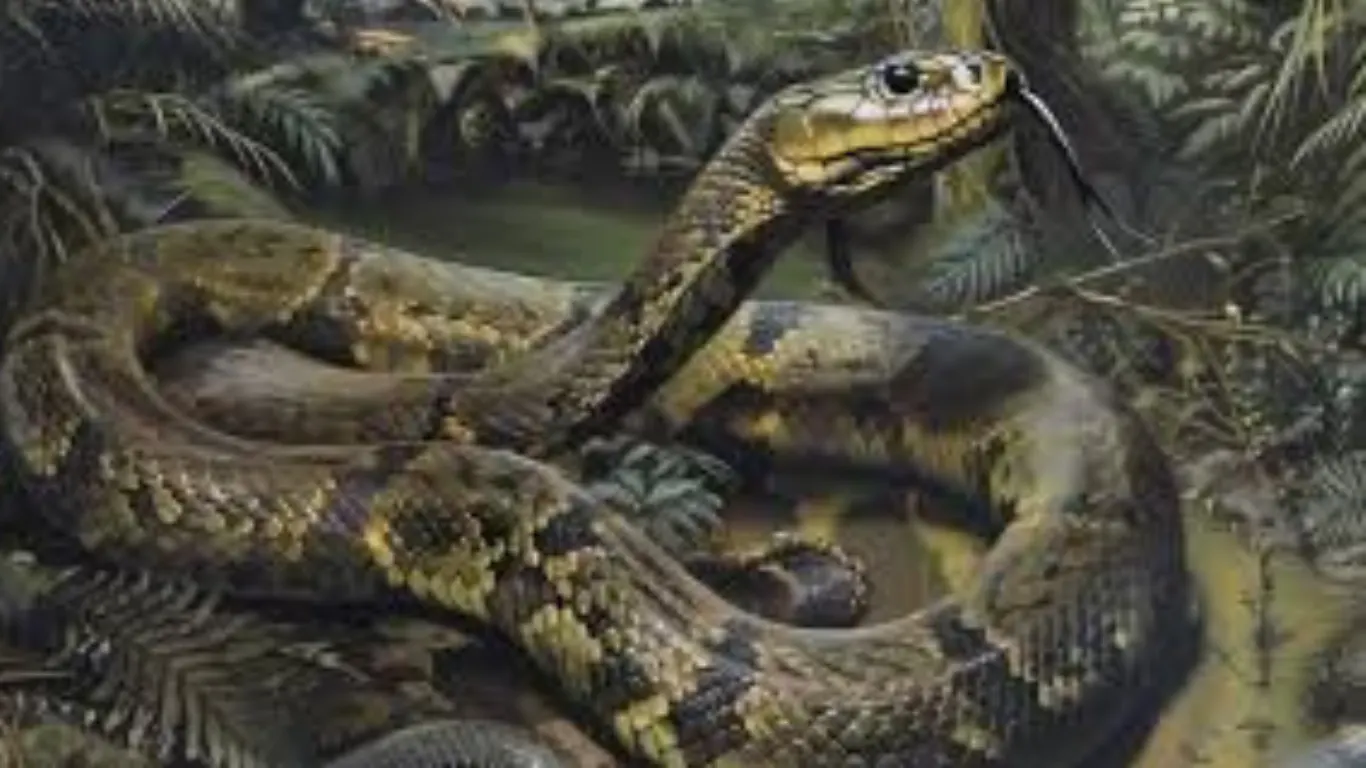
Both lived in warm, tropical climates. Both were enormous because they could be. A snake's size is, fundamentally, a function of how warm its environment is. Warmer ambient temperatures raise a cold-blooded animal's metabolic rate, allowing it to grow larger. The researchers estimated that the Middle Eocene tropics where Vasuki lived had a mean annual temperature of approximately 28 degrees Celsius. That warmth, sustained over millions of years, allowed a snake to reach the size of a school bus.
What Vasuki Indicus Ate , and What Lived Alongside It
The team cannot say with certainty what Vasuki ate. But the fossils found in the same geological layer as the snake's remains offer strong clues. Associated fauna from the Naredi Formation in Kutch includes catfish, bony fish, turtles, crocodilians, and early cetaceans , primitive ancestors of modern whales, including species like Andrewsiphius and Kutchicetus.
That is a remarkable ecosystem. A 47-million-year-old Gujarat that hosted early whales, crocodilians, and a 15-metre snake all in the same backswamp marsh. Vasuki was almost certainly an apex predator in that environment, probably using the same strategy as modern pythons: slow movement, patient ambush, and constriction to subdue prey far larger than would seem possible.
Whether it ever attacked early cetaceans or crocodilians , the researchers suggest it may have , is a question the fossil record does not yet answer directly.
Read More: Modi in Gangtok: What Sikkim's 50 Years of Statehood Really Means for India's Smallest State
The Fossil Was First Discovered in 2005, and was identified two decades later
One detail that tends to get lost in the excitement: the holotype specimen was actually discovered in 2005 at the Panandhro Lignite Mine. It took nearly two decades of study, comparison with other specimens, and a formal publication in Scientific Reports in 2024 to establish Vasuki indicus as a new genus and species.
Science at this scale moves slowly and carefully. A subsequent vertebra, found at the same location but considered potentially distinct from the holotype, raises the possibility of a second species in the same genus , or evidence of sexual dimorphism within the same species. That question remains open.
A 47-million-year-old snake fossil in a Gujarat coal mine. Twenty-seven vertebrae. Two decades of study. And a creature that may have been longer than any other snake that ever lived on this planet.
The Vasuki indicus discovery does not just add a new name to the list of prehistoric giants. It places India at the origin point of one of the most successful large snake lineages in evolutionary history. That detail tends to get overlooked in the excitement over size. It probably should not.
Disclaimer: This article is based on information available across the web. Parchar Manch does not take responsibility for its complete accuracy, as the content could not be fully verified.
FAQs
What is Vasuki indicus?
Vasuki indicus is an extinct prehistoric snake species identified by researchers from IIT Roorkee. It lived approximately 47 million years ago in the Kutch region of Gujarat, India, and is estimated to have been 11 to 15.2 metres long.
Where was Vasuki indicus found?
The fossil vertebrae were discovered at the Panandhro Lignite Mine in Kutch, Gujarat State, India. The holotype was first found in 2005 and formally described in the journal Scientific Reports.
Is Vasuki indicus bigger than Titanoboa?
At its upper estimate of 15.2 metres, Vasuki would exceed Titanoboa, which measured approximately 13 metres. At its lower estimate of 10.9 metres, it falls slightly short. Both animals are considered among the largest snakes ever discovered, and neither has a confirmed definitive size due to incomplete fossil records.
Who discovered Vasuki indicus?
The species was described by palaeontologists Debajit Datta and Sunil Bajpai from the Indian Institute of Technology, Roorkee. Their study was published in Scientific Reports.
Why is Vasuki indicus significant for India?
The discovery suggests that the Madtsoiidae family of large snakes may have originated in India, and that Vasuki's lineage spread from India to Europe and Africa after the Indian subcontinent collided with Asia around 50 million years ago. It highlights India's importance in understanding global snake evolution.
What did Vasuki indicus eat?
Researchers believe Vasuki was a slow-moving ambush predator that used constriction to subdue prey. Associated fossils from the same location include catfish, turtles, crocodilians, and early primitive whales , any of which could have been prey.