West Bengal election 2026 LIVE: Modi says Bengal phase 1 polls show 'wave of change', end to TMC's ‘maha jungle raj’| India News
West Bengal Election 2026 LIVE updates are pouring in fast. And if you have been even loosely following Indian politics, you already sense that something significant is unfolding right now in Bengal. Not just another state election. Something that feels like a turning point, or at least that is what both sides are loudly claiming.
Phase 1 of the 2026 West Bengal Assembly Election concluded on April 23, 2026. One hundred and fifty-two seats. Sixteen districts. And a voter turnout that, frankly, stopped a lot of political observers mid-sentence.
Let us get into all of it properly.
Why the WB Election 2026 Is Not Just Another State Poll
Bengal has always been its own thing in Indian politics. It has a history that runs deep, a political culture that is intensely local, and an electorate that does not follow national trends as neatly as some other states do. Since 2011, Mamata Banerjee and her Trinamool Congress have ruled the state with commanding majorities, winning again in 2021 despite intense pressure from a surging BJP.
But 2026 feels different to many observers. Fifteen years of one-party rule have a weight to it. Questions around law and order, the school recruitment scam, allegations of political violence, the R.G. Kar Medical College rape and murder case that shook the country in 2024, voter roll revisions sparking controversy, and women's safety concerns that never fully quieted down. These are not small issues. They are the kind of accumulated grievances that shift electorates.
Read More: Tim Cook to Step Down as Apple CEO: Inside Apple’s Biggest Leadership Transition in Years
So when you see a 92-plus per cent voter turnout in Phase 1, covering constituencies across North Bengal, Jangalmahal, and parts of South Bengal, you do not dismiss it. That number does not happen by accident.
What Happened on Polling Day: Phase 1 at a Glance
Phase 1 of the WB election 2026 was held on April 23, 2026. The constituencies that voted span a wide geographic and demographic range: Cooch Behar, Alipurduar, Jalpaiguri, Darjeeling, Purulia, Bankura, Jhargram, Paschim Medinipur, and others. Roughly 3.60 crore eligible voters were registered across these 152 seats.
By 1 PM, the Election Commission of India reported a turnout of 62.18 per cent. By 3 PM, that figure had already crossed 78 per cent. By the time polling wrapped up, the final number settled above 92 per cent, making it one of the highest turnouts in the state's recent electoral history.
There were incidents, of course. There always are in Bengal. Tensions in Murshidabad led to a mild lathi charge. An FIR was registered over clashes in Nowda. A Congress candidate from Berhampore constituency claimed his party agent was attacked by TMC workers. Polling personnel at booths in Pingla were suspended by the Election Commission for leaving their stations unattended. A BJP candidate from Siuri was involved in a heated altercation with a TMC worker in Birbhum.
None of this overshadowed the turnout figure. But it does confirm that Bengal's political temperature remains genuinely high.
Amit Shah's Big Claim: 'More Than 110 Seats' and a Bengal-Born CM
Here is where things got loud. After Phase 1 concluded, Union Home Minister Amit Shah held a press conference in which he made claims that are already dominating political conversations across the country.
Shah said that based on internal BJP assessments and feedback from committee members reviewed through the night, the party is confident of winning more than 110 of the 152 seats that went to the polls in Phase 1.
"After reviewing the situation with committee members last night, we estimate that the BJP will win more than 110 out of 152 seats," he said.
He framed the high turnout as a decisive rejection of Mamata Banerjee's government. His words: "Didi is on her way out, and the Bharatiya Janata Party is set to come in. Fear will go, and trust will take its place."
Then came the line that got everyone's attention. Shah said the next Chief Minister of Bengal would be someone who was born in Bengal, educated in Bengali medium, and able to speak Bengali fluently. It was a pointed message. The subtext was unmistakable. He was addressing long-standing questions about whether the BJP would install an outsider as CM if it came to power, and also took a direct swipe at Abhishek Banerjee, Mamata's nephew, whose political influence within the TMC has been a recurring point of criticism.
"The only thing is that your nephew will not be there," he added.
Who Is Samik Bhattacharya and Why His Role Matters
Before the election was announced, the BJP made a significant organisational move. Senior leader and Rajya Sabha MP Samik Bhattacharya was named the new BJP West Bengal state president in July 2025, replacing Sukanta Majumdar.
Bhattacharya is not a flashy political personality. He is the quiet, patient kind. Born in 1963, with roots in the RSS since 1971, decades spent climbing organisational ranks within the BJP machinery. He served as the party's chief spokesperson in West Bengal from 2020 to 2024, a period that included the bruising 2021 election, where the BJP ultimately fell short. He was elected to the Rajya Sabha in 2024.
Read More: Rajnath Singh Arrives in Berlin for Defence Talks — A Quiet Visit With Loud Global Signals

His appointment was widely read as the BJP bringing in someone with ideological steadiness, organisational discipline, and most crucially, deep local credibility, to lead the charge for 2026. He has been a vocal critic of what he describes as the weakening of democratic institutions in Bengal, pointing to allegations of political violence, partisan administration, and the normalisation of corruption.
In a pre-election interview, he framed the contest plainly: "In 2011, Mamata Banerjee came to power promising democratic restoration after 34 years of left rule. People voted for her with that hope. But today, institutions have weakened, the administration has become politicised, and democratic rights are under pressure."
His presence at the front of the BJP's Bengal campaign gives the party's push a grounded, recognisable face that is harder to dismiss as parachuted-in national politics.
The Anit Thapa Alliance: TMC's Strategic Play in the Hills
The 2026 West Bengal Assembly Election also saw a notable alliance come into play. Mamata Banerjee announced that the TMC would contest alongside Anit Thapa's Bharatiya Gorkha Prajatantrik Morcha (BGPM), with Banerjee predicting her alliance would cross 226 seats overall.
The Darjeeling Hills and Dooars region has historically been a volatile political terrain, with demands for a separate Gorkhaland state never fully resolved. Securing Thapa's BGPM as an alliance partner was a deliberate move by the TMC to consolidate votes in North Bengal, precisely the region where the BJP has traditionally drawn significant support.
Whether that strategy succeeded in Phase 1 is something the numbers on May 4 will reveal.
The Key Issues That Shaped This Election
To understand the WB election 2026 properly, you have to understand what voters were actually weighing.
The school recruitment scam hung over the TMC like a cloud throughout the campaign. Multiple arrests, central agency investigations, and the spectacle of court proceedings involving government appointments made for an uncomfortable backdrop for a ruling party seeking a fourth consecutive term.
The R.G. Kar Medical College rape and murder case from 2024 crystallised concerns around women's safety and institutional accountability in ways that resonated far beyond the immediate tragedy. The BJP even fielded the victim's mother as a candidate, a move the TMC called exploitative and the BJP defended as giving voice to a demand for justice.
The Special Intensive Revision (SIR) of electoral rolls became a battlefield in itself. Nearly 89 lakh names were removed under the exercise. The AITC accused the process of disenfranchising genuine voters. The BJP called it a cleanup of bogus entries and illegal migrants. Courts are still scrutinising aspects of it. Voter confusion on polling day, with some people finding their names missing despite tribunal-restored status, added a chaotic undertone to an already heated process.
Bengali asmita, identity, language, and a sense of cultural pride were also woven into campaign messaging on both sides. The TMC positioned itself as the guardian of Bengali identity against what it framed as outsider influence. The BJP countered with Amit Shah's promise of a Bengali-speaking, Bengal-born Chief Minister. Both were playing to the same emotional register, just from opposite sides.
What the Turnout Really Tells Us
A 92-plus per cent turnout is extraordinary by any measure. Even for Bengal, which has historically recorded strong participation.
Political scientists and observers are cautious about reading turnout as a simple indicator of which way votes swung. High turnout can reflect enthusiasm for the ruling party, or an energised opposition, or both simultaneously in different pockets of a diverse electorate.
What it does suggest is deep engagement. Voters did not stay home. They came out in large numbers across 16 districts and 152 constituencies. That fact alone makes whatever happens on May 4 feel consequential.
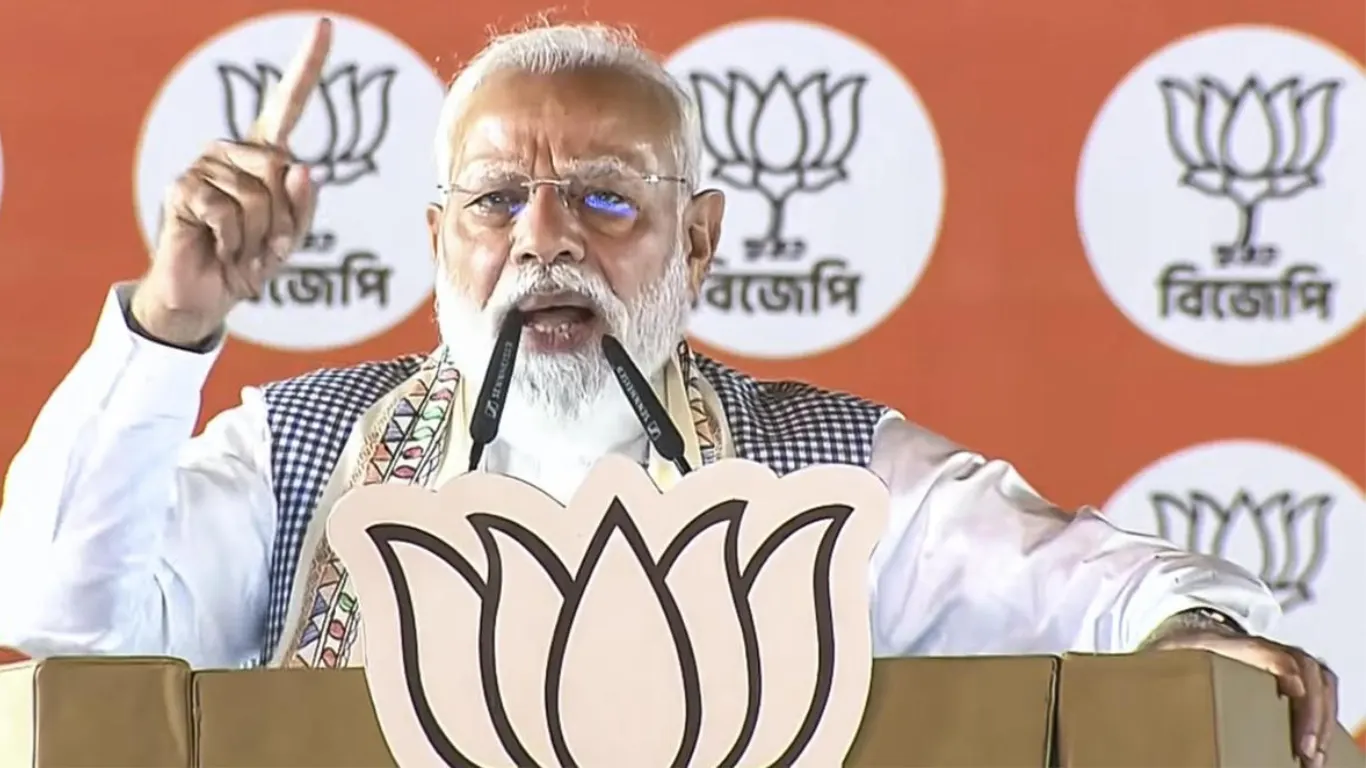
PM Narendra Modi, speaking after Phase 1, called the turnout a signal of the electorate's desire for change and framed May 4 as "TMC's expiry date."
The TMC has not conceded any ground. Mamata Banerjee's party is running on its welfare schemes, infrastructure investments, and a Bengali-first identity campaign. It is a machine with deep roots at the local level, not an organisation that folds easily under pressure.
Phase 2 votes on April 29, covering the remaining 142 constituencies. The full picture arrives only then.
Read More: ChatGPT Images 2.0 Launched: A Major Breakthrough in AI Image Generation with Perfect Text Rendering
Common Mistakes People Make When Reading Bengal Politics
One thing worth pausing on: reading Bengal politics from a purely national lens often leads to wrong conclusions.
The BJP has surged and then faced headwinds in this state before. In 2021, many analysts predicted a close contest or even a BJP win. The TMC won 215 of 294 seats. Exit polls and internal party estimates have been significantly off-mark in Bengal before.
Similarly, dismissing the BJP's momentum in 2026 simply because 2021 did not go their way would also be a mistake. The context has shifted. Anti-incumbency at the 15-year mark is real. The school scam, the R.G. Kar case, and voter roll controversies have created specific pressure points that did not exist in 2021.
Bengal is not a state where you plug in a national formula and get an accurate local answer.
What Happens Next
Phase 2 voting on April 29 covers 142 more constituencies, including urban and semi-urban areas that may carry different dynamics than the North Bengal-heavy Phase 1. Results are scheduled for May 4, 2026.
If the BJP does come close to Amit Shah's 110-plus claim from Phase 1 alone, the final seat count could tell a very different story than 2021. If the TMC holds North Bengal better than expected and sweeps Phase 2, Mamata Banerjee will be looking at a fourth term.
The only certain thing right now is that the wait for May 4 is going to feel long.
Disclaimer: This article is based on information available across the web. Parchar Manch does not take responsibility for its complete accuracy, as the content could not be fully verified.
FAQs
When will the West Bengal Election 2026 results be declared?
Vote counting is scheduled for May 4, 2026. That is when both Phase 1 (April 23) and Phase 2 (April 29) results will be declared together.
How many seats are there in the West Bengal Assembly?
The West Bengal Legislative Assembly has a total of 294 seats. Phase 1 covered 152 seats across 16 districts. Phase 2 will cover the remaining 142 seats.
Who is Samik Bhattacharya and what is his role in the BJP's 2026 campaign?
Samik Bhattacharya is the state president of the BJP in West Bengal, a position he took over in July 2025. He is also a Rajya Sabha MP from West Bengal. He has been the face of the party's organisational campaign ahead of the 2026 assembly elections and is known for his oratory skills and deep roots in party structures.
What did Amit Shah mean by 'Bengal-born CM'?
Shah's statement at a post-Phase 1 press conference was a commitment that if the BJP wins, the Chief Minister of West Bengal will be someone born in Bengal, educated in Bengali medium, and fluent in Bengali. It was also a pointed jab at Abhishek Banerjee, Mamata's nephew, suggesting that TMC's dynastic politics would end.
What is the TMC's alliance arrangement for the 2026 elections?
Mamata Banerjee's Trinamool Congress has allied with Anit Thapa's Bharatiya Gorkha Prajatantrik Morcha (BGPM) for the hill constituencies. The BGPM contested three seats under this arrangement. Banerjee predicted her alliance would win over 226 seats in total.
Why was the voter turnout in Phase 1 considered significant?
The turnout in Phase 1 crossed 92 per cent across 152 constituencies, covering about 3.60 crore eligible voters. This was described as one of the highest turnouts in the state's recent electoral history and was cited by both sides as evidence of voter intent, though interpretations of what it signals differ sharply.