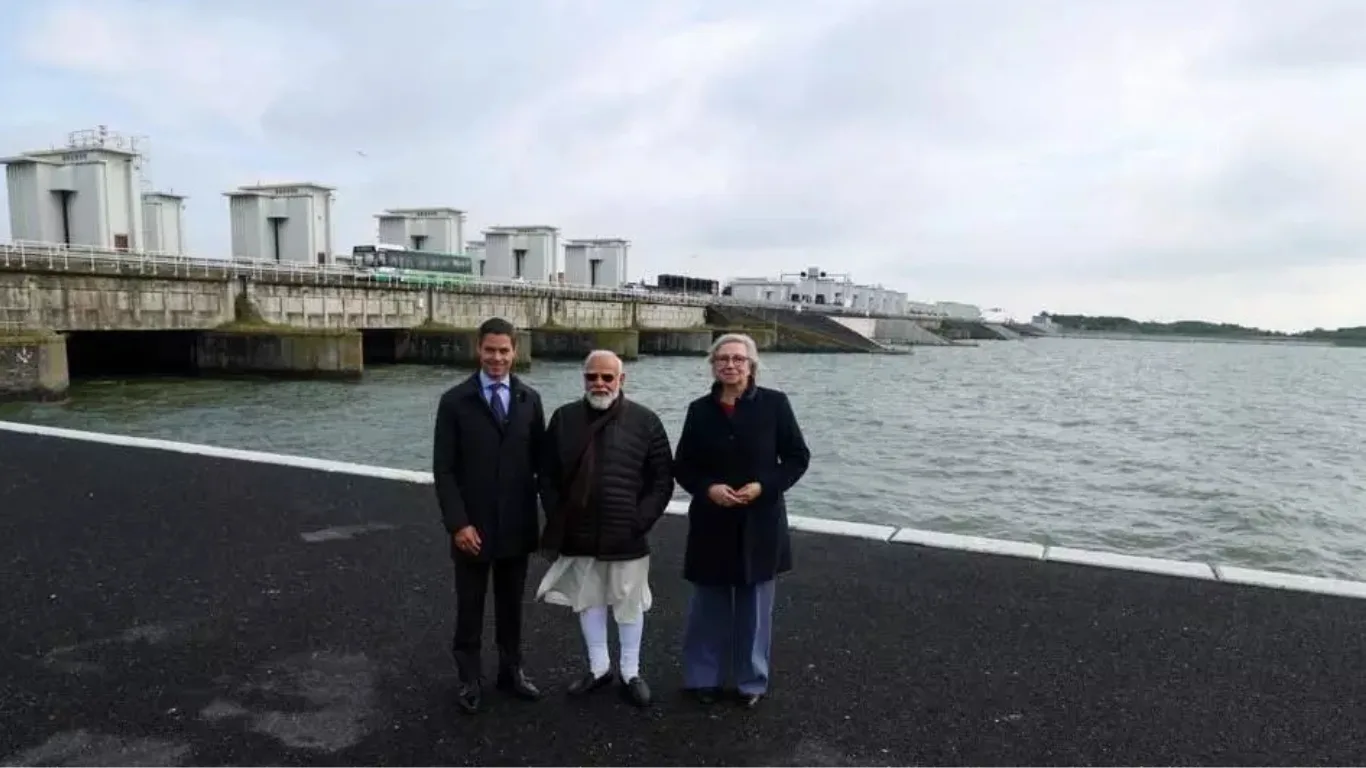
Why PM Modi Visited the Afsluitdijk Dam in the Netherlands , and What It Means for India's Water Future
PM Modi's visit to the Afsluitdijk Dam was not a routine diplomatic photo-stop. When a Prime Minister personally walks the length of a 32-kilometre dam in a foreign country and publicly praises it as something the entire world should study, that is worth paying attention to.
Something is being signalled. And it connects directly to one of the most ambitious, most delayed, and most consequential infrastructure projects India has quietly been planning for decades.
The Dam That Made a Country Stop Drowning
The Afsluitdijk , pronounced roughly as "af-sloyt-dike" , is a barrier dam in the Netherlands that separates the North Sea from a large inland freshwater lake called the IJsselmeer. Built roughly 80 years ago, the 32-kilometre-long structure shields low-lying Dutch regions from severe sea flooding while enabling freshwater storage, inland transport, navigation, and renewable energy generation.
The Netherlands is a country where large portions of land sit below sea level. Without engineering like this, significant parts of it would simply not exist in any livable form. The Dutch did not adapt to water. They redesigned their relationship with it entirely.
Dutch authorities are currently upgrading the system through what they call the "Afsluitdijk 2.0" modernisation project, estimated at nearly 800 million euros. So this is not a relic being preserved. It is an evolving system being made more powerful.
What Modi Said , and Why It Was Not Just Diplomacy
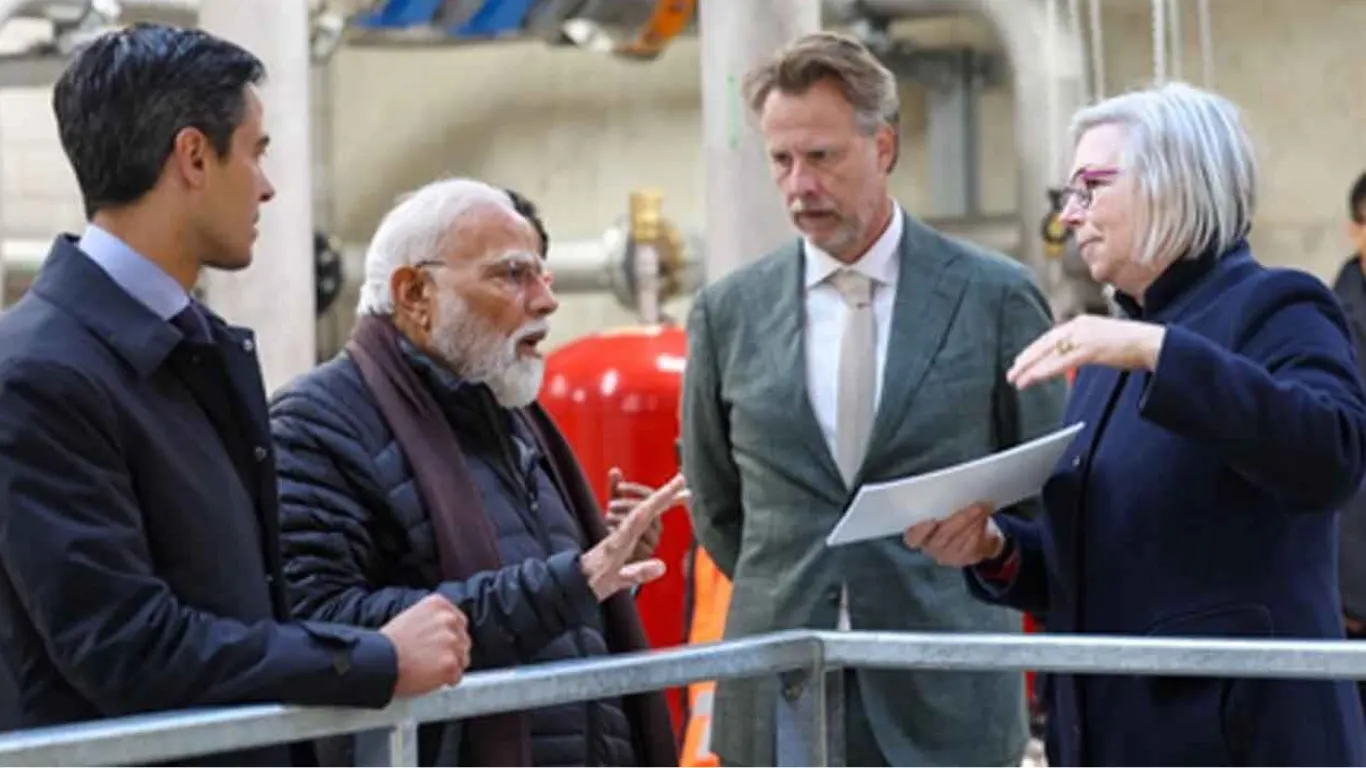
Accompanied by Dutch Prime Minister Rob Jetten, Modi visited the dam and said the Netherlands has done groundbreaking work in water management, and that the entire international community can learn a great deal from this. He added that India is committed to bringing modern technology for irrigation, flood protection, and expanding the inland waterway network.
The two sides also welcomed the signing of a Letter of Intent between India's Ministry of Jal Shakti and the Netherlands' Ministry of Infrastructure and Water Management for technical cooperation on India's Kalpasar Project. That last part is the real story.
India's Own Afsluitdijk , The Kalpasar Project
The Kalpasar Project is Gujarat's proposal to build a dam across the Gulf of Khambhat , an inlet of the Arabian Sea that separates the Saurashtra peninsula from mainland Gujarat. The project envisions a 30-kilometre sea dam with the capacity to store 10 billion cubic metres of freshwater, equalling roughly 25 percent of Gujarat's average annual rainwater flow, collected from rivers including the Narmada, Mahi, Dhadhar, and Sabarmati.
It would also include a 10-lane road link over the dam, reducing travel distance between Saurashtra and South Gujarat, alongside plans for tidal power generation, fisheries development, and improved regional connectivity.
The scale is staggering. Gujarat is a water-deficient state. It covers 6.4 percent of India's land area and holds 5 percent of the population, but controls only 2 percent of the country's surface water resources. The per capita water availability in the state falls well below what is considered the minimum threshold.
More than 30,000 million cubic metres of water from the Narmada river alone flows into the sea every year due to insufficient storage capacity. Kalpasar, if it ever reaches completion, would be one answer to that loss.
Why the Dutch Connection Makes Sense
The parallels between the Afsluitdijk and Kalpasar are not superficial. Both involve closing off a large marine inlet with a dam. Both aim to convert saltwater geography into usable freshwater storage. Both serve multiple purposes at once , transport, power, irrigation, flood control.
Dutch expertise in hydraulic engineering and India's scale of implementation present opportunities for mutually beneficial partnerships, the two leaders noted. The Dutch have spent nearly a century learning how to build and maintain exactly the kind of structure India now wants to construct. That knowledge transfer has real value.
The visit also reaffirms the India-Netherlands Strategic Partnership on Water, reflecting a shared commitment to innovation and sustainability.
The Honest Reality: Kalpasar Is Still Not Built
Here is where the story gets complicated. As of 2023, core feasibility studies for Kalpasar remained incomplete, with the Gujarat government unable to confirm the project's viability despite decades of planning and over 216 crore rupees expended on investigations by 2022.
The project was first conceptualised in the 1980s. It has moved through multiple redesigns, environmental reviews, and budgetary revisions. As of recent reports, it remains in the detailed project report and environmental clearance stage. Full-scale construction has not begun.
That context matters. Modi's Netherlands visit and the Letter of Intent signal renewed political will. Whether that translates into groundbreaking on the Gulf of Khambhat is a separate question entirely.
Read More: Google's REPLIQA Program: How Quantum AI and Life Sciences Are About to Change Medicine Forever
What India Could Actually Learn From the Dutch
The Afsluitdijk works not just because it was built, but because it was built right and then continuously maintained and modernised. The Dutch approach to flood management, coastal infrastructure, and freshwater reservoir design is rooted in decades of failure, correction, and institutional patience.
India's challenge with Kalpasar is not primarily a technology challenge. It is an implementation, coordination, and environmental-assessment challenge. Dutch expertise could genuinely help on the technical side. But the harder work , political continuity, regulatory clearance, ecological sensitivity , remains entirely India's to manage.
The visit was meaningful. The signal is clear. The real question is whether this particular diplomatic moment accelerates something that has been moving very slowly for a very long time.
Closing Thought
There is something quietly fascinating about a sitting Prime Minister standing on a dam in northern Europe and seeing, quite literally, a version of what his country is trying to build. The Afsluitdijk works. It has worked for decades. It is getting better.
Kalpasar could be transformative for millions of people in Gujarat who face real water scarcity every year. The Dutch model is not just inspirational , it is potentially instructional, if the political and institutional will holds long enough to actually use what is being learned.
Disclaimer: This article is based on information available across the web. Parchar Manch does not take responsibility for its complete accuracy, as the content could not be fully verified.
FAQs
What is the Afsluitdijk Dam and where is it located?
The Afsluitdijk is a 32-kilometre-long barrier dam in the Netherlands that separates the North Sea from the IJsselmeer freshwater lake. It serves multiple functions including flood protection, freshwater storage, transport, and renewable energy generation.
Why did PM Modi visit the Afsluitdijk Dam?
PM Modi visited the dam accompanied by Dutch PM Rob Jetten to explore Dutch water management expertise and its relevance for India's Kalpasar Project in Gujarat, and to strengthen cooperation on flood control, irrigation, and inland waterways.
What is India's Kalpasar Project?
The Kalpasar Project proposes building a 30-kilometre dam across the Gulf of Khambhat in Gujarat to create a massive freshwater reservoir, store water from rivers including the Narmada and Mahi, generate tidal power, and improve regional transport connectivity.
What was the formal outcome of the Modi-Netherlands dam visit?
Both countries signed a Letter of Intent between India's Ministry of Jal Shakti and the Netherlands' Ministry of Infrastructure and Water Management for technical cooperation on the Kalpasar Project.
How much will the Kalpasar Project cost?
The estimated cost of the project is projected at over 90,000 crore rupees, covering dam construction, water canals, power generation facilities, and environmental management.