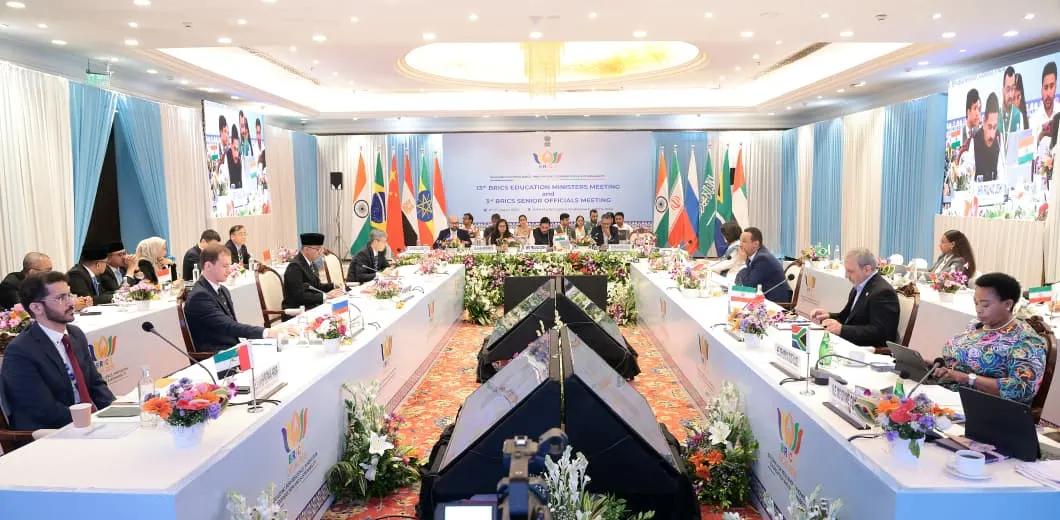
India Chairs the 13th BRICS Education Ministers Meeting, and the Declaration That Came Out of It
Eight countries, one shared classroom problem, and a city in Odisha that most of the world doesn't usually associate with global diplomacy. That's roughly the scene in Bhubaneswar this week, where the BRICS Education Ministers Meeting brought together delegates from Brazil, Russia, China, South Africa, Indonesia, Iran, Ethiopia, and the UAE, all under India's chairship for 2026. Union Education Minister Pralhad Joshi led the proceedings, and what emerged wasn't just another diplomatic photo opportunity. It was a genuine attempt to coordinate education policy across countries that rarely agree on much else.
Let's actually walk through what happened, and why it matters beyond the ministerial handshakes.
Why Bhubaneswar, and Why This Particular Week
India holds the BRICS chairship for 2026, which means it gets to set priorities and host the year's key meetings across every sector, education included. Joshi arrived in Bhubaneswar on Thursday, received by Odisha's own ministers, Industries Minister Sampad Swain and Higher Education Minister Suryabanshi Suraj, before the formal ministerial meeting on Friday. The choice of Bhubaneswar itself signals something, India using its chairship to showcase a growing city beyond the usual Delhi or Mumbai diplomatic circuit.
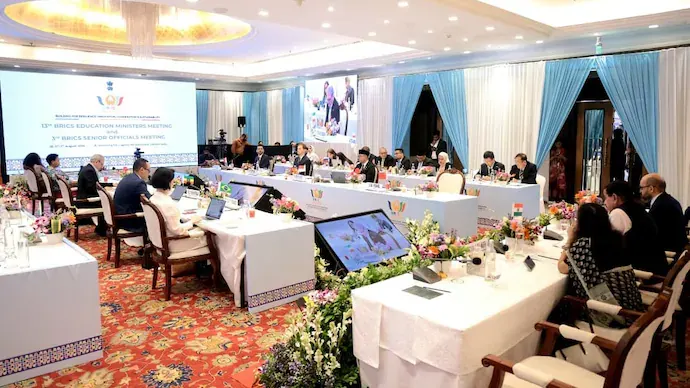
This wasn't a standalone event either. The Ministry of Education had already hosted the 3rd BRICS Senior Officials Meeting two days earlier, on August 5, laying the groundwork so ministers arriving Friday wouldn't be starting negotiations from scratch.
The Five Priorities That Actually Got Discussed
Here's where the substance lives, because vague diplomatic language often hides genuinely specific commitments underneath.
- Early Childhood Care and Education, sometimes shortened to ECCE, focused on standardizing quality expectations for the youngest learners across vastly different national systems.
- Technical and Vocational Education and Training, aimed at making skill based education more portable and recognized across BRICS economies.
- Collaborative research and innovation, essentially finding ways for universities and research institutions in member countries to work together more easily.
- Mutual recognition of academic qualifications, a genuinely thorny issue, since a degree earned in Brazil doesn't automatically carry weight in Ethiopia or vice versa.
- Academic leadership and traditional knowledge systems, including BRICS' own guiding principles on indigenous knowledge, an area India has pushed hard given its own emphasis on traditional education models.
Notice how technical this list actually is. This wasn't ceremonial diplomacy, it was working level negotiation over frameworks that could genuinely change how students and researchers move between these countries.
How the Senior Officials Meeting Set the Stage
Understanding the sequence here matters. The 3rd BRICS Senior Officials Meeting on August 5 wasn't just a warm up act, it did the heavy lifting. Officials from all member countries reviewed the proposed text of what would become the BRICS Education Ministers Declaration, exchanging suggestions and working through disagreements before ministers arrived. By the time Friday's ministerial session began, the senior officials meeting had already concluded with a finalized proposed text ready for ministerial endorsement.
That's how most multilateral declarations actually get built, not through ministers negotiating line by line in real time, but through months of prior groundwork culminating in a signature moment everyone can point to.
A Side Conversation That Revealed Something Bigger
Away from the main proceedings, Joshi held a bilateral meeting with Iran's Acting Minister of Science, Research and Technology, Masood Shams-Bakhsh. The two discussed strengthening institutional linkages between India and Iran, framed explicitly around what officials called their countries' longstanding civilisational ties. Digital education came up too, both sides emphasizing how online learning tools could improve knowledge sharing between the two nations.
This kind of sidebar meeting rarely makes headlines, but it's often where the most concrete bilateral progress actually happens, away from the choreographed multilateral statements.
What This Actually Means If You're Not a Diplomat
If you're a student, researcher, or educator, and none of this feels immediately relevant, here's the practical angle. Agreements on mutual recognition of qualifications could eventually mean an Indian degree carries more automatic weight when you apply to study or work in another BRICS country, and vice versa. Progress on vocational training standards could mean skill certifications earned in one member country get recognized faster elsewhere. These outcomes take years to fully materialize, but this week's meeting is where that groundwork gets laid.
The Challenge No Declaration Can Fully Solve
Here's the honest complication worth naming. Eight countries with wildly different education systems, funding levels, and political priorities agreeing on a shared declaration doesn't automatically mean implementation follows smoothly at the national level. India can commit to mutual qualification recognition on paper, but actually updating domestic accreditation processes to match takes bureaucratic will that outlasts any single ministerial meeting. Declarations set direction, they don't guarantee delivery.
Where BRICS Education Cooperation Goes From Here
Watch for how India, as chair, follows up on this declaration once the ministerial meeting concludes, since chairship countries typically bear responsibility for tracking implementation through the rest of their term. Also worth watching, whether the India-Iran education discussions translate into any concrete bilateral agreement beyond this week's meeting, since that kind of follow through often separates genuine cooperation from diplomatic pleasantries.
A Meeting That Quietly Shapes How Millions of Students Move
Multilateral education summits rarely generate dramatic headlines, no breaking news alerts, no viral moments. But the BRICS Education Ministers Meeting in Bhubaneswar this week is exactly the kind of unglamorous groundwork that eventually determines whether a student's qualifications travel with them across borders, whether research collaboration happens smoothly, and whether the next generation across these eight countries gets educated in systems that talk to each other instead of past each other.
FAQs
Which countries participated in the 13th BRICS Education Ministers Meeting?
Brazil, Russia, India, China, South Africa, Indonesia, Iran, Ethiopia, and the UAE, with India chairing under its 2026 BRICS presidency.
Who led India's delegation?
Union Education Minister Pralhad Joshi led the Indian delegation and chaired the proceedings.
What topics did the meeting focus on?
Early Childhood Care and Education, skill development, research and innovation, mutual recognition of qualifications, and academic leadership.
What is the BRICS Education Ministers Declaration?
A joint statement outlining shared education priorities and commitments among member countries, finalized through prior senior officials meetings before ministerial endorsement.
Did any bilateral meetings happen alongside the main summit?
Yes. Pralhad Joshi held a bilateral discussion with Iran's Acting Science Minister on strengthening academic and research ties between the two countries.
Why is this meeting significant for India specifically?
It reflects India's 2026 BRICS chairship, giving the country a leading role in shaping multilateral education cooperation priorities for the year.