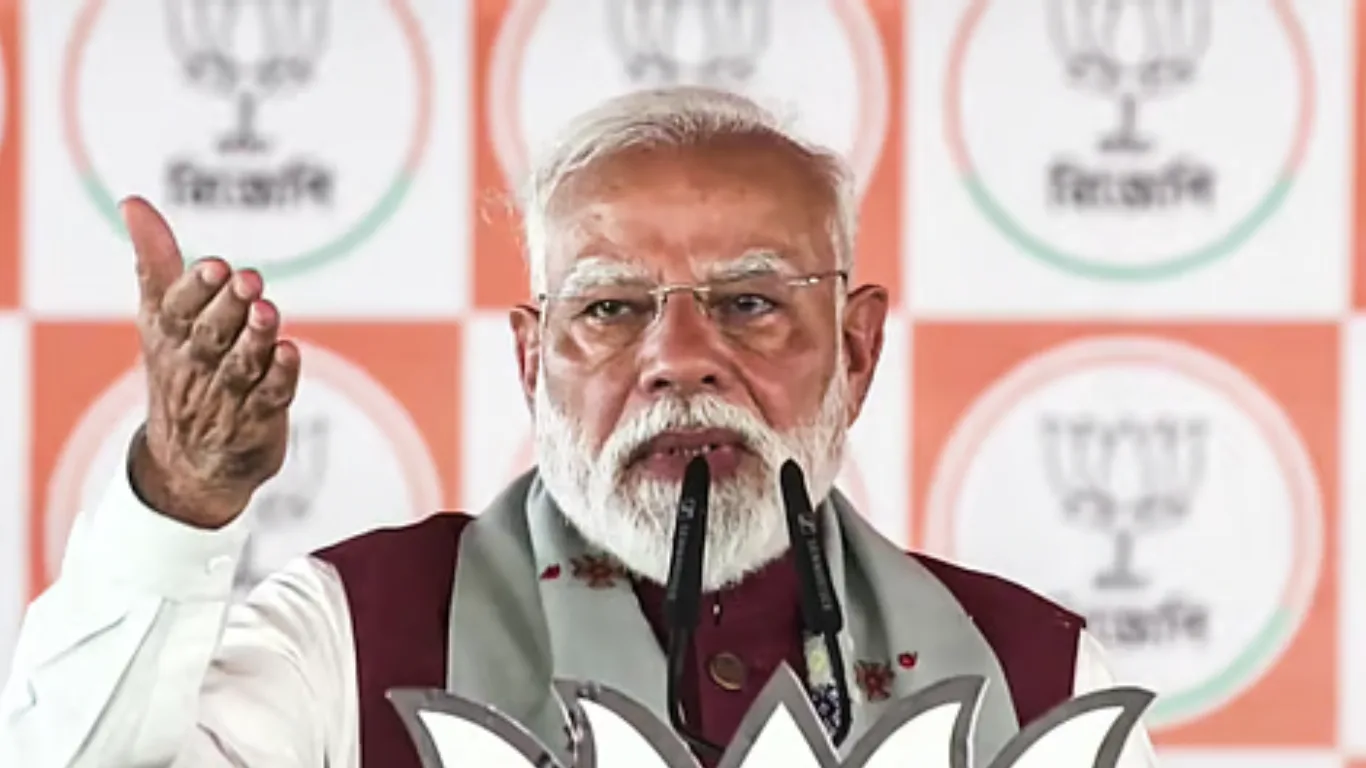
West Bengal Election 2026: How a Bowl of Jhaal Muri Became the Hottest Political Debate Between Modi and Mamata
PM Modi jhaal muri moment from a roadside stall in Jhargram has done something extraordinary in the middle of a fiercely contested election it turned a humble Bengali street snack into the most talked-about political symbol of the West Bengal Assembly election 2026. A bowl of puffed rice, mustard oil, green chillies, and spices. That is what this fight is really about now, at least on the surface.
But of course, it never is just about the food.
Why a Street Snack Is Shaking Up the West Bengal Assembly Election 2026
West Bengal goes to the polls in two phases April 23 and April 29, 2026 with results expected on May 4. And while the real issues are serious voter list deletions, unemployment, central funds, border security the campaign has taken an unexpected detour into something far more personal: what Bengalis eat, and who truly understands them.
Bengali cultural identity has always been a quiet but powerful undercurrent in the state's politics. Language, literature, music, food these are not decorative aspects of Bengali life. They are the backbone of it. And in an election where the Trinamool Congress (TMC) under Chief Minister Mamata Banerjee is seeking a fourth consecutive term, and the BJP is mounting its most aggressive challenge yet, both sides have chosen food as the arena.
The jhaal muri episode sits right at the centre of that arena.
What Happened at That Jhargram Roadside Stall
On a Sunday during the campaign period, Prime Minister Narendra Modi made what was described as an "unscheduled stop" in Jhargram, West Bengal. He stepped out, walked up to a jhaal muri vendor, and bought a cone of the snack. Cameras captured the moment. It spread quickly.
Mamata Banerjee was not impressed or at least she made sure everyone knew she wasn't. Speaking at a rally in Murarai, Birbhum district, the following day, she called the whole episode a scripted performance.
"It's all drama," she said. "How come a camera was present when the Prime Minister suddenly made an unscheduled stop during the campaign? The entire episode was scripted. He was seen carrying a Rs 10 note in his pocket. Is it believable?"
She went further. She alleged that the SPG had prepared the jhaal muri in advance, that a microphone had been installed inside the shop, and that the spontaneity of the moment was entirely manufactured. "Had it been a spontaneous act, then how were cameras fitted inside the shop?" she asked.
Modi did not let that go unanswered. At a rally in Krishnanagar ahead of Phase 2 voting, he delivered what has since become one of the most quoted lines of this election season: "Jhalmuri maine khayi, lekin jhal TMC ko lag gayi." Translated: I ate the jhaal muri, but the spice hit TMC.
The crowd loved it. And the line did what good political lines always do it stuck.
The Bigger Picture: Food, Identity, and the Battle for Bengali Pride
To understand why this episode landed the way it did, you need to understand what food means in West Bengal especially maach (fish), muri (puffed rice), and the street food culture that is woven into everyday Bengali life.
Jhaal muri is not fancy. It is not a restaurant item. It is what you eat standing at a stall, wrapped in a newspaper cone, watching the road. It is deeply democratic food the kind that cuts across class, caste, and religion. That is precisely why it is politically potent.
The TMC's campaign narrative has leaned heavily on a specific fear: that a BJP government in Bengal would impose a north-centric, vegetarian cultural framework on a state that has always been proudly non-vegetarian. Mamata Banerjee has repeatedly warned voters that the BJP would "ban fish, meat, and even eggs." The BJP has rejected these allegations at every turn.
But the TMC has pointed to real incidents meat bans in BJP-ruled states like Bihar, Rajasthan, and Uttar Pradesh to back up its claims. Mamata herself, at a rally in Haldia, challenged Modi's promises about improving fish production in Bengal: "They themselves do not allow fish in Bihar, UP, Rajasthan. In Delhi, shops selling fish and meat are attacked. You do not let people speak in Bengali are you not ashamed of it? And then you come to teach us a lesson on fish production."
It is sharp. And it is calculated.
The BJP Pushes Back: Fish in Hand, Cameras Rolling
The BJP is not sitting quietly through any of this. Understanding that its image as a north-centric, Hindu nationalist party is a liability in Bengal, it has gone out of its way to prove otherwise.
BJP candidates were photographed holding large catla fish during campaigning. Sharadwat Mukherjee, a first-time BJP candidate contesting from Bidhannagar, was seen canvassing with a jumbo-sized catla in hand almost certainly the most photogenic campaign prop of this election season. BJP MP Anurag Thakur was photographed eating fish in Bengal.

PM Modi himself talked about fish in campaign speeches, promising to make West Bengal self-sufficient in fish production, arguing that the state was currently relying too heavily on imports. He accused the TMC government of not cooperating with the Centre on improving the fisheries sector.
What the BJP is doing here is deliberate image correction. As political analyst Biswanath Chakraborty told Al Jazeera, Mamata Banerjee has been "the champion" of constructing campaign narratives around food and Bengali identity. And by aggressively pushing back with fish and jhaal muri moments of their own, the BJP may have inadvertently helped keep that very narrative front and centre.
A social activist named Banojyotsna Lahiri put it plainly: "In Bengal, they have suddenly realised that they appear as aliens with their vegetarian posturing because both fish and meat are integral to the Bengal culinary choices, caste or religion notwithstanding."
Read More: Rajnath Singh Arrives in Berlin for Defence Talks — A Quiet Visit With Loud Global Signals
What the Jhaal Muri Moment Really Reveals About This Election
Strip away the humour and the one-liners, and the Mamata Modi jhaal muri debate tells you something quite serious about how Indian elections work.
Cultural signalling matters. Voters, especially those with a deep sense of regional identity, watch for whether national leaders actually understand their lives, not just their policy problems. Eating jhaal muri at a roadside stall is Modi trying to say: I am not alien to you. I know your streets, your snacks, your daily rhythms. Whether you believe that or not depends on where you already stand politically.
Authenticity is impossible to verify, but it is deeply felt. Mamata's attack on the episode as "staged drama" is effective precisely because it confirms what many TMC voters already suspect. And Modi's witty comeback "the spice hit TMC, not me" works because his supporters see the entire controversy as evidence that his gesture bothered Mamata enough to respond.
Both sides are winning, in their own echo chambers.
The Real Contest Behind the Cultural Noise
Amid all the Bengali food politics and street-snack theatre, the actual election involves hard stakes.
The BJP won 77 seats in the 2021 elections. It is trying to significantly improve on that possibly even to unseat Mamata Banerjee, who won a commanding 215 of 294 seats last time and appears to be seeking a fourth consecutive term.
The campaign has been marked by a deeply controversial Special Intensive Revision (SIR) of electoral rolls, which removed around 9 million voters from the rolls roughly 12 per cent of the electorate. Mamata has been vocal in her condemnation of this process. There have also been allegations of voter intimidation, clashes in Murshidabad, and significant central force deployment across the state.
The TMC, meanwhile, has relied on its welfare delivery record schemes targeting women, farmers, and the poor as its primary pitch. Mamata's popularity on the ground remains real, even if anti-incumbency after 15 years is a factor the party cannot ignore.
The fish and the jhaal muri are sideshows. But they are sideshows that do real political work mobilising identity, making national leaders seem either relatable or out of touch, and giving the media something to cover that isn't just grim.
How Voters Actually See This
Voters in West Bengal are not one thing. The Bengali electorate is urban and rural, educated and not, deeply political and entirely fed up with politics. Most of them know that food is not an election issue in the literal sense. BJP candidates holding catla fish and Modi eating jhaal muri will not fix roads or create jobs.
But identity still matters. If a voter feels that a party fundamentally misunderstands who they are their language, their culture, their food, their daily life that is a reason not to vote for them. And that is exactly the gap that Mamata has spent years building into the BJP's image in Bengal.
The BJP's strategy of cultural recalibration eat fish, eat jhaal muri, talk about fisheries is an attempt to close that gap. Whether it works will only become clear on May 4.
Closing Thoughts: When Snacks Carry the Weight of an Election
There is something almost philosophical about the fact that a bowl of puffed rice, spiced mustard oil, and green chillies has become a flashpoint in one of India's most important state elections.
But maybe that is not so strange. Politics, at its most effective, is not about abstract policies it is about whether people feel seen. And food, more than almost anything else, is about belonging.
Modi, eating jhaal muri, says: I see you. Mamata, calling it staged, says: He doesn't. And somewhere between those two positions, about 68 million voters in West Bengal will decide who they believe.
The spice, as they say, has landed. The question is where.
Read More: Tim Cook to Step Down as Apple CEO: Inside Apple’s Biggest Leadership Transition in Years
FAQs
What is jhaal muri, and why is it significant in the West Bengal election 2026?
Jhaal muri is a popular Bengali street food made of puffed rice (muri), mustard oil, green chillies, spices, and vegetables, typically served in a paper cone at roadside stalls. It became politically significant when PM Modi made an unscheduled stop to eat jhaal muri during his campaign in Jhargram, which TMC called "staged drama" and Modi turned into a political punchline.
What did Mamata Banerjee say about PM Modi's jhaal muri moment?
Mamata Banerjee called the episode entirely scripted, questioning how cameras were already present for an "unscheduled" stop. She alleged that the SPG had prepared the jhaal muri in advance and that a microphone was installed in the shop. She said PM Modi was seen carrying a Rs 10 note, and asked if that was believable.
What is PM Modi's famous one-liner about jhaal muri?
At a Krishnanagar rally, Modi said, "Jhalmuri maine khayi, lekin jhal TMC ko lag gayi" — meaning "I ate the jhaal muri, but the spice hit TMC." He used this to mock the TMC's strong reaction to what he framed as a simple, friendly gesture.
Why is food such a big issue in the West Bengal Assembly election 2026?
The TMC has built a campaign narrative around the fear that a BJP government would impose vegetarianism and restrict fish and meat a threat to Bengali cultural identity. BJP has responded by campaigning with fish and eating local food to counter this image. Food has become a proxy war for questions about cultural belonging and who really understands Bengal.
What are the actual issues in the West Bengal election 2026?
Beyond food and cultural politics, the election is shaped by disputes over voter list deletions under the SIR process (which removed around 9 million voters), allegations of central fund deprivation, border security, employment, women's safety, and anti-incumbency against 15 years of TMC rule. The BJP won 77 seats in 2021 and is pushing hard for a significantly stronger showing.
When are the West Bengal election 2026 results?
The West Bengal Assembly election 2026 is being held in two phases April 23 and April 29, 2026. Vote counting and results are scheduled for May 4, 2026.