What Is Delimitation of Constituencies? Meaning, Process and Its Impact Explained
Constituency appears to be an easy space on an electoral map. However, behind every boundary lies an intricate constitutional process that includes the representation of people, population and balance of power. What is the definition of delimitation? In simple words, it's the process of defining or drawing boundaries for electoral districts so that their representation of voters is more accurate and reflects demographic patterns.
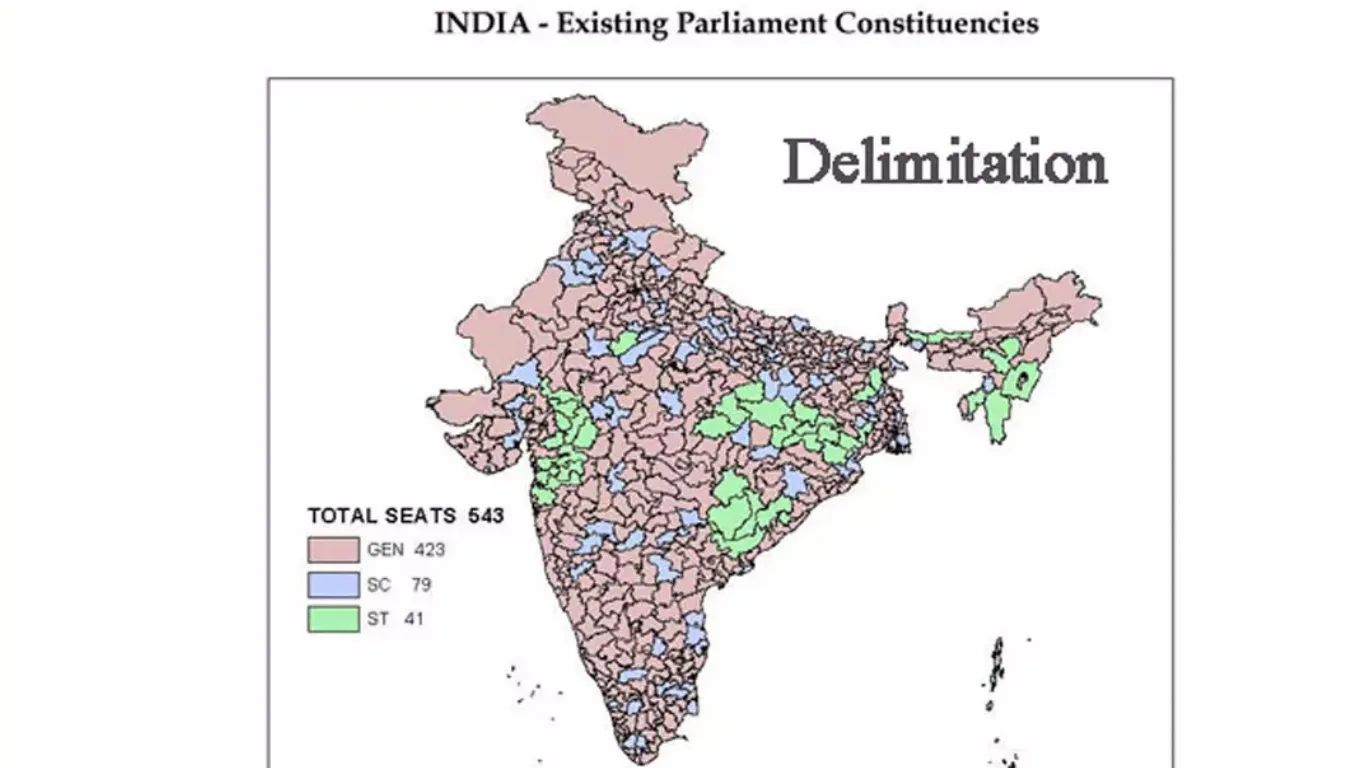
In India, this procedure is tightly linked to the Constitution as well as census data and the laws of Parliament. In India, the Election Commission says the present electoral districts were defined by the 2001 Census as per the Delimitation Act, 2002.
What Is Delimitation of Constituencies and Why Does It Matter?
To better understand the definition of constituencies, consider the size of a school, divided into classes. If the student population increases, retaining the same divisions in each classroom may not be a good idea. Elections also face a similar issue.
Population changes over decades. Villages expand, cities grow, and the flow of people changes communities. Delimitation aims to create communities that are balanced in terms of population, while still respecting the boundaries of geography and administrative borders.
This is the reason the redrawing of a constituency is important. It may alter which towns, villages or urban neighbourhoods are part of a specific constituency. It could also affect the reserved constituencies of Scheduled Castes and Scheduled Tribes.
The main issue is representation. A major session of the Parliament on seat redistribution will determine which States will be represented in the Lok Sabha following the readjustment freeze in the Constitution being lifted.
What Is Delimitation of Constituencies Under Indian Law?
What is the legal delimitation of constituencies? Article 82 of the Constitution allows the possibility of readjusting every census, through the law of Parliament. Parliament sets the legal framework with the Delimitation Act.
The delimitation commission of India is established once the applicable law enters into effect. According to the Delimitation Act, 2002, the Commission comprises a Supreme Court judge or former judge as Chairperson, the Chief Election Commissioner or Election Commissioner who has been nominated, and the State Election Commissioner.
The most important thing to remember is that delimitation is not just an Election Commission casually changing an electoral map. It is a legally-defined procedure.
How Does Constituency Boundary Redrawing Work?
The procedure may appear complex; however, the fundamental process is easy to understand.
First, census information pertinent to the population is made available. The main factor is population, as representation is a function of changes in demographics.
Then, the Parliament creates the legal foundation for the exercise by enacting the appropriate legislation on delimitation. A commission to define boundaries in India can then be established.
The Commission looks at population numbers as well as geographical considerations. Constituencies are usually assumed to be compact geographically; in comparison, physical characteristics, administrative boundaries, communication facilities, and public conveniences are taken into consideration.
Proposals are published. This is crucial since delimitation isn't supposed to take place in a closed-door setting. The opposition and suggestions could be requested, and public hearings can be part of the procedure.
After examining submissions, the Commission issues its final order. They are legally binding as per the law in force.
This is at the root of the redrawing of boundaries for constituencies.
Must read: What Is the Model Code of Conduct: Meaning, Rules and Why It Actually Matters in Indian Elections
Does Delimitation Change the Number of Seats?
This is often where confusion starts.
Delimitation may include drawing the boundaries of constituencies within the State. However, seat redistribution in Parliament is a different, more important issue regarding the number of seats States get within the Lok Sabha.
The amendments to the Constitution of India stopped the distribution of Lok Sabha seats among States according to the Census of 1971. Census until the next Census following 2026. At the same time, constituency boundaries were revised in accordance with Census data from the year 2001. Census.
Therefore, boundary changes as well as adjustments to the seats are both related; however, they aren't identical.
Why Is Delimitation Politically Important?
Because representation is power.
If population growth is more rapid in certain States than other States, using population growth as the primary basis for future seat redistribution in Parliament could affect their participation in the Lok Sabha. This raises a logical policy question: should representation be based on the current population, or should States which have successfully managed the growth of their population not lose their political influence?
There isn't a single answer. This is why the issue of delimitation is so popular.
For those who vote, but in reality, the result is less complicated. The constituency you reside in could be changed. The area you vote in could be moved to an alternative constituency, either a parliamentary or an Assembly constituency. The status of reserve may be changed.
Must read: Latest Election Developments 2026 — Clear Picture of Poll Surveys, Exit Poll Analysis, and Predicted Outcomes
Common Misunderstandings About Delimitation
A common error is to think the delimitation of elections means they are held over again. It's not.
Another assumption is that the Election Commission alone decides everything. In reality, the delimitation commission in India is governed by the legal and constitutional framework that was created to facilitate the purpose.
Another misconception is that every population change immediately creates new boundaries. However, it isn't. Constitutional provisions can block certain kinds of readjustment over an agreed-upon time.
Finally, delimitation does not mean the same thing as changing the borders of a State. Redrawing the boundaries of a constituency divides a state and Union Territory into electoral areas, but it doesn't automatically make or abolish States.
What Should Voters Watch For?
If a delimitation exercise impacts your locality, be sure to read maps in draft and official notices, rather than making a decision based solely on the claims of social media.
Find out if your locality, village, or ward is still part of the same electoral district. Examine any proposed changes with care. If the law allows the possibility of submitting comments or suggestions, the public are encouraged to use this process.
The delimitation commission in India is a public body that publishes official documents related to delimitation activities, including the final orders and proposals.
The Bigger Picture
The final decision on the delineation of constituencies comes down to a single democratic principle, which is the matching of electoral representation to the geography and people it is a part of.
However, the specifics are important. The factors of population, geography, administrative boundaries, as well as reserved seats and constitutional boundaries all go together.
The next debate will likely be less about drawing lines on a map, and more focused on how India manages representation of its population in line with the political needs of its States. This is the point at which the redistribution of seats in parliament is particularly important.
Perhaps that's the most interesting part to watch. The map might look calm. But the consequences aren't.
FAQs
What is the definition of delimitation for constituents in simple terms?
It's the act of determining or revising the boundaries of electoral constituencies to ensure that representation is organised according to the population, as well as other legally-defined elements.
Who determines the delimitation of India?
A delimitation commission in India is established under the law applicable to it. The Commission executes the delimitation process in accordance with statute and constitutional requirements.
What is the Delimitation Act?
Delimitation Act: The Delimitation Act is a law that establishes the legal framework for changing seats and splitting States or qualified Union Territories into electoral constituencies. The Delimitation Act, 2002 is the law that is incorporated into the current delimitation framework for the entire country.
Does delimitation change constituency boundaries?
Yes. Constituency boundary Redrawing may alter the areas that belong to Assembly or parliamentary constituencies.
Can delimitation change Lok Sabha seats for States?
Yes, it could, depending on the legal and constitutional structure that will govern the exercise. This is the point at which the seat redistribution in Parliament is a crucial national concern.
What was the delimitation of the present delimitation?
The boundaries of the current constituency in Parliament were drawn based on the 2001 Census as part of the Delimitation Act, 2002. The Constitution currently allows that the division of seats between States is frozen until the next Census following 2026.