Difference Between Democracy and Republic: Why India Calls Itself Both
One question that confuses even the most well-read people at the dinner table is: is my country a democracy or a republic? Both, actually. The difference between republic and democracy is something we all assume we know until asked to explain it clearly.
Why The Difference Between Democracy And Republic Actually Matters
This isn't a textbook issue. Understanding the distinction between republic and democracy influences how you look at the news regarding elections and courts, as well as debates on the definition of a nation as one that is an autonomous socialist, secular democracy. If a judge decides to overturn an act passed by an electorate majority, some consider it to be undemocratic. That is not the case. The republic would be the layer performing its job.
The Concept Explained Simply
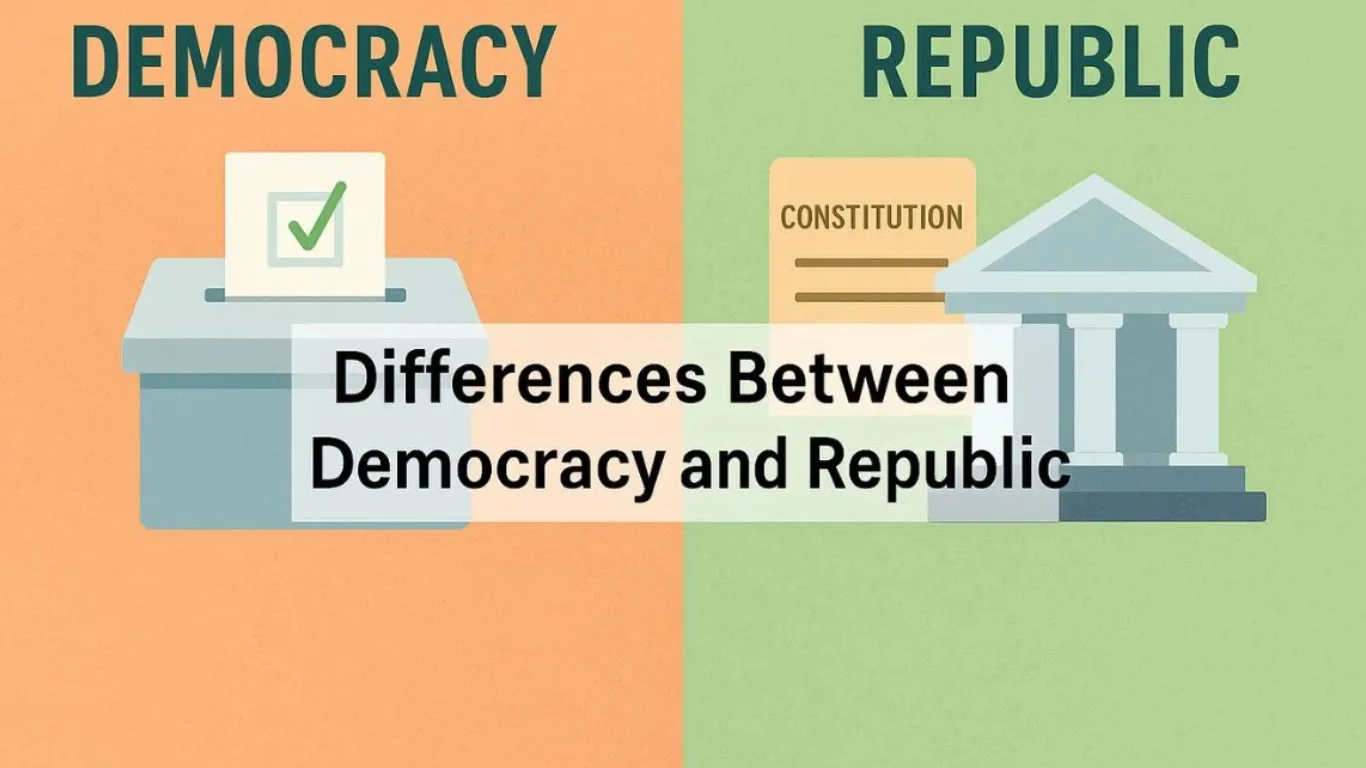
Think of democracy as a person who has power, while a republic is the way power is organised and regulated. The term democracy refers to the fact that people choose the leaders they want to follow through their vote. A republic is a country that is governed by elected officials through a constitution, and not a dynastic ruler. This is among the most straightforward ways of government described democratically. Democracy determines who governs; a republic provides the framework, making India an independent, democratic, and democratic, sovereign socialist republic.
Step By Step: Understanding The Difference Between Democracy And Republic
First, democracy. The power is in the hands of the people either directly or via representatives. Ancient Athens practised direct democracy. Most modern nations use representative democracy.
Second, republic. It is a term used to describe a monarchy that does not exist or where the head of state is elected under a constitution that limits powers. This is the fundamental part of the distinction between a republic and a democracy, and it is one of the differences that people ignore.
Thirdly, they have overlaps, but they're not the same. A country may be democratic but not a republic. For instance, the UK holds elections but is a monarchy. A country may call itself a republic but not be truly democratic. Some states even use the word "republic" while shutting down elections. This is the place where the distinction between republic and democracy is most obvious.
Fourth, think of India as an independent republic. India was the first country to hold a general election in 1951and became an actual democracy. It was declared a republic on 26 January 1950, the day that the Constitution took over from the British monarch as the primary source of power. This is the reason Republic Day exists separately from Independence Day, clear proof of India being a republic.
Real World Examples That Make This Click
The preamble of the Indian Constitution names both, and describes India as being a sovereign democratic socialist republic. Sovereign means no foreign power controls India. It is classified as secular and socialist. values. Democratic defines who is in power. Republic defines the structure, with a head elected by the state under the constitution. The four concepts are all contained in the phrase sovereign democratic socialist republic, which is one of the most comprehensive models of government described in a single sentence.
Compare this with what is happening in the United States, also a republic that has democratic elections organised through an electoral college, rather than direct national voting. Also, the UK is democratic through Parliament but not a republic, as the monarch is still the head of state. India is a sovereign republic that is unique, as it combines the elective head of state and universal adult suffrage since day one.
Must read: Power Shifts 2026: A Clear Look at India’s Changing Political Scene
Mistakes People Keep Making, And Why
The most frequent mistake is to view the terms republic and democracy as if they were opposites or as synonyms; in the case of two distinct layers, the primary distinction between republic and democracy is what people tend to miss. It is not enough to have elections alone to create a republic, unless there is a monarch, and an unfree republic is hardly a democratic one, no matter what the constitution may say regarding the characteristics of democracy.
Many people also interpret the aspects that make democracy as belonging to democracies. But things like the free press or judicial independence are dependent upon the structure of a republican government that protects against the influence of a majority. Confusion of the aspects of democratic institutions with republican guarantees or fundamental ways of government explained casually is where political debates fall flat.
Pro Tips That Actually Help
If you hear a discussion of constitutional powers, you should ask what layer is being discussed. If someone says that courts are preventing the majority's wishes generally, it's the republic layer that is functioning properly and not a democracy that is failing. Knowing the characteristics of democracy along with the safeguards built within India as a republic can distinguish real problems from normal checks and balances. The identical distinction between republic and democracy is taking place in real time, as well as one of the clearest types of government that can be described.
Closing Thoughts
The distinction between republican and democratic systems isn't about choosing one side, but realising that a healthy nation requires both layers. A republic without limits on democracy can be a slippery slope towards mob rule. A republic with no democratic participation could drift towards peaceful authoritarianism. India declared itself a sovereign democratic socialist republic specifically to keep the two in check, and understanding the difference between a republic and a democracy is knowing the importance of balance.
Must read: Difference Between Lok Sabha and Rajya Sabha: Complete Comparison
FAQs
The most basic distinction between republic and democracy?
Democracy describes who is in charge: the people. The republic describes how power is organised, using elected representatives in the form of a constitution, rather than an absolute monarch. This alone is the fundamental distinction between a republic and a democracy.
Is India a democracy or a republic?
Both. India is described as a sovereign democratic socialist republic with a mix of elected governance and a constitutional framework; that is why India is a republic, and India as a democracy are the same.
Can a nation be considered a republic even though it is not democratic?
Yes, some countries are referred to as republics while limiting elections, which hinders democracy despite being labelled an additional flaw among all models of government. In a real-world example, the distinction between a republic and democracy falls apart.
What are the most important characteristics of a democratic society?
Free and fair elections, as well as freedom of speech, an independent judiciary, and accountability of the leaders to the public are fundamental aspects of democratic government, which is one of the clearest types of government described in this article.
What is the reason why India recognises Republic Day separately from Independence Day?
Independence Day is a celebration of the liberation from British rule in the year 1947. Republic Day marks 26 January 1950, the date that the Constitution became effective in 1950, officially establishing India as an independent republic.