
From Reel to Real Power: Was Vijay's Journey to Tamil Nadu CM Always Part of the Plan?
There is a line from a 2013 Tamil film that keeps coming back now. "Born to Lead." That was the tagline of Vijay's movie "Thalaiva." Most people read it as a marketing strapline. Looking back, some are now asking if it was something else entirely.
That question, which was Vijay's political rise planned years before anyone took it seriously, is the one everyone is quietly asking after April 23, 2026.
The Clues Hidden in Plain Sight
When Vijay's movie "Thalaiva" was released in 2013 with the tagline "Born to Lead," it gave a first, clear hint of his political ambition, though not definitive enough to conclude anything for certain. The AIADMK government at the time was uncomfortable enough that the film's release was delayed in Tamil Nadu by two weeks, and the tagline was removed before it was screened. That is a remarkable overreaction to a movie poster, unless the political establishment sensed something the general public had not fully clocked yet.
Two years before "Thalaiva," Vijay had visited Anna Hazare during his anti-corruption fast in Delhi, publicly expressing support. It was an unusual move for a Tamil actor at the peak of his commercial career. People noticed. Not everyone understood what it meant.
For years, Vijay lived two lives in the public imagination. On screen, he was the mass hero who walked into chaos and walked out with applause. Off-screen, he quietly built a persona that blended stardom with a growing political voice.
That dual identity was not an accident. It was being constructed, slowly, over more than a decade.
Read More: UAE Quits OPEC Amid Iran War – Impact on Global Oil Markets & Prices
The Fan Network That Was Never Just a Fan Network
Here is something worth understanding about how Tamilaga Vettri Kazhagam got ready before anyone called it a political party.
Vijay's fan network, later formalised as the All India Thalapathy Vijay Makkal Iyakkam, had already shown organisational muscle in local body polls in 2021, winning a notable number of seats. Unlike stars who announced political plans and retreated, Vijay built a structure first and entered later.
That distinction matters more than it sounds. Tamil Nadu has seen actors dabble in politics before. Kamal Haasan launched a party. Rajinikanth announced one and then did not. What made Vijay different was that his fan clubs were already behaving like a political cadre years before the party had a name.
The party's organisational model converted Vijay's 85,000 fan clubs across Tamil Nadu wholesale into political cadres, giving TVK one of the most extensive grassroots networks of any debut contestant in Indian state history.
That network took over a decade to build. Nobody builds something like that for a hobby.
Why Tamil Nadu Is the One Place This Could Actually Work
No state in India understands the connection between cinema and politics like Tamil Nadu. MG Ramachandran transformed screen fame into mass politics. J Jayalalithaa followed. Even DMK stalwart Karunanidhi came from the film world as a writer.
Vijay entered this tradition with something his predecessors did not have at comparable stages: a social media-era fan base that was already politically literate, young, and organised. He also brilliantly combined elements of Dravidian ideology and Tamil nationalism in formulating his party's ideology, making it feel rooted rather than opportunistic.
Read More: Modi in Gangtok: What Sikkim's 50 Years of Statehood Really Means for India's Smallest State
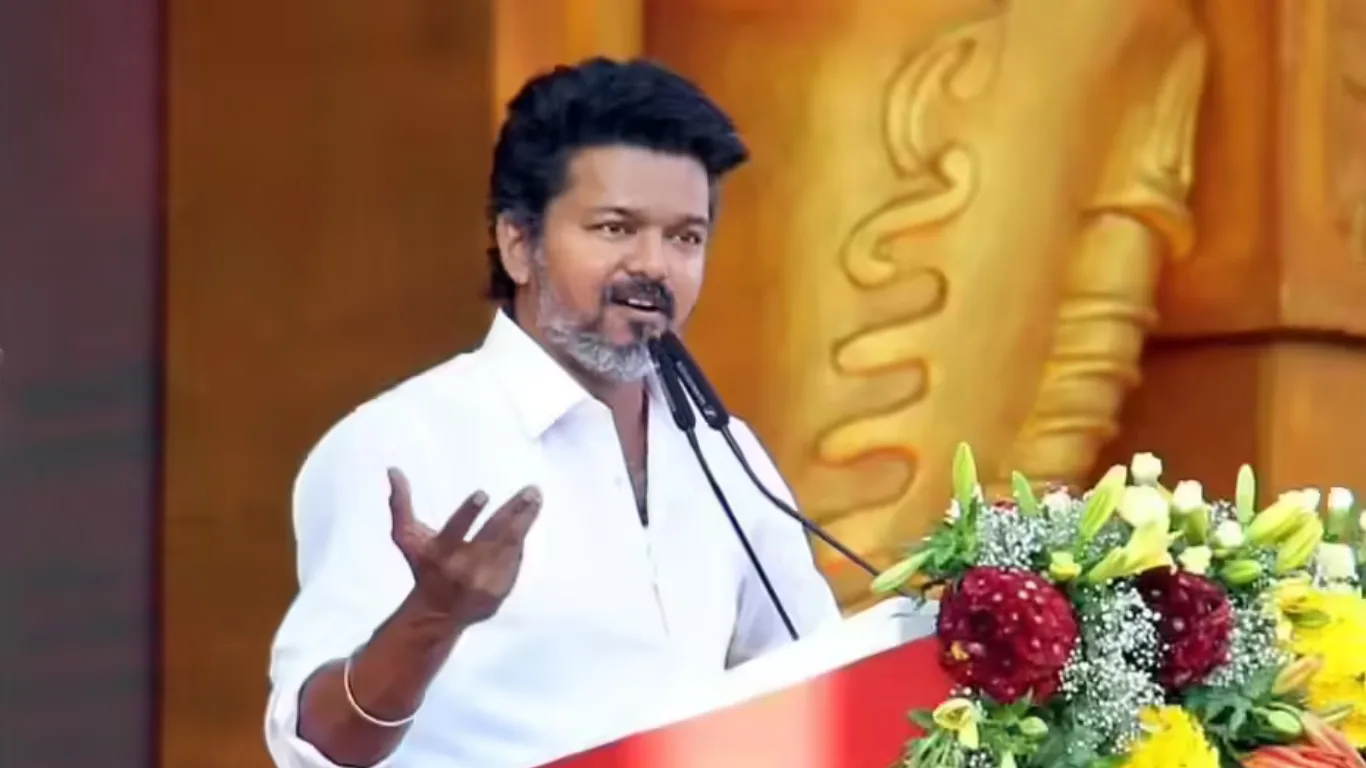
He also had an unusual communication strategy. He neither met the press nor gave interviews, and instead communicated directly with people via social media. He focused unusually on teenagers and children, encouraging them to guide their families toward TVK, and when polling crossed 85 per cent, he specially thanked young children for guiding their families to vote.
That is not instinct. That is a strategy.
The 2026 Result and What It Confirms
Vijay announced TVK in February 2024, immediately staking out an ambitious strategy of contesting all 234 seats independently, without alliance partners. Most political analysts called this reckless. A party with no legislative experience, no senior politicians of note, contesting every single seat alone.
TVK won 108. The DMK, which had governed Tamil Nadu for five years, won 59. The AIADMK won 47. Vijay's party outpolled both Dravidian giants on its very first attempt at the ballot box, claiming approximately 35 per cent of the popular vote.
TVK's first major political conference at Vikravandi in October 2024 drew a reported 800,000 attendees, signalling that the party's momentum was genuine and not simply based on Vijay's star power.
They hint at a shift where celebrity is only the starting point, and where organisational groundwork and voter connect begin to take over.
Read More: One Year of Operation Sindoor: How India Rewrote the Rules of War with Pakistan
What This Tells Us About How Political Rises Are Actually Built
The honest answer to the question in the headline is probably: yes, and no. Not a single masterminded plan with dates and targets. But something more interesting than an accident.
Vijay appears to have spent fifteen years building the conditions for a political entry, testing the waters through films with political undertones, organising fan structures into something resembling a party, and reading Tamil Nadu's mood closely enough to know when the moment had arrived. His family introduced the promotional title "Ilaya Thalapathy" (Young Commander) for his third film in 1994, which reflected their understanding of the importance of branding from very early in his career.
That branding was never just about cinema.
Closing Thoughts
There is a version of this story where Vijay simply got lucky, where the DMK underperformed, where voter fatigue did the heavy lifting, and where he was just the right face at the right time. That version is probably too simple.
The more complete picture is of someone who understood that in Tamil Nadu, the line between screen and state has always been porous, and who prepared for that crossing more carefully than most people realised. The films were real. The politics were always there underneath. What changed in 2026 is that the two finally became the same thing.
Disclaimer: This article is based on information available across the web. Parchar Manch does not take responsibility for its complete accuracy, as the content could not be fully verified.
Read More: Virat Kohli Becomes First Batter to Score 9000 Runs in IPL History: A Record Nobody Else Is Close To
FAQs
Did Vijay's films actually hint at political ambitions?
Several films carry themes of political leadership and social reform. The clearest signal came from the 2013 film "Thalaiva," whose tagline "Born to Lead" was removed under pressure from the ruling AIADMK government before the film could screen in Tamil Nadu. Analysts have since pointed to this as an early, deliberate signal.
When did Vijay officially enter politics?
Vijay formally announced the formation of Tamilaga Vettri Kazhagam in February 2024. However, his fan network had been functioning as a political organisation years earlier, winning local body seats in 2021 under the banner Vijay Makkal Iyakkam.
Why did TVK contest all 234 seats alone without any alliance?
Vijay announced that TVK would contest all 234 assembly constituencies independently, without any pre-election alliance partners. This was widely considered a high-risk strategy, but it allowed the party to build its own identity and avoid the perception of being a junior partner to any established party.
What happened to MK Stalin and the DMK after TVK's win?
MK Stalin lost his own Kolathur constituency seat and resigned as Chief Minister on May 5, 2026. The DMK, which had governed Tamil Nadu since 2021, was reduced to 59 seats and moved into opposition.
Is Vijay's rise really comparable to MG Ramachandran's political entry?
There are genuine similarities: both were dominant Tamil cinema stars who converted fan loyalty into political capital. TVK winning 108 seats in its debut election has been described as comparable to the feat MGR achieved in 1977, making it one of the most remarkable actor-to-politics transitions in the state's history.