IMF World Growth Forecast Cut Again, and This Time AI and War Are Fighting for Control of the Global Economy
There is something oddly poetic about two forces this different, a war in the Middle East and an artificial intelligence boom, ending up on opposite sides of the same economic tug of war. The IMF world growth forecast released this week captures exactly that tension. Global growth is being trimmed again, yet not nearly as much as feared, because a genuinely powerful technology cycle is quietly absorbing much of the shock.
If you have felt like the news cannot decide whether the global economy is struggling or thriving lately, this latest outlook explains why that confusion makes perfect sense.
Why This Actually Matters
Numbers like global growth rates can feel abstract until you connect them to your own life. The IMF world growth forecast directly touches inflation at your grocery store, energy prices at the pump, and how confidently your employer plans hiring for the year ahead. When the IMF trims its global growth forecast for the second time this year, it means real households and businesses are adjusting expectations too, whether they realize it or not.
There is also a genuinely interesting split happening beneath the surface. Some countries are getting upgraded forecasts thanks to AI related exports, while others tied more closely to energy imports are absorbing real pain. Understanding which side of that divide your own country or industry sits on matters more than the single headline number ever could.
What This IMF Growth Forecast Really Means, Explained Simply
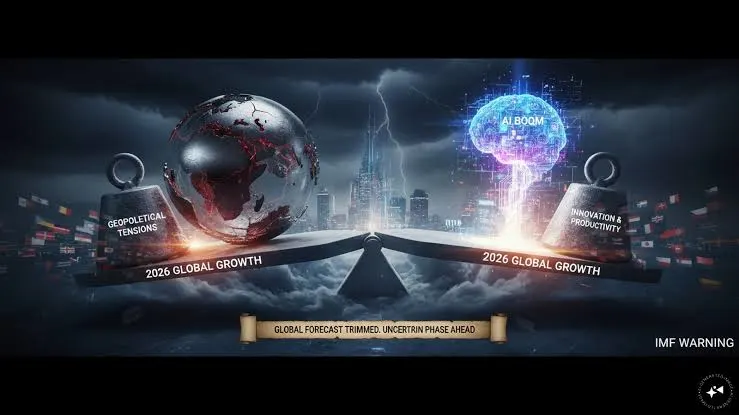
Picture the global economy like two people pulling against each other in a tug of war, one team representing war driven energy shocks, the other representing an AI investment boom. Neither side has fully won yet, but the AI team is pulling hard enough that the rope has barely moved compared to how far it might have shifted otherwise.
That is essentially what the IMF is describing. The fund cut its 2026 global growth forecast to 3.0 percent, down slightly from April's 3.1 percent estimate, citing energy shocks tied to the war between the US, Israel, and Iran. At the same time, it explicitly credited accelerated momentum in the global technology cycle for softening what could have been a much sharper downturn.
How the IMF Reached This World Growth Forecast, Step by Step
- The IMF released its July 2026 World Economic Outlook update on Wednesday, revising figures from its April baseline.
- Global growth for 2026 was trimmed to 3.0 percent, with a rebound expected to 3.4 percent in 2027, still below the 3.5 percent average seen across 2024 and 2025.
- Global headline inflation was revised upward to 4.7 percent for 2026, compared with 4.1 percent in 2025, before easing to 3.9 percent in 2027.
- The forecast assumes oil averages around 89 dollars per barrel in 2026, with energy prices sitting roughly 25 percent higher than before the war began in February.
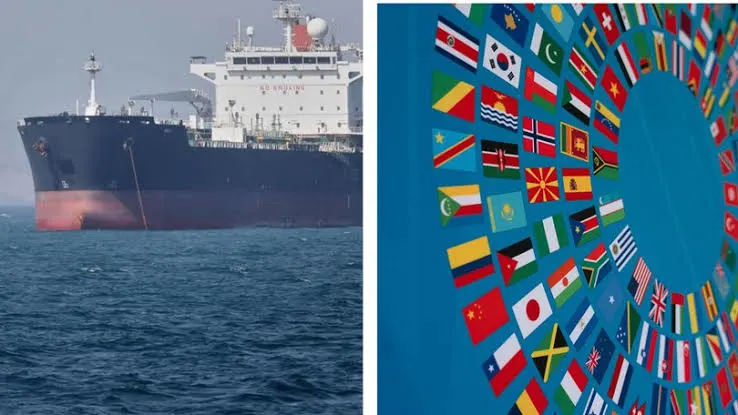
- The IMF assumed the Strait of Hormuz would begin reopening by mid July, gradually returning to prewar shipping conditions by March 2027.
- Regional and country level forecasts were adjusted individually, with energy importers generally downgraded and technology exporters generally upgraded.
Reading through that sequence, the picture becomes less about one single global number and more about very different regional stories layered underneath it.
Real World Examples From the IMF's Latest Numbers
China received one of the few genuine upward revisions, with its 2026 growth forecast raised to 4.6 percent from April's 4.4 percent estimate. South Korea, despite being an oil importer, saw its forecast lifted to 2.6 percent thanks to strong AI related export demand. The IMF specifically highlighted that top exporters of AI hardware posted an average 4.4 percentage point growth surprise in the first quarter, compared with a negative 0.3 percentage point surprise for the rest of the world.
On the harder hit side, the Middle East and Central Asia region absorbed a steep 1.2 percentage point downgrade to just 0.7 percent growth for 2026, the clearest regional casualty of the ongoing conflict, though the IMF did raise its 2027 rebound forecast for that same region by 1.9 percentage points. India also saw a small downgrade to 6.4 percent for 2026, though its 2027 outlook was actually lifted to 6.7 percent.
Mistakes People Keep Making While Reading This Forecast
A common one. People see a headline cut to global growth and assume every country is struggling equally. That is simply not true this cycle. The IMF's own data shows a genuinely uneven landscape, where AI hardware exporters like Taiwan, South Korea, Thailand, and Malaysia received upward revisions while energy dependent, non resource economies took the brunt of the damage.
Another mistake is treating this IMF world growth forecast as a guaranteed outcome rather than a baseline assumption. The projections explicitly depend on the Strait of Hormuz reopening by mid July and returning to prewar shipping levels by March 2027. If that assumption fails, given that daily transits have fallen from roughly 130 before the war to just 41 recently, the entire forecast could shift again.
Pro Tips for Understanding Global Growth Forecasts Like This
Always check which specific assumptions sit underneath a headline growth number, since small changes in oil prices or shipping conditions can shift country level forecasts dramatically. Pay attention to inflation alongside growth too, since the IMF's 4.7 percent global inflation projection for 2026 matters just as much as the 3.0 percent growth figure for understanding real world cost pressures. And watch for how quickly AI related investment momentum either continues or corrects, since the IMF explicitly flagged a potential technology expectation correction as a genuine downside risk to this entire outlook.
Closing Thoughts
There is something quietly reassuring, and a little unsettling, about watching the global economy get pulled in two directions at once and somehow stay roughly upright. The IMF world growth forecast this cycle suggests resilience, not comfort, and whether that balance holds through 2027 depends on forces well beyond any single country's control.
Disclaimer: This article is based on information available across the web. Parchar Manch does not take responsibility for its complete accuracy, as the content could not be fully verified.
FAQs
What is the IMF's latest global growth forecast for 2026?
The IMF projects global growth of 3.0 percent for 2026, down slightly from its April estimate of 3.1 percent.
Why did the IMF cut its growth forecast again?
The cut reflects energy price shocks and uncertainty tied to the ongoing war involving the US, Israel, and Iran, partly offset by strong technology sector momentum.
What is the IMF's inflation forecast for 2026?
Global headline inflation is projected to rise to 4.7 percent in 2026, up from 4.1 percent in 2025, before easing to 3.9 percent in 2027.
Which countries got upgraded forecasts?
China and South Korea both received upward revisions, largely credited to strong AI hardware demand and technology sector exports.
Which region was hit hardest by this forecast?
The Middle East and Central Asia region saw the steepest downgrade, with 2026 growth cut to just 0.7 percent due to the ongoing conflict.
What is the US growth forecast for 2026?
The IMF left the US forecast unchanged at 2.3 percent for 2026, with 2027 growth projected at 2.2 percent.