India Imports 90% of Its Chips. The NITI Aayog Semiconductor Report Just Explained Why That Has to Change
The number that should stop you cold is this: India spent nearly $150 billion importing semiconductor products between FY 2017 and FY 2025. That is not a trade statistic. That is a measure of dependence. And the NITI Aayog semiconductor industry report, titled "Future of India's Semiconductor Industry" and released on May 30, 2026, is essentially a strategic alarm written in the form of a policy document.
India currently imports 90 to 95 percent of the chips it uses. The report projects domestic demand will exceed $200 billion by 2035. The gap between what India needs and what it can produce is not narrowing. It is widening. Fast
.
Why the NITI Aayog Semiconductor Roadmap Matters to Every Indian
Semiconductors are the invisible foundation of modern life. Your smartphone, your car, your hospital's imaging equipment, the defence systems protecting India's borders, the 5G tower that connects your city. Every one of these runs on chips. When a country cannot make its own chips, it is, at some level, dependent on other countries for all of the above.
The report puts it plainly: this dependence is both an economic and a national security vulnerability. At a time when global supply chains are being reshuffled by geopolitical tensions, India cannot afford to remain a downstream consumer.
Finance Minister Nirmala Sitharaman, who released the report, stated that India is committed to moving from being a major consumer of chips to becoming an indispensable part of the global semiconductor value chain.
Read More: Sun Pharma's $11.75 Billion Organon Acquisition: India's Biggest Pharma Bet Explained
What the NITI Aayog Report Actually Recommends: A Pivot, Not Just a Push
Here is the part that makes this report different from standard policy documents. NITI Aayog is not simply saying: make more chips. It is saying India is running the wrong race.
The report's central argument is that India cannot win by trying to compete with Taiwan, South Korea, or the United States in building cutting-edge fabrication at the 3nm or 5nm level. The capital requirements are staggering. The learning curves are years long. The infrastructure gaps are real.
Instead, the report urges India to "shift gears and target becoming the ecosystem player that the global semiconductor industry cannot run without." The focus areas it recommends are mature-node chips, advanced packaging and testing, compound semiconductors including Silicon Carbide (SiC) and Gallium Nitride (GaN), and semiconductor design.
This is a smarter bet. Advanced packaging, for instance, is a segment where India can build world-class capability quickly, attract investment, and serve global clients without needing to first build a 5nm foundry from scratch.
The Scale of Investment India Needs
The roadmap projects that India will need between $135 billion and $180 billion in cumulative capital expenditure over the next decade. That covers semiconductor manufacturing, design, packaging, materials, and supporting infrastructure.
NITI Aayog recommends that the Government of India contribute at least one-third of this amount directly, to de-risk projects and signal confidence to private investors. That government commitment is what turns a policy document into an investment magnet.
The ambition is specific: build a semiconductor value chain worth $120 to $150 billion by 2035, capturing 10 to 13 percent of the global semiconductor market, and achieving self-sufficiency of 35 to 50 percent of domestic chip demand.
India's semiconductor demand is expected to grow at a compound annual rate of 19 percent, reaching $90 billion by 2030 and over $200 billion by 2035.
Read More: Modi's Matua Gambit: The One Speech That Could Decide West Bengal's 2026 Election
What Is Already Happening: India Semiconductor Mission and Dholera
The report acknowledges that India has already begun. The India Semiconductor Mission has catalysed investment from Tata Electronics, Micron, and others. Tata's fabrication plant at Dholera in Gujarat, being built in partnership with Taiwan's Powerchip Semiconductor Manufacturing Corp, is expected to produce its first chips by late 2026. Capacity is set at 50,000 wafers per month and will target 28nm, 50nm, and 55nm nodes, covering power management chips for EVs, telecom, defence, and consumer electronics.
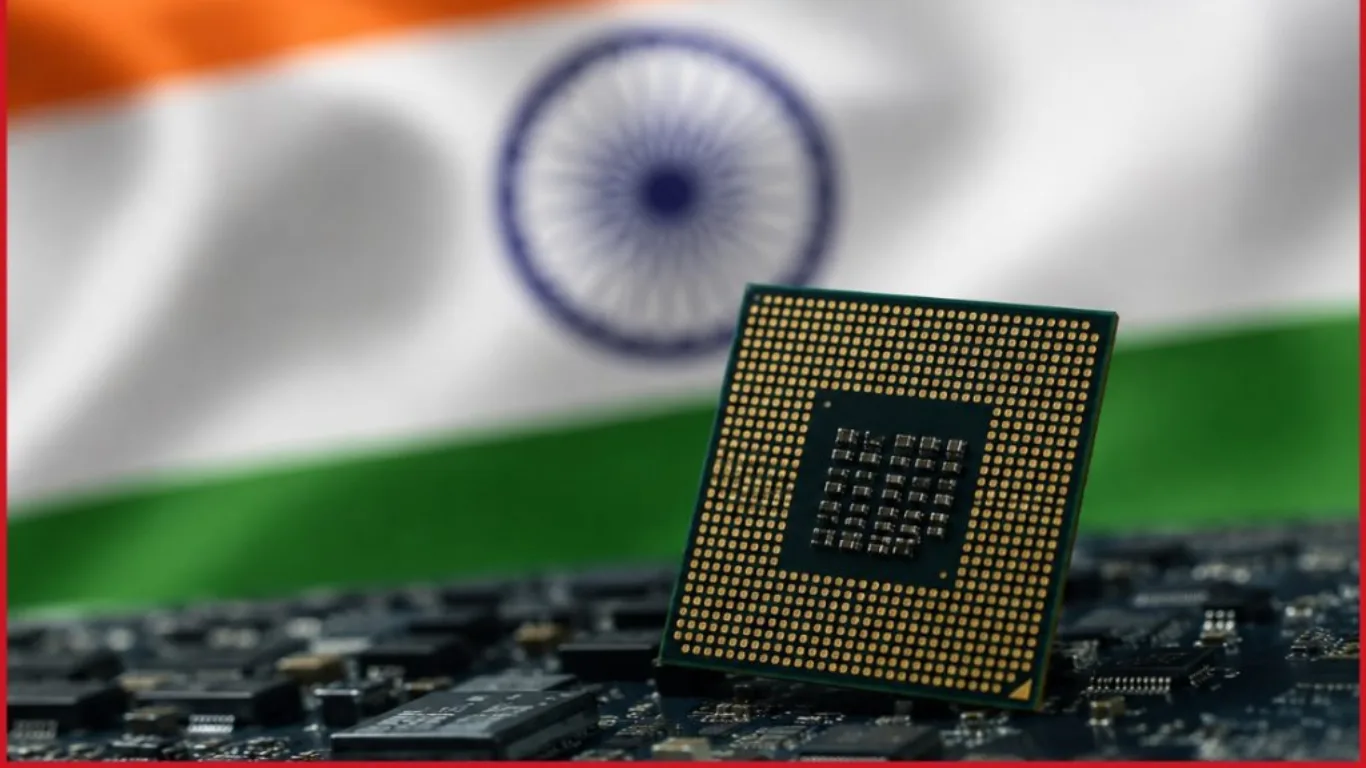
A Tata Electronics assembly and test facility is also coming up in Jagiroad, Assam.
But the report is careful to note that this manufacturing ecosystem remains nascent. The window to act, it warns, is narrowing. Global supply chains are realigning now, and countries that build credible semiconductor capacity in the next few years will shape the next decade of technology. Those that wait may find the entry barriers have risen further.
Read More: I Could Be Wrong, But Not All 7": Raghav Chadha Explains His Shock Move From AAP to BJP
The Five Pillars the Report Builds Its Strategy Around
The roadmap is structured around five areas. Frontier research and design intellectual property comes first, because India's strength in chip design must be formalised and expanded. Policy and investment support follows, meaning sustained government commitment and clarity. Advanced packaging and compound semiconductor production is the third pillar, where India has a real shot at near-term global leadership. Talent development is the fourth, because the report identifies semiconductor workforce gaps as a critical constraint, calling for fab-ready technicians, materials scientists, packaging specialists, and system architects. Finally, strategic partnerships with trusted nations and global industry leaders completes the framework.
A Thought for the Long Game
The India semiconductor self-reliance goal is ambitious. It is also, for the first time, backed by a credible roadmap rather than just aspiration. India has the design talent, the growing domestic market, and a government that has signalled genuine commitment. What the NITI Aayog report adds is honesty: about where India is today, what it realistically can win, and the precise investments needed.
The global semiconductor market is expected to exceed $1.5 trillion by 2035. India needs a meaningful seat at that table. Not because of pride. Because chips are what power everything that comes next.
Disclaimer: This article is based on information available across the web. Parchar Manch does not take responsibility for its complete accuracy, as the content could not be fully verified.
Read More: Narendra Modi Addresses Vijay Sankalp Sabha in Mathurapur: Impact on West Bengal Election 2026
FAQs
What is the NITI Aayog semiconductor industry report?
Released on May 30, 2026, the report titled "Future of India's Semiconductor Industry" is a ten-year roadmap prepared by NITI Aayog's Frontier Tech Hub. It outlines India's semiconductor strategy, vulnerabilities, investment requirements, and target outcomes through 2035.
How much does India currently import in semiconductors?
India imports 90 to 95 percent of the semiconductors it uses. The country spent nearly $150 billion on semiconductor imports between FY 2017 and FY 2025, and annual import costs could reach $240 billion by 2035 if current trends continue.
What is India's semiconductor target for 2035?
The NITI Aayog report targets building a semiconductor value chain worth $120 to $150 billion by 2035, capturing 10 to 13 percent of the global semiconductor market, and meeting 35 to 50 percent of domestic chip demand through domestic production.
What types of chips should India focus on, according to the report?
Rather than competing in cutting-edge nodes, NITI Aayog recommends India focus on mature-node logic chips, advanced packaging, compound semiconductors like Silicon Carbide and Gallium Nitride, and semiconductor design services.
When will India's first chip fabrication plant produce chips?
Tata Electronics' plant at Dholera, Gujarat, built with Taiwan's Powerchip Semiconductor Manufacturing Corp, is expected to produce its first chips in late 2026. It will produce chips at 28nm, 50nm, and 55nm nodes.
How much investment does India need for its semiconductor industry?
The report estimates India needs $135 billion to $180 billion in cumulative investment over the next decade. It recommends the government contribute at least one-third of this to attract private capital and reduce investor risk.