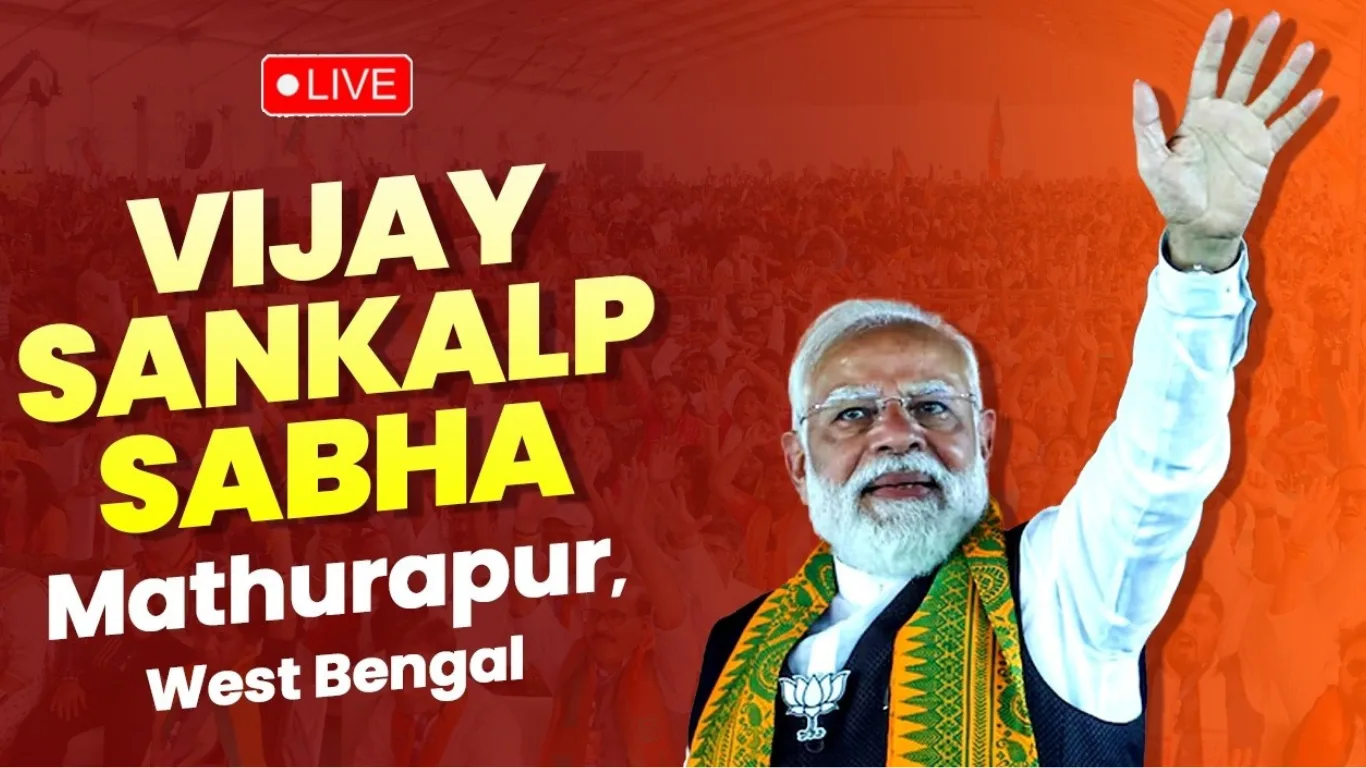
Narendra Modi Addresses Vijay Sankalp Sabha in Mathurapur: Impact on West Bengal Election 2026
West Bengal Election 2026 LIVE updates have kept the country glued to screens, and for good reason. On April 23, the day Phase 1 voting began across 152 constituencies, Prime Minister Narendra Modi chose Mathurapur in South 24 Parganas to hold a massive Vijay Sankalp Sabha a rally whose name itself carries intent. "Victory Resolution Assembly." That is not subtle. And Modi was not trying to be subtle.
The rally at Kakdwip Stadium drew enormous crowds even as voting was already underway in other parts of the state. The timing alone said something. This was not just a campaign speech. This was a statement of confidence, a signal to voters still heading to booths, and a direct challenge to Mamata Banerjee and her Trinamool Congress after 15 years of uninterrupted rule in Bengal.
Why Bengal 2026 Is Not Just Another State Election
There is something different about this election cycle. Anyone following the 2026 West Bengal Assembly Election knows it carries stakes that go well beyond seat counts.
Elections were held in West Bengal on April 23 and April 29, 2026, to elect all 294 members of the West Bengal Legislative Assembly, with votes to be counted and results declared on May 4, 2026. That result date May 4 has become almost mythological in the current political climate. Modi himself invoked it repeatedly.
Bengal has not had a non-TMC government since 2011. Before that, it was 34 years of Left rule. The state has not seen political alternation in over half a century. That context matters enormously when you try to understand what BJP is attempting here, and why Modi's appearance in Mathurapur carried weight beyond a routine rally.
The school recruitment scam and other ongoing investigations by central agencies made corruption and governance important opposition themes. Women's safety was a recurring issue, especially after the 2024 R. G. Kar Medical College and Hospital rape and murder case, which drew national attention. These are not abstract policy disputes. These are things Bengali voters felt personally, in their neighbourhoods, in their families.
What Modi Said at the Vijay Sankalp Sabha in Mathurapur
The speech was sharp. Focused. Not the kind of generic rally address that fades from memory by the next morning.
Modi expressed full confidence of a BJP victory in the West Bengal assembly polls and launched a scathing attack on the Trinamool Congress, saying, "May 4 is the expiry date of TMC's syndicate and this reign of jungle law."
That phrase "expiry date" was calculated. It reframes the election not as a contest between parties but as a product recall. An accountability moment. He said there will be accountability for all wrongdoings after the results are declared on May 4.
Addressing the gathering at Kakdwip Stadium under the Mathurapur assembly constituency, he claimed that the massive poll turnout indicated that the TMC's regime of 'bhoy' (fear) was "surely getting defeated" by the 'bharosa' (trust) the BJP has promised. He said, "There's not one sector in Bengal where work gets done without bribes, where TMC syndicates and their middlemen don't take cut money."
The cut money reference is something Bengal voters understand viscerally. It refers to the practice of local TMC workers allegedly siphoning a percentage of government scheme money meant for ordinary beneficiaries. This is not a BJP invention it has been documented, debated, and even acknowledged by Mamata Banerjee herself in a different political moment years ago.
Modi also addressed the issue of women's reservation, saying the BJP government had come to Parliament with a proposal to provide 33 percent reservation to women from the 2029 Lok Sabha elections, but TMC voted against it, adding, "TMC has snatched away the rights of Bengal's women."
He also touched on development promising to transform the Bhanga Mela of Mathurapur, a local fair of cultural importance, into something more structured and dignified. He said the BJP's resolve is to provide digital skills to the artisans of this fair, equip them with safety gear, and convert the fairground into an organized market hub. Small promises, maybe. But the kind that register with local voters who feel overlooked.
Phase 1 Voting: What Happened on the Ground Across wb election 2026
The fate of 152 constituencies, more than half of the state's total 294 seats, was sealed on April 23 after weeks of intense, high-decibel campaigning, where the fight was mostly between the ruling TMC and the BJP, which seeks to topple the Mamata Banerjee-led government and come to power for the first time in the state.
Phase 1 voting began on April 23 across 152 constituencies spread across north Bengal and selected southern constituencies containing more than 3.6 crore eligible voters. Polling operations proceeded from 7 AM to 6 PM under strict security measures.

The turnout was striking. Phase 1 witnessed polling across 16 districts, including the entire North Bengal region Cooch Behar, Alipurduar, Jalpaiguri, Darjeeling, and others parts of South Bengal, and Jangalmahal areas such as Purulia, Bankura, Jhargram, and Paschim Medinipur.
Darjeeling is significant here because that is where Ankit Thapa and his Bharatiya Gorkha Prajatantrik Morcha factor into the picture. The hill politics of Bengal operate differently from the plains. Local identity, self-governance demands, and the Gorkhaland question have historically complicated the BJP's ability to consolidate votes in that region even as they ally with hill-based parties.
The ground situation was not entirely peaceful. Tensions flared in Murshidabad as TMC workers clashed with cadres of another party. Violence flared at Booth 65 in Dubrajpur's Budhpur Primary School following reports of a faulty EVM, with tensions between voters and CRPF personnel escalating into a scuffle. These incidents, while not widespread, reinforced the BJP's narrative about political violence and governance failure under TMC.
BJP candidate from Asansol Dakshin, Agnimitra Paul, urged voters to cast their votes without fear, saying, "During last elections, there were incidents of bomb attacks in different places, and they may try to do the same this time as well.
Read More: Tiwari Tries Touching Kohli's Feet: A Viral IPL 2026 Moment That Says More Than It Shows
Samik Bhattacharya: The Man Steering BJP Bengal's Campaign
If Modi represents the national face of Bharatiya Janata Party in Bengal, Samik Bhattacharya is the state-level architect of the party's 2026 push.
Senior BJP leader and Rajya Sabha MP Samik Bhattacharya was officially named the new president of the party's West Bengal unit in a grand felicitation ceremony held at Science City in Kolkata.
Born in 1963, Bhattacharya began his early career by joining the Rashtriya Swayamsevak Sangh (RSS) in 1971 and later joined BJP in the early 1980s. He served as the chief spokesperson of the West Bengal BJP from 2020 to 2024 and was known for his oratory skills, and as someone accepted by both old and new factions in the party.
That last detail matters. Internal party cohesion in Bengal BJP has been a persistent problem. Various factions, defectors from TMC, old-guard members, and newer entrants have not always pulled in the same direction. Bhattacharya's appointment was partly a stabilisation move.
In his assessment ahead of the election, Bhattacharya said: "This election is about the restoration of democracy. In 2011, Mamata Banerjee came to power promising democratic restoration after 34 years of left rule. People voted for her with that hope. But today, institutions have weakened, the administration has become politicised, and democratic rights are under pressure. Public sentiment favours the BJP."
Whether that sentiment translates to votes is what May 4 will decide.
The Key Issues Driving WB Election 2026 Voters
It would be a mistake to see this election through only one lens as a Modi vs. Mamata binary. On the ground, voters are weighing a cluster of concerns that are deeply local.
Corruption and governance remained important opposition themes, especially because of the school recruitment scam. Employment, industrial development, and public recruitment were prominent issues, particularly among younger and urban voters. Concerns about job creation, delayed recruitment examinations, and competing claims over investment and industrial growth featured prominently in the campaign.
Then there is the CAA factor. The Citizenship Amendment Act remained a separate campaign issue, particularly in areas where refugee and Matua politics were significant. BJP leaders said a BJP government in West Bengal would speed up citizenship processing under the Act.The Matua community a large and historically marginalised Hindu group from refugee families has been a key swing bloc.
Read More: Rajnath Singh Arrives in Berlin for Defence Talks — A Quiet Visit With Loud Global Signals
Border security and the NDA's infiltration narrative also ran through the campaign. BJP leaders framed cross-border movement, border fencing, and the Siliguri Corridor as matters of national security and linked them to their wider argument on infiltration. The AITC rejected these claims as politically motivated.
TMC, for its part, leaned hard on welfare. The Lakshmir Bhandar scheme direct cash transfers to women — has genuine reach and genuine supporters. Dismissing it as mere populism misses how tangibly it has touched household budgets in rural Bengal.
What BJP Needs to Actually Win Bengal
Here is the honest part of the analysis. BHAJAPA or BJP has performed strongly in Bengal in Lok Sabha elections (winning 18 of 42 seats in 2019, dropping to 12 in 2024), but assembly elections are a different beast. Booth-level organisation, local leadership credibility, and the ability to counter systematic election-day pressure all matter more at the state level.
The parties entered into heated conflict before the voting period because they disagreed about essential issues, including the Uniform Civil Code, border security, claims of illegal entry, and welfare program implementation. The TMC firmly refuted BJP allegations, pointing out its model of welfare-based governance.
BJP needs to win a significant number of Phase 1 seats to create momentum going into Phase 2 on April 29. The North Bengal districts areas where the party showed strength in 2021 are critical. Jangalmahal, once a Maoist belt and now a contested swing region, is another indicator zone.
Modi's rally in Mathurapur was specifically aimed at South 24 Parganas, which is a TMC stronghold. Holding a Vijay Sankalp Sabha there is not a defensive move it is a signal that the BJP India campaign believes it can make inroads in territory that was previously considered out of reach.
After the Votes: What May 4 Could Look Like
The results on May 4 will carry weight far beyond Bengal. A BJP win would reshape Indian politics in ways difficult to overstate it would mean the party controls most major states outside the south, and it would be Mamata Banerjee's political end. A TMC win, especially a strong one, would validate welfare-based state governance as a model that can resist national wave politics.
There is also the question of what a hung assembly would mean though given Bengal's political culture, a truly hung result seems unlikely. One side will win clearly.
Modi said it plainly: "Exactly 10 days from now, when the votes are counted, I am confident that the lotus will bloom everywhere."
Mamata Banerjee is equally confident of a fourth term. Somebody is wrong. And Bengal's voters who turned out in remarkable numbers on April 23 have made their choice. The counting machines will tell us what that choice was.
Disclaimer: This article is based on information available across the web. Parchar Manch does not take responsibility for its complete accuracy, as the content could not be fully verified.
FAQs
What is the Vijay Sankalp Sabha and why did Modi hold it in Mathurapur?
Vijay Sankalp Sabha translates to "Victory Resolution Assembly." It is a BJP campaign rally format designed to energise ground workers and demonstrate organisational strength. Mathurapur was chosen because it falls in South 24 Parganas, a traditionally TMC-dominant region, making a large rally there a show of confidence in difficult territory.
When is West Bengal Election 2026 voting happening and when will results be declared?
Phase 1 voting took place on April 23, 2026, covering 152 constituencies. Phase 2 is scheduled for April 29, 2026. Results for all 294 seats will be declared on May 4, 2026.
Who is Samik Bhattacharya and what is his role in the WB election 2026?
Samik Bhattacharya is the president of BJP's West Bengal unit and a Rajya Sabha MP. He is a long-time RSS and BJP worker appointed to lead and unify the state party ahead of the 2026 assembly polls. He has served as BJP's chief spokesperson in Bengal and is known for being accepted across factional lines within the party.
What are the main issues in the 2026 West Bengal Assembly Election?
The major issues include alleged corruption and the school recruitment scam under TMC, women's safety following the 2024 R.G. Kar case, the Citizenship Amendment Act and Matua community politics, border security and infiltration, employment and industrial growth, and TMC's welfare schemes like Lakshmir Bhandar.
What is cut money and why does Modi keep mentioning it?
Cut money refers to the alleged practice of TMC local workers deducting a percentage from government scheme payments before passing benefits to beneficiaries. Modi raises it because it is a tangible, credible grievance that resonates with rural voters who have directly experienced the practice.
What is Ankit Thapa's role in Bengal election 2026?
Ankit Thapa leads the Bharatiya Gorkha Prajatantrik Morcha, a hill-based party that has aligned with the BJP-led NDA alliance in the Darjeeling hills region. Hill politics in Bengal operate differently from the plains, with local identity and self-governance demands playing a major role in how constituencies like Darjeeling vote.