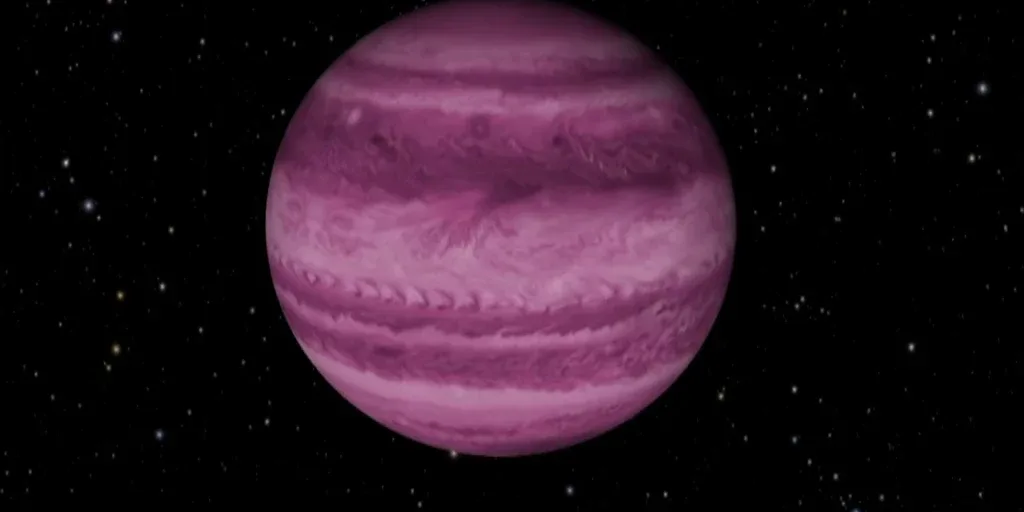
JWST Just Found Salt Clouds on the Pink Planet GJ 504 b — and Nobody Fully Knows What It Is
There is a pink world sitting 57 light-years from Earth, circling a star that looks a lot like our Sun, and for over a decade it refused to show astronomers anything useful. Ground-based telescopes, some of the biggest ever built, stared at it all night and came away with almost nothing. Then the James Webb Space Telescope pointed at it for roughly two hours and unlocked its atmosphere completely.
What Webb found inside GJ 504 b, the object astronomers nicknamed the Pink Planet, is genuinely unlike anything previously confirmed in a cold world's sky: salt clouds. Not water clouds like on Earth. Not ice clouds. Clouds made of salt compounds, floating high in an alien atmosphere and quietly reshaping every reading scientists took from below.
Why the Pink Planet GJ 504 b Kept Astronomers Guessing for Years
Discovered in 2013, GJ 504 b quickly became one of the more puzzling objects in nearby space. The basic facts were clear enough: a faint, pinkish companion orbiting a sunlike star, roughly 25 times the mass of Jupiter. But that mass figure created its own problem. At that size, GJ 504 b sits right on the border between a genuine giant exoplanet and a brown dwarf what astronomers call a failed star, a body massive enough to form like a star but never quite massive enough to ignite hydrogen fusion. Scientists still call it a "planetary-mass companion" precisely because they cannot fully commit to either label.
And it was too dim to study in detail from the ground. "Many teams all around the world performed follow-up observations to study its light, but it was too faint for ground-based instruments," said Aneesh Baburaj, a postdoctoral astronomer at Northwestern University who led the JWST study. "That made it a perfect target for JWST."
How JWST Cracked the Spectrum of a World 57 Light-Years Away
The tool Webb used is called spectroscopy essentially splitting the planet's faint light into its component colours, each colour betraying the fingerprint of a different molecule. Think of it as a kind of cosmic ingredient list, read from the light itself.
The team had to first strip out the overwhelming glare of GJ 504 b's host star using advanced image-processing techniques. Once the star's light was removed, the planet's own faint glow was left behind, and from that glow Webb extracted a detailed atmospheric spectrum.
The data showed water vapour, methane, carbon dioxide, ammonia, hydrogen sulfide, and isotopic forms of carbon monoxide. It was a rich chemical portrait, but it refused to match standard atmospheric models. Something was missing from the picture. Every simulation produced results that were physically implausible. The numbers pointed somewhere strange.
Read More: Praggnanandhaa Beats Magnus Carlsen Twice at Norway Chess 2026: What Just Happened Is Historic
The Salt Cloud Discovery and What It Actually Means
The breakthrough came when the team added clouds to their atmospheric model. Specifically, potassium chloride and zinc sulfide clouds salt compounds. When those were included, the data suddenly made sense. The clouds appear to sit around the one-bar level in the atmosphere, a pressure layer comparable to sea-level air pressure on Earth. From that position, they block light from deeper layers and alter the full spectrum reaching any telescope pointed at this world.
"This is the first time we have found that salt clouds are critical to explaining the spectrum of an object," Baburaj said.
Why salt and not water? Temperature is the answer. GJ 504 b sits at around 290 degrees Celsius, about the heat of a bread-baking oven. That is warm enough that water ice clouds cannot form, but cool enough that the molten rock and iron vapour clouds found on hotter giant planets have already sunk out of view. In this narrow temperature window, salt compounds condense into clouds the way water does in Earth's cooler atmosphere. Theorists had predicted this for over fifteen years. Webb confirmed it for the first time.
Read More: The Cockroach Janta Party: India's Gen Z Turned Humiliation Into a Political Warning Shot
A Metal-Rich Atmosphere and a Mystery That Remains Open
The metal-rich atmosphere of GJ 504 b was another surprise. In astronomy, "metals" means anything heavier than hydrogen and helium carbon, oxygen, sulfur and so on. GJ 504 b has those in proportions higher than expected for a brown dwarf, which typically forms like a star and reflects its star's composition more closely. The enhanced carbon and oxygen hint at a planet-like formation history, where a solid core accumulated icy and rocky material and then pulled in gas around it.
But the case is not closed. The evidence is suggestive, not definitive. What is clear is that the atmospheric composition of GJ 504 b does not look like anything analysts have modelled before and that is precisely what makes the finding so valuable.
What This Means for Studying Other Cold, Faint Worlds
This study matters beyond one odd pink object. Most directly imaged exoplanets studied so far are scorching hot, between 1,000 and 2,000 degrees Fahrenheit. GJ 504 b is cold by comparison, and Webb showed it can reach into that colder temperature regime to extract meaningful exoplanet atmospheric data in just a couple of hours. That opens the door to studying old giant planets, planetary-mass companions, and cool brown dwarfs whose chemistry sits between the familiar and the completely alien.
Baburaj noted the same techniques used here could help decode other cold, faint worlds that have resisted study. "It's a good reminder to account for clouds in our models," he said.
Closing Thoughts
A planet that spent over a decade hiding its secrets finally showed them to a telescope in space in about two hours. That is a reminder of how much the instrument changes what we can see, not just the object itself. GJ 504 b is still not fully understood — its identity, its formation, even whether to call it a planet at all, remain open questions. But its sky is no longer a mystery. Somewhere, 57 light-years away, clouds of salt drift through a pink atmosphere around a world older than most astronomers initially thought.
That image stays with you.
Disclaimer: This article is based on information available across the web. Parchar Manch does not take responsibility for its complete accuracy, as the content could not be fully verified.
FAQs
What are salt clouds on GJ 504 b made of?
The salt clouds identified by JWST are primarily composed of potassium chloride and zinc sulfide. These compounds condense at the planet's temperature range of around 290 degrees Celsius, a zone too warm for water ice but too cool for the molten rock vapours seen on hotter planets.
Is GJ 504 b actually a planet?
Not definitively. At roughly 25 times the mass of Jupiter, it sits on the boundary between a giant planet and a brown dwarf. Scientists currently classify it as a "planetary-mass companion" until more evidence clarifies how it formed.
How did JWST detect salt clouds if salt has no direct spectral fingerprint?
The detection is indirect. When scientists modelled the atmosphere without clouds, the data produced physically impossible results. Adding potassium chloride and zinc sulfide clouds to the model made the spectrum match. The clouds were identified by the gap they explained, not by direct observation.
How old is GJ 504 b?
The JWST study estimates the Pink Planet is between 2.5 billion and 4 billion years old. Earlier estimates had placed it at only around 160 million years old. The revised age helps explain its relatively low atmospheric temperature.
Why could ground-based telescopes not study this planet before JWST?
GJ 504 b is too faint and too close in the sky to its much brighter host star. Ground-based observatories, even spending entire nights pointing at it, could not separate the planet's light from the star's glare. JWST's infrared sensitivity and image-processing capabilities resolved this in roughly two hours.
Why does this discovery matter beyond GJ 504 b?
It proves that JWST can analyse the atmospheres of cold, faint worlds that were previously out of reach. This opens up a new category of targets including old giant planets and cool brown dwarfs, significantly expanding the scope of exoplanet atmospheric science.