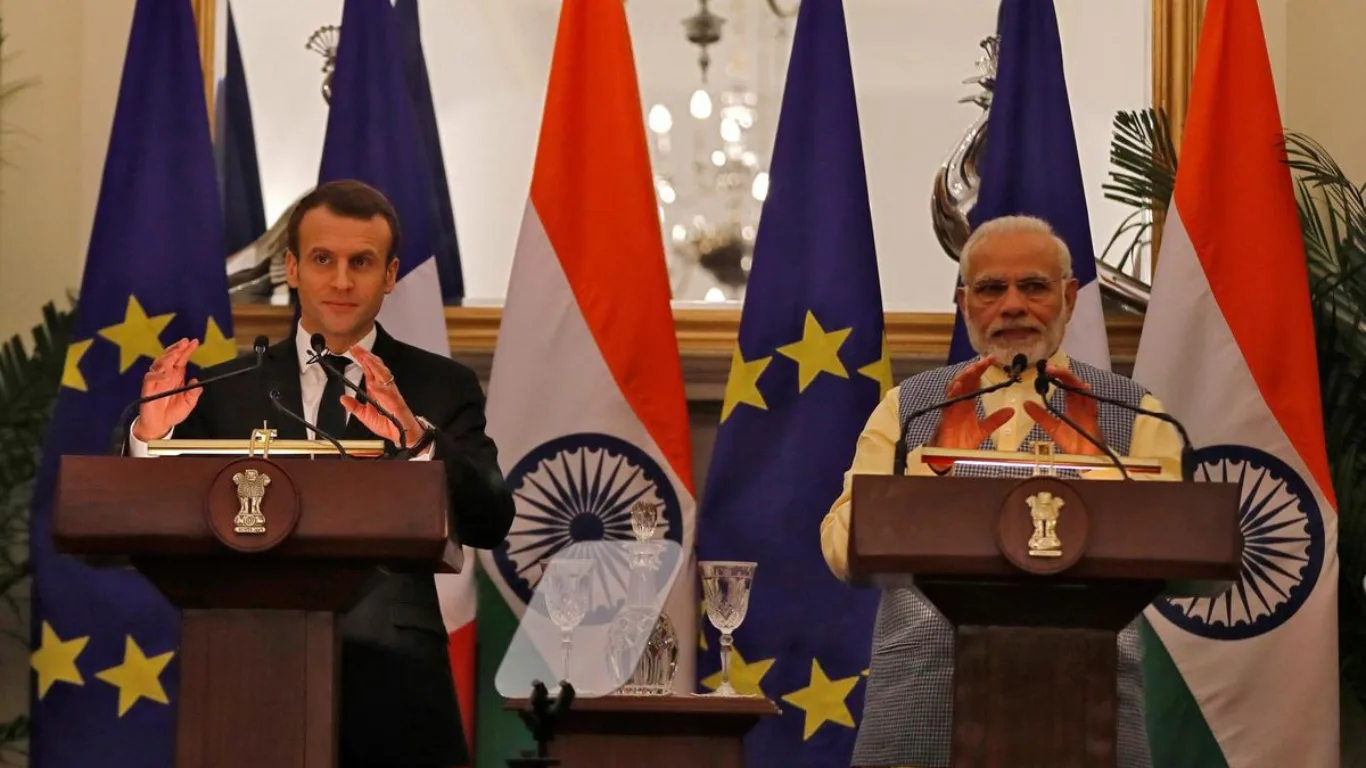
Modi in Paris: What India's VivaTech Moment and the France Visit Really Signal
Paris has a way of making things look grander than they are. But what PM Modi's Paris visit this week represents is not optics. It is architecture. Quiet, careful, and genuinely consequential.
Prime Minister Narendra Modi arrived in the French capital on June 18, 2026, completing the final leg of a five-day France trip that began in Nice, moved through the G7 Summit in Evian, and ended with two of the most symbolically loaded stops on the entire itinerary: the VivaTech 2026 summit and a diaspora community event. Both matter. But for very different reasons.
read more: 20 Rebel TMC MPs Merge With NCPI to Back NDA: The Political Gamble Reshaping Bengal's Power Equation
Why This France Trip Was More Than a Standard State Visit
India and France elevated their relationship to a Special Global Strategic Partnership earlier this year. That phrase sounds ceremonial until you look at what sits underneath it.
When Modi and French President Emmanuel Macron met for bilateral talks in Nice on June 14, both leaders expressed satisfaction at the excellent growth in bilateral defence collaboration and agreed to further intensify it with a focus on co-design, co-development, and co-production of defence platforms and advanced technologies.
That language, co-design and co-production, is significant. It signals that France is not just selling India weapons or technology. It is building them together with India. That is a different kind of relationship.
The two leaders also adopted an Innovation Roadmap 2030 to give the partnership long-term direction, agreed to create a Joint India-France AI Working Group, and noted the signing of 19 agreements among institutions in the innovation ecosystems of both countries. France also moved quickly on visa-free transit for Indian nationals, a practical, people-level benefit that rarely makes headlines but matters enormously to business travelers and students.
What VivaTech 2026 in Paris Actually Means for India
VivaTech is Europe's largest technology and startup festival. It draws venture capitalists, global tech firms, and innovation policymakers. And this year, India arrived with something it has never quite brought before: a national pavilion at scale, backed by a policy framework it is actively promoting to the world.
India was designated as the official AI Country Partner at VivaTech 2026, erecting one of the largest national pavilions in the event's history, under the civilizational theme of Tech for Humanity.
Modi used the platform to present India's MANAV Vision for artificial intelligence governance. MANAV stands for a framework that positions AI development as ethical, human-centric, and inclusive, particularly for developing nations. The argument India is making is straightforward: the West built AI around profitability. India wants to build it around population-scale public good, the same logic that produced systems like UPI, CoWIN, and Aadhaar.
During the G7 Summit in Evian, Modi had already participated in a session titled Ensuring Safe, Rapid and Efficient Rollout of AI, where he underlined India's commitment to ethical and human-centric artificial intelligence development and highlighted India's MANAV Vision, stressing that technology should remain anchored in the principles of inclusivity, security, and public good.
The repetition of this message across G7 and VivaTech is deliberate. India is not just attending these events. It is showing up with a position.
read more: India Blocks Telegram for NEET UG 2026 Re-Exam: What the Government Did and Why It Had To
The Modi-Trump Moment That Caught Attention
On the sidelines of the G7 in Evian, Modi and US President Donald Trump met. The exchange was brief but notably warm in tone.
Trump praised the Indian Prime Minister, describing him as a "good-looking guy" and a "tough negotiator," and highlighted Modi's negotiating skills and political acumen, saying the Indian leader was far tougher in negotiations than his calm public image might suggest.
That framing, Trump publicly acknowledging Modi as a tough negotiator, carries weight at a moment when India and the United States are navigating active trade discussions. It is the kind of signal that negotiating rooms pay attention to.
read more: Operation Tiger Strikes: Seven Shiv Sena (UBT) MPs Set to Cross Over to Eknath Shinde's Camp
The Global South Thread Running Through Everything
There is a consistent undertone across Modi's entire France visit that is worth naming directly.
India has been actively positioning itself as a voice of the Global South, advocating for inclusive growth, fair trade practices, and equitable access to technology. At every forum, whether bilateral talks with Macron, the G7 session on AI, or the VivaTech stage, Modi returned to this theme: that the countries with the most people, the fastest-growing economies, and the least representation in existing global institutions deserve a bigger seat at the table.
At VivaTech, India's growing innovation ecosystem was on full display, while the diaspora interaction in Paris underlined the role of overseas Indians in strengthening bilateral ties. The diaspora component is often treated as a feel-good add-on. It is not. The Indian community in France is active in business, academia, and technology sectors. Engaging them directly is a form of soft power that builds trust in ways formal agreements cannot.
What Comes Next From This Visit
The Innovation Roadmap 2030 and the Joint AI Working Group are frameworks that will require follow-through. The 19 signed innovation agreements need implementation. The India-France defence co-production agenda will move at its own pace. None of this delivers immediate results.
But the architecture being built here is visible. India is no longer just a large market that others want access to. It is positioning itself as a co-creator of the rules, frameworks, and technologies that will shape the next decade.
Paris was the final stop. But the work it set in motion has barely started.
read more: Modi at the G7 Summit: India's Call for Trust, Maritime Safety, and a New Global Order
Disclaimer: This article is based on information available across the web. Parchar Manch does not take responsibility for its complete accuracy, as the content could not be fully verified.
FAQs
What was the main purpose of PM Modi's Paris visit in June 2026?
Modi attended VivaTech 2026 as the headline speaker, where India was the official AI Country Partner. He also engaged with the Indian diaspora in Paris. The Paris visit followed bilateral talks with French President Macron in Nice and the G7 Summit in Evian.
What is the India-France Special Global Strategic Partnership?
It is the highest level of formal bilateral relationship between India and France, elevated in 2026. It covers defence co-production, space cooperation, nuclear energy, AI, innovation, and people-to-people ties, backed by the Innovation Roadmap 2030.
What is MANAV Vision and why did Modi promote it at VivaTech?
MANAV is India's policy framework for AI governance that prioritizes ethical development, inclusivity, and public good over commercial profitability. Modi used VivaTech to present it as an alternative model for AI development, particularly suited to developing nations.
What defence outcomes came from the Modi-Macron bilateral talks?
Both sides agreed to deepen co-design, co-development, and co-production of defence platforms and advanced technologies. They also discussed expanding cooperation in space, including human spaceflight and space situational awareness.
Did Modi meet Trump during the France visit?
Yes, on the sidelines of the G7 Summit in Evian. Trump publicly described Modi as a tough negotiator with strong political acumen, a characterization seen as significant given ongoing India-US trade negotiations.