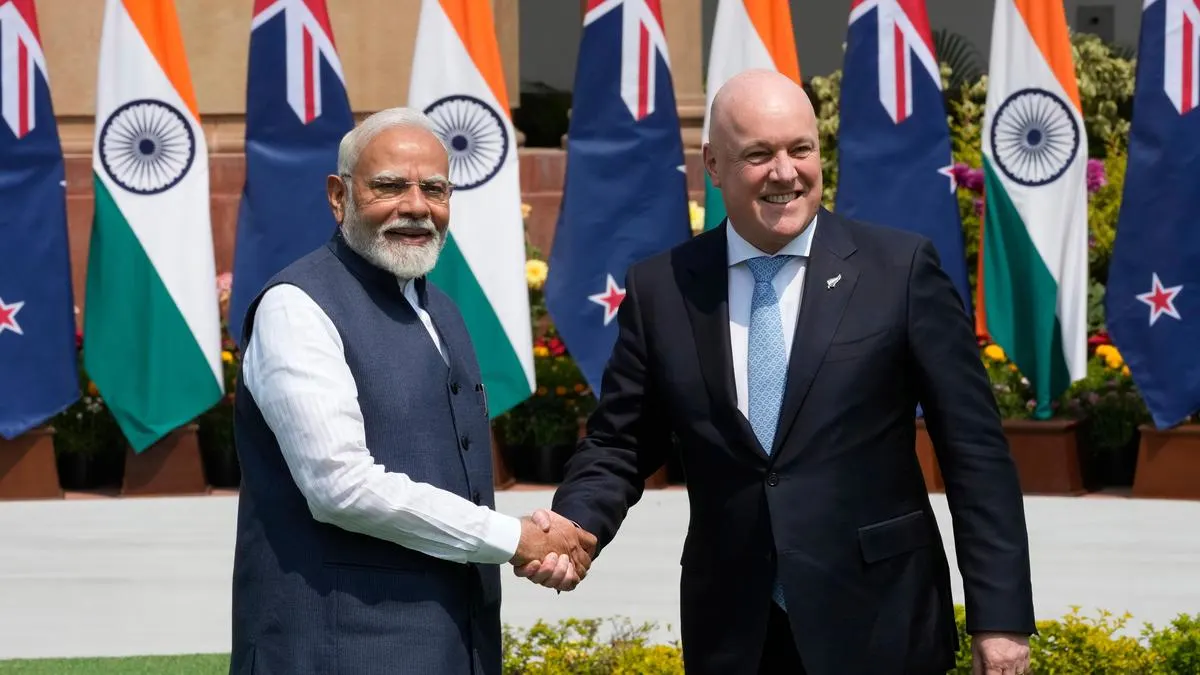
Modi New Zealand Visit: PM Set to Make Historic First Trip Next Week After 40 Years
Forty years. That is how long it has been since an Indian Prime Minister set foot in New Zealand. Now Narendra Modi is about to change that, and honestly, the timing could not be more interesting.
New Zealand Prime Minister Christopher Luxon confirmed the news himself, on X, calling it a moment worth celebrating. The Modi New Zealand visit is scheduled for July 10 and 11, with Modi arriving in Auckland on the Friday and departing the following day. Short trip. Big symbolism. People have speculated about this Modi New Zealand visit for months, particularly within New Zealand's Indian community, and now it is finally confirmed.
Why This Modi New Zealand Visit Actually Matters
Here is the thing people keep missing. This is not just a courtesy call between two leaders who like taking photos together. This is India's Prime Minister validating a relationship that, for decades, sat somewhere near the bottom of New Zealand's foreign policy priority list.
Luxon put it plainly. India is one of the world's largest and fastest growing economies, and he said it is a country of enormous importance to New Zealand's economic future. That is not diplomatic flattery, that is arithmetic. A market of 1.4 billion people does not need convincing language.
This Modi New Zealand visit also lands at a politically sensitive moment back in Wellington, which makes the Narendra Modi Auckland visit even more closely watched than a routine bilateral trip usually would be. There has been friction within the coalition government over immigration settings tied to the trade deal, with Foreign Minister Winston Peters accusing National ministers of quietly tightening rules for Indian migrants. So this visit is not happening in a vacuum. It is happening while the ink on a major agreement is still, in some sense, drying.
What the New Zealand India Trade Agreement Really Is
Let's break this down simply. In April 2026, India and New Zealand signed a New Zealand India trade agreement, formally a Free Trade Agreement, that removes tariffs on ninety five percent of goods coming from New Zealand. This is really the backbone the entire Modi New Zealand visit is built around. In return, all Indian exports into New Zealand become duty free.
Think of it like two neighbours who used to charge each other a toll every time they crossed into each other's property. Now, mostly, that toll is gone. Dairy, kiwifruit, apples, honey, these New Zealand exports get a real shot at India's massive consumer base. Meanwhile India secures cheaper access to raw materials it needs, things like wooden logs, coking coal, and scrap metal, inputs that feed its manufacturing engine.
How the Deal Is Meant to Work, Step by Step
- The FTA legislation is currently being pushed through New Zealand's Parliament, introduced just this week, so the visit lines up with implementation, not just signing.
- New Zealand has committed to encouraging up to USD 20 billion in investment into India over the next fifteen years.
- India has agreed to set up a dedicated "single desk" purely for New Zealand investors, meant to speed up approvals that usually crawl through bureaucracy.
- An agrotechnology partnership will help Indian farmers with expertise for kiwifruit, apple, and honey production, a slightly unexpected but genuinely practical add on.
Read More: Awarapan 2 Teaser Out: Emraan Hashmi Returns As Shivam Pandit After 19 Long Years
Real World Examples of What Changes
Picture an Indian pharmaceutical exporter who previously paid tariffs to sell in New Zealand. That cost mostly disappears now, meaning better margins or lower prices for the buyer. Now flip it. A New Zealand dairy cooperative that once found the Indian market hard to enter profitably suddenly has a clearer runway, assuming India's own dairy protections do not slow things down, something some Indian commentators are already worried about.
Mistakes People Keep Making While Reading This News
A lot of readers assume a one day visit means it is symbolic and nothing more. That is not quite fair. No, actually, let me rephrase that. Short visits between heads of government often carry more weight than week long tours, because every hour is scheduled around something specific, usually trade follow through and bilateral signing ceremonies.
Another mistake is treating the Modi Christopher Luxon meeting as purely economic. There is a security and strategic layer too. New Zealand sits inside a Pacific region where India wants a stronger diplomatic footprint, quietly countering the broader geopolitical picture involving China's regional influence. The Modi New Zealand visit, seen this way, is as much about positioning as it is about trade paperwork.
Read More: Mountain Lions in California Preserve: How One Predator Quietly Rewired an Entire Ecosystem
Pro Tips for Understanding This Story as It Develops
If you want to actually follow this properly, watch two things closely. First, how New Zealand's Parliament handles the pending FTA legislation this month, since political infighting could still slow implementation. Second, watch what specific sectors get named during the Modi New Zealand visit itself, tourism, education, and technology all have room to expand beyond what the FTA text currently covers. Anyone tracking the Narendra Modi Auckland visit closely should also keep an eye on joint statements released right after the Modi Christopher Luxon meeting, since those usually reveal more than the pre visit announcements ever do.
Closing Thoughts
There is something quietly telling about a forty year gap finally closing not with a grand gesture but with a tight, two day schedule. Maybe that is how modern diplomacy works now, less ceremony, more spreadsheet. Either way, the Modi New Zealand visit signals that India is no longer content playing a background role in the Pacific's economic conversations. Whether the follow through matches the announcement, well, that is the part nobody can promise yet.
Read More: Anti-Ageing Skincare Routine 2026: How to Reduce Wrinkles and Fine Lines Naturally
Disclaimer: This article is based on information available across the web. Parchar Manch does not take responsibility for its complete accuracy, as the content could not be fully verified.
FAQs
When exactly is the Modi New Zealand visit happening?
Modi arrives in Auckland on July 10 and departs on July 11, 2026, with the Narendra Modi Auckland visit and the Modi Christopher Luxon meeting both packed into this same tight window.
Why is this visit called historic?
Because it marks the first visit by an Indian Prime Minister to New Zealand in forty years.
What is the New Zealand India trade agreement about?
It is a Free Trade Agreement signed in April 2026 that removes tariffs on ninety five percent of New Zealand goods and makes Indian exports duty free.
How much investment is New Zealand promising India?
New Zealand has committed to promoting up to USD 20 billion in investment into India over fifteen years.
Is there any controversy around the visit?
Yes, there is internal disagreement in New Zealand's coalition government over immigration settings connected to the trade deal.
What sectors benefit most from the FTA?
Dairy, agriculture, and manufacturing inputs on New Zealand's side, and pharmaceuticals plus IT services on India's side are expected to see the earliest gains.