
Noida Workers and Police Clash: Inside the Wage Protest That Shook the City
When tens of thousands of factory workers walked out of their shifts and onto the streets of Noida in April 2026, it felt , to many observers , like a slow thunderstorm finally breaking. The tension had been building for years. Wages had not kept pace with inflation. Rent that quietly ate into every rupee. Neighbouring states announced double-digit wage hikes while Uttar Pradesh sat still. And then, like a match to dry tinder, it all caught fire.
The Noida labour protest is one of the most significant episodes of industrial unrest in India in recent years. It is not just about a few workers demanding more money. It is about a structural failure , in policy, in enforcement, and in the basic relationship between labour and capital in one of Asia's largest planned industrial townships.
What Happened: The Timeline of the Noida Industrial Unrest
On April 13, 2026, worker gatherings began across multiple industrial areas in Noida and Greater Noida. What started as scattered demonstrations at individual factory gates , including a peaceful protest outside the Ahuja factory , quickly scaled into something much larger. By the end of the first day, over 40,000 workers had mobilised across nearly 80 locations, blocking roads and halting movement across key industrial corridors.
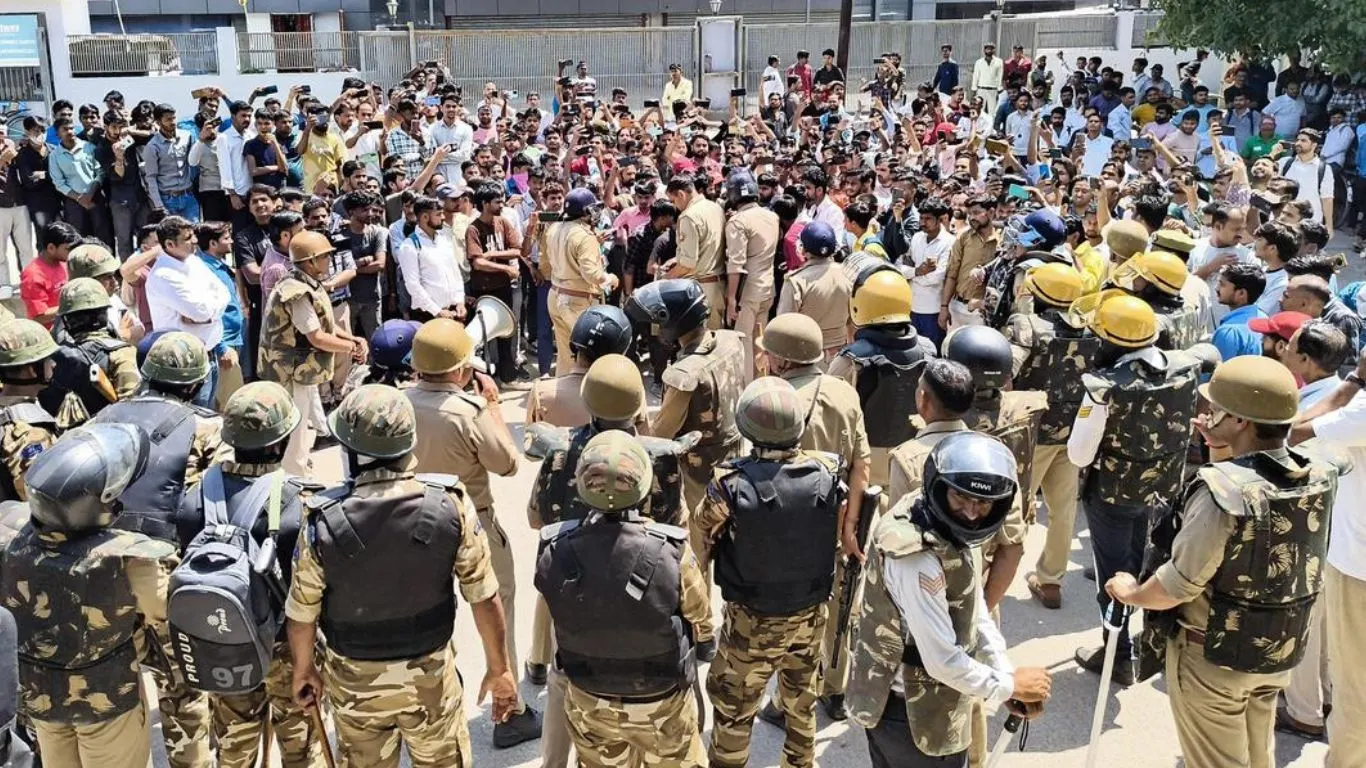
The Noida factory workers' protest turned violent. Vehicles were torched. Stones were pelted at the police. Near Sector 63 and the Motherson company premises, clashes broke out between protesters and security forces. Police responded with tear gas shells and baton charges, describing their actions as "minimum force" to maintain law and order. Noida Police registered seven FIRs and arrested over 300 individuals in connection with vandalism and arson.
By the second day, a fresh protest erupted in Sector 80, even as police attempted to explain the government's upcoming minimum wage hike to workers still demanding a monthly pay of at least ₹20,000. Heavy deployment , 15 companies of RRF, RAF, and PAC , was positioned across sensitive zones. Drone surveillance covered industrial sectors around the clock. The situation was controlled but fragile.
Why Did This Happen? The Real Reasons Behind the Protest
This is the question that matters most, and it deserves a direct answer.
The wage gap was the trigger, not the whole story.
- Workers in Noida's factories were earning between ₹11,000 and ₹13,000 per month for long shifts , sometimes 10 to 12 hours a day.
- Comparable workers in neighbouring Haryana, specifically in Gurgaon and Manesar, were earning close to ₹19,000 per month after the Haryana government announced a 35 per cent minimum wage hike.
- This cross-border disparity became impossible to ignore. Workers could see , through WhatsApp groups, social media, and conversations with friends , that identical labour in a neighbouring state was being paid far more.
- On top of this, living costs in the NCR region had risen sharply, further widened by global fuel supply disruptions. A room in Noida's worker colonies costs more than it did three years ago. Food costs more. Commuting costs more.
The UP wage structure also failed to account for regional differences. Earlier frameworks applied uniform minimum rates across all districts, making no distinction between a rural area and an industrial mega-hub like Noida , a city that houses thousands of industrial units and is among the largest planned industrial townships in Asia.
Workers were not just underpaid in absolute terms. They were structurally disadvantaged by a policy that treated Noida the same as a small-town district , and that bitterness had been accumulating quietly for years.
Read More: Why China’s Wang Yi Is Skipping the BRICS Delhi Meet — And What It Signals for Global Diplomacy
How the Noida Workers' Protest Escalated
The speed at which the protest spread across Noida's industrial belt highlighted how quickly workers can mobilise through digital communication and local networks. Instead of being coordinated by a single labour union, the demonstrations reportedly grew through WhatsApp groups, conversations among co-workers, and word-of-mouth across neighbouring factories.
According to reports, many workers initially raised their concerns within their own manufacturing units before joining employees from nearby factories who had already gathered outside. As more workers left their workplaces, the protest expanded rapidly, affecting multiple industrial areas within a short period.
Investigating agencies later stated that several WhatsApp groups were actively used to coordinate information during the demonstrations. Authorities also alleged that certain social media accounts shared misleading or provocative content while the unrest was unfolding, leading to multiple FIRs as part of the investigation. Officials are continuing to examine whether online misinformation contributed to the escalation of tensions.
However, while digital platforms may have accelerated the spread of information, labour experts point out that worker dissatisfaction over wage-related issues had existed well before the protests began. Concerns surrounding salaries, working conditions, and employment security had been building over time, making the situation increasingly sensitive. The incident therefore reflects both the growing influence of digital communication in labour movements and the importance of addressing workplace grievances before they develop into large-scale public demonstrations.
The Government Response: What Was Announced
The Uttar Pradesh government, led by Chief Minister Yogi Adityanath, moved relatively quickly to announce an interim minimum wage hike, effective retrospectively from April 1, 2026:
- Unskilled workers in Noida and Ghaziabad: Monthly wages increased from ₹11,313 to ₹13,690 , a 21 per cent hike.
- Semi-skilled workers: Rose from ₹12,445 to ₹15,059 per month.
- Skilled workers: Increased from ₹13,940 to ₹16,868 per month.
- In areas with municipal corporations elsewhere in UP, the hike is 15 per cent; in the remaining parts of the state, 9 per cent.
Read More: Iran-Israel War LIVE: Middle East Tensions & Global Stability
A Wage Board was announced to be constituted in the following month to determine long-term wage structures through consultations with employers, industry bodies, and worker unions.
The government also addressed misinformation directly, clarifying that reports of a ₹20,000 fixed minimum wage circulating on social media were "completely baseless."
CM Yogi Adityanath appealed to industries to ensure timely wages, overtime pay, weekly holiday bonuses, social security benefits, and safe workplaces , particularly for women workers.
A Real Example: What a Worker Actually Earns and Spends
Let's make this concrete, because numbers on paper can feel abstract.
Take a migrant worker from Bihar working in a garment factory in Noida. Before the wage revision, they earned approximately ₹11,313 per month. Here is what their monthly expenses might look like:
- Rent for a shared room in a worker colony: ₹3,000–4,000
- Food (basic meals, often cooked on a shared stove): ₹3,500–4,500
- Commuting to and from the factory: ₹500–800
- Money sent home (remittance to family): ₹2,000–3,000
That leaves, at best, ₹1,000 to ₹2,000 for anything else , medical expenses, clothing, phone recharge, emergencies. As one BBC report asked pointedly: "How does one survive?" It is not rhetorical. It is arithmetic.
Even after the 21 per cent hike, a worker earning ₹13,690 is still far below the ₹19,000 that comparable workers in Haryana now receive. The gap has narrowed. It has not closed.
The Mistake: What Went Wrong Before This Boiled Over
With the benefit of hindsight, several failures stand out:
- The uniform wage framework that treated Noida the same as rural UP ignored decades of urbanisation and rising living costs in the NCR belt.
- Lack of proactive engagement with worker unions before the crisis. The Haryana government had already announced a 35 per cent hike. There was time for UP to act , before workers came out into the streets.
- Delayed enforcement of existing minimum wage laws. Reports indicate that many factories were not even paying the legally mandated minimum wage that was already in place before the protest. Enforcement, not just legislation, is the missing link.
- Employers are failing to adjust wages despite rising productivity. Forbes India noted that UP workers had seen productivity gains in manufacturing, but wages had not moved proportionally , a gap that compounds resentment over time.
- Dismissing early signals. Small protests and worker complaints had been building for months. They were not treated as warnings.
Pro Tips: What Workers, Industry, and Policymakers Can Learn
For workers:
- Document your wage slips and working hours carefully. If you are paid below the notified minimum wage, you have a legal right to file a complaint with the labour department.
- Organise through registered trade unions where possible , they provide legal standing and negotiating power that informal groups do not.
- Be cautious of unverified information spreading on social media during periods of unrest. Misinformation can lead to situations that harm the very cause being fought for.
For employers and factory owners:
- The Noida industrial unrest is a reminder that wage suppression is not a sustainable cost-control strategy. Low wages create high turnover, reduced productivity, and , eventually , exactly this kind of costly disruption.
- Proactively communicate with workers and engage with wage revision processes. Companies that had dialogue channels with their workforce fared better during these protests than those that did not.
For policymakers:
- Regional differentiation in minimum wage policy is not a luxury , it is a necessity in a country as economically varied as India.
- A Wage Board is a good step, but its recommendations need enforceable timelines. Historical wage boards in India have often produced recommendations that gathered dust.
- Social security for informal and contract workers , provident fund, health coverage, compensation for injuries , must be part of any sustainable industrial labour framework.
Is This Bigger Than Noida? The Larger Picture
Yes , and that may be the most important thing to understand about this episode.
The Noida workers' unrest is not an isolated event. Labour economists and reporters covering this story have noted that it is part of a broader pattern of mobilisation across the National Capital Region, including earlier protests in Manesar and Gurgaon. Workers in different industrial hubs are increasingly comparing wages and conditions across state lines, creating cross-border pressure on state-level labour policy in India.
Globally, the context matters too. Living costs have risen sharply as fuel supply disruptions continue to push up prices across supply chains. The squeeze workers feel in Noida is connected, in a diffuse but real way, to macro pressures well beyond any single factory gate.
The phrase "labour market friction" , used in some business press coverage , is technically accurate but somewhat sanitising. What happened in Noida is better understood as a rupture: the visible breaking point of a system that had been under strain for a long time.
Read More: BlackRock's Larry Fink Calls the AI Bubble Theory Dead Wrong — "We Have a Severe Shortage, Not a Surplus
Conclusion
The Noida workers' protest and subsequent police clash brought national attention to long-standing concerns surrounding wages, labour rights, and working conditions in one of India's largest industrial hubs. While the immediate trigger was the demand for better wages, the incident also highlighted broader issues such as rising living costs, employment security, social protection, and effective implementation of labour laws.
Following the unrest, the government's decision to revise minimum wages and announce additional labour welfare measures marked an important step toward addressing workers' concerns. However, policy announcements alone are unlikely to deliver lasting change unless they are supported by consistent enforcement, timely compliance by employers, and stronger protection for contract and migrant workers.
The incident serves as a reminder that sustainable industrial growth depends not only on investment and production but also on fair wages, safe working conditions, and constructive dialogue between workers, employers, and government authorities. Addressing labour grievances through communication and policy implementation can help reduce future conflicts while creating a more balanced and resilient industrial ecosystem.
Ultimately, the Noida workers' protest reflects the growing importance of balancing economic development with worker welfare. Ensuring fair labour practices and responsive governance will remain essential for maintaining industrial stability and protecting the interests of both businesses and employees.
Read More: Why Iran and Israel are at War: 2026 Conflict & Operation Epic Fury Explained
FAQs
What was the main cause of the Noida workers' protest in 2026?
The primary cause was a significant wage gap. Workers in Noida were earning ₹11,000–₹13,000 per month while comparable workers in neighbouring Haryana received close to ₹19,000 after a 35 per cent minimum wage hike was announced there. Combined with rising living costs in the NCR region, this disparity triggered the unrest.
How many workers were involved in the Noida labour protest?
Over 40,000 workers mobilised across nearly 80 locations in Noida and Greater Noida during the first day of protests on April 13, 2026.
What was the government's response to the Noida industrial unrest?
The UP government announced an interim minimum wage hike effective from April 1, 2026. Unskilled workers in Noida and Ghaziabad received a 21 per cent increase, taking their monthly wage from ₹11,313 to ₹13,690. A Wage Board was also announced to determine long-term wage structures.
Were there any arrests during the Noida factory workers' protest?
Yes. Noida Police registered seven FIRs and arrested over 300 individuals in connection with vandalism and arson. Over 400 total arrests were made across the duration of the unrest.
What role did social media play in the Noida protest?
Police identified at least 17 WhatsApp groups used during the mobilisation, and flagged Pakistan-based social media accounts that allegedly spread misinformation. However, the underlying causes were economic, not social-media driven.
Is the new minimum wage of ₹20,000 per month official for Noida workers?
No. The UP government explicitly clarified that reports of a ₹20,000 fixed minimum wage circulating on social media are baseless. The revised minimum for skilled workers in Noida is ₹16,868 per month.