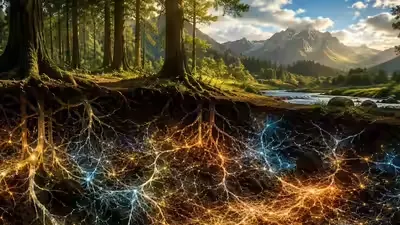
Scientists Just Mapped Earth's Underground Fungal Network and the Scale Is Almost Impossible to Comprehend
Beneath every forest, every grassland, every backyard garden, there exists a living system so vast that if you stretched it out into space, it would cover roughly ten percent of the Milky Way. This is not a metaphor. It is the result of the first global map of underground fungal networks, published in the journal Science, and the numbers involved are the kind that take a moment to actually land.
Scientists have estimated that the world's topsoils contain approximately 110 quadrillion kilometers of living fungal filaments. That is almost one billion times the distance between the Earth and the Sun. And until now, we had no real picture of where all of it was, how dense it was, or how much of it was quietly disappearing.
Why the Global Fungal Network Map Is One of the Most Important Studies of 2026
Most people think of fungi as mushrooms. A few think of bread or beer fermentation. Very few think of them as a planetary life-support system. But that is exactly what they are.
Arbuscular mycorrhizal fungi, known as AM fungi, form symbiotic trade relationships with roughly 70 percent of plant species on Earth. The fungi provide nutrients and water in exchange for carbon produced by plants. Strip out these networks and you do not just lose some underground threads. You lose the mechanism by which most plants absorb nutrients. You destabilise ecosystems that billions of people depend on for food, clean water, and climate stability.
Each year, arbuscular mycorrhizal fungi channel an estimated 3.12 billion tonnes of CO2 equivalent from plant photosynthesis into the soil and collectively contain around 300 megatonnes of carbon. That is a climate function, running silently, without any policy framework protecting it.
What the Underground Fungal Network Actually Is
Think of it as the internet of the plant world, except it has been running for hundreds of millions of years. The mycorrhizal network is made of hyphae, which are thread-like filaments so fine they can penetrate soil gaps that plant roots cannot reach. Plants send carbon down through their roots. Fungi absorb it and, in return, ferry back phosphorus and nitrogen. The exchange is ancient and deeply mutual.
Their hyphae explore soil that roots cannot reach. The fungi are invisible to the naked eye and form partnerships with the roots of most land plants. It is a relationship that predates trees. Predates forests. It is older than almost anything complex on land.
How Scientists Built the First Global Fungal Map
The map was created using data from over 16,000 soil cores from around the world. These cores, taken from sites across continents, gave researchers a physical sample of what was actually present underground at each location. The team then used that data to model fungal density and biomass across the entire planet, producing the first high-resolution estimate of where these networks are thriving and where they are thinning.
The next step, according to the team, is to refine the map with more local data and to monitor changes over time. What they built is a foundation. A baseline. The kind of tool that can tell scientists in twenty years whether things got better or worse.
Read More: Ram Temple Donation Fraud: How Scammers Are Exploiting Faith and What Devotees Need to Know
Where the Networks Are Most Concentrated and Most at Risk
Around 40 percent of these fungi are in grasslands, which are threatened by agriculture. That concentration in one of the world's most converted biomes is a serious concern. When grassland is tilled for farming, the fungal threads are broken. When synthetic fertilisers are applied, the chemical incentive for the plant-fungi exchange disappears and the network shrinks.
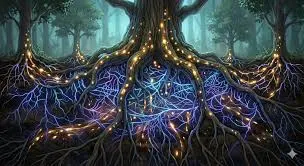
Less than 0.02 percent of Earth's terrestrial surface has been mapped for mycorrhizal fungi. That figure, coming from the researchers themselves, captures exactly why this study matters. We have been making land-use decisions, agricultural policies, and conservation strategies without understanding what we were standing on.
"The destruction of underground networks increases global warming, accelerates biodiversity loss, and disrupts nutrient cycles," said Dr. Toby Kiers, evolutionary biologist and professor at Vrije Universiteit Amsterdam.
A Thought Worth Carrying
There is something quietly humbling about this research. For all the attention paid to forests above ground, the system sustaining those forests has been almost entirely invisible in global conservation planning. The map changes that. It gives decision-makers something real to point at, defend, and protect. The Amazon forests of the underground, as one researcher put it, finally have a map.
Disclaimer: This article is based on information available across the web. Parchar Manch does not take responsibility for its complete accuracy, as the content could not be fully verified.
FAQs
What is the global underground fungal network?
It refers to the mycorrhizal fungal network, a vast web of microscopic filaments that live in soil and form partnerships with plant roots, exchanging nutrients for carbon.
How large is Earth's fungal network?
Scientists estimate there are approximately 110 quadrillion kilometers of living fungal filaments in the world's topsoils, a figure close to one billion times the Earth-Sun distance.
How was the global fungal map created?
Researchers used data from over 16,000 soil cores collected from around the world to model fungal density and biomass across all major land areas.
Why do mycorrhizal fungi matter for climate change?
Each year, arbuscular mycorrhizal fungi channel an estimated 3.12 billion tonnes of CO2 equivalent from plant photosynthesis into the soil, making them a significant and largely unrecognised part of the global carbon cycle.
Are underground fungal networks under threat?
Yes. Agriculture, deforestation, and soil erosion all damage these networks. Around 40 percent of these fungi are in grasslands, which are under direct threat from agricultural conversion.
Where was this study published?
The study was published in the journal Science by an international research team.