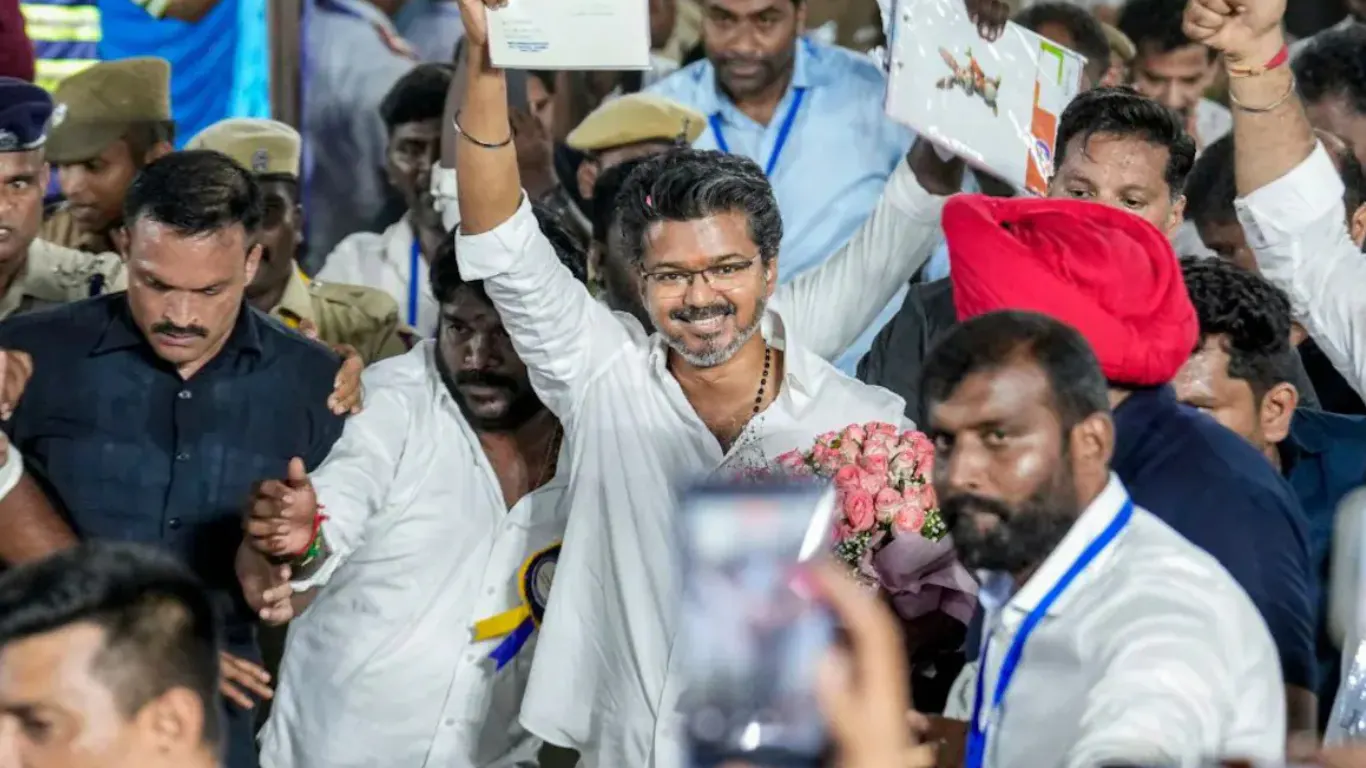
Tamil Nadu Hung Assembly 2026: Why Vijay's Historic Win Is Hanging by a Thread
The votes have been counted. The people of Tamil Nadu have spoken. And yet, as of today, nobody knows who will be the next Chief Minister of the state.
That is not a dramatic exaggeration. It is exactly what is happening.
Tamil Nadu's 2026 election results have produced something this state has not seen in decades , a genuinely hung assembly. Vijay, the former film actor-turned-politician who leads the Tamilaga Vettri Kazhagam (TVK), emerged as the single largest party. His supporters called it a revolution. But winning the most seats and forming a government are two very different things. Right now, TVK does not have the numbers. And what happens next will define Tamil Nadu politics for the next five years , maybe longer.
Why the Tamil Nadu Election Outcome Matters Beyond Just One State
Tamil Nadu is not a small state. It is one of India's most politically sophisticated electorates , a state with a proud tradition of Dravidian politics going back more than six decades. DMK and AIADMK have taken turns ruling this state since the 1960s. They built institutions, commanded loyalties, and shaped policy with a kind of competitive intensity that few states in India can match.
So when a first-time political party, led by a film star with no prior administrative experience, breaks into that duopoly and becomes the single largest party, that is genuinely significant. It tells you something about how voters feel. Something about disillusionment, aspiration, and the desire for something new.
The TVK election win is not just political news. It is a cultural shift. Tamil Nadu's voters did not accidentally elect Vijay's party. They chose it deliberately, knowing full well it was untested.
The problem is that "largest party" does not mean "majority." And without a majority, you cannot govern.
What a Hung Assembly Actually Means , Simply Explained
Most people hear "hung assembly" and assume something went wrong. Nothing went wrong. It is simply a situation where no single party or pre-election alliance wins enough seats to form a government on its own.
In Tamil Nadu's 234-seat assembly, a party needs at least 118 seats to claim a majority. If the numbers from the 2026 results are anything like what reports indicate, TVK has won more seats than any other party , but still falls short of that magic number.
Think of it this way. Imagine 10 people voting on where to go for dinner. If four vote for pizza, three for biryani, and three for dosas, pizza wins the most votes, but it does not have a majority. No one can move until someone changes their mind or agrees to combine.
That is Tamil Nadu right now. Everyone is waiting to see who changes their mind.
How Post-Election Alliance Negotiations Work , Step by Step
Once election results come in and no one has a majority, the process becomes almost entirely about floor management and political bargaining. Here is how it typically unfolds.
The Governor plays a central role first. The Governor invites the leader of the single largest party to prove a majority, typically within a stipulated time. TVK's Vijay has already met the Governor to stake his claim. That part is done.
Next comes the frantic behind-the-scenes work. TVK needs to pull smaller parties and independent MLAs into its camp to reach 118. Congress has already reportedly moved toward supporting TVK, which is significant, given that Congress was earlier part of DMK's alliance. Each of these decisions involves negotiation: cabinet berths, portfolios, assurances on policy positions.

Meanwhile, the rival camp tries to do the same thing but in reverse , prevent TVK from reaching the majority threshold. Reports suggest that AIADMK moved a group of its newly elected MLAs to a resort in Puducherry. This is a well-worn tactic in Indian politics: physically isolating MLAs to prevent them from being poached by the other side. It is not illegal. It is, in a grim way, standard operating procedure.
DMK, which lost power after years of being the ruling party, is in a peculiar position. Reports suggest DMK initially entertained overtures from AIADMK , their old rivals , possibly to block Vijay. But DMK's MK Stalin has since clarified that DMK will not disturb TVK and will give Vijay six months to prove his mandate. That statement, if it holds, changes the calculus significantly.
Real Examples: When Indian States Have Faced This Before
Tamil Nadu hung assembly situations are rare, but India has seen this play out many times elsewhere. Karnataka in 2018 saw BS Yediyurappa sworn in as Chief Minister with the BJP as the largest party, only to resign two days later after failing a floor test. Goa in 2017, Manipur in 2017, and Bihar in 2005 , all went through protracted post-election negotiations, broken alliances, and in some cases, re-elections.
The lesson from each of those episodes: the period between results and a stable government is genuinely volatile. Loyalties shift. Promises are made and broken. And the party that looked victorious on counting day is not always the one that takes oath.
Read More: Modi's Matua Gambit: The One Speech That Could Decide West Bengal's 2026 Election
Mistakes Politicians and Voters Make During a Hung Assembly
The biggest mistake is assuming the largest party will automatically govern. It will not, unless it secures numbers. Vijay's TVK cannot bank on moral authority alone , Indian constitutional law is clear that you need to prove a majority on the floor of the house.
Another common error is reading resort politics as confirmation of something concrete. MLAs being moved to Puducherry tells you AIADMK leadership is nervous about defections. It does not tell you the defections are certain. These are precautionary moves.
For ordinary voters, the mistake is disengaging. The next few days will determine whether their vote translates into the government they intended to elect.
What Should TVK Do Now , And What Experts Are Saying
TVK's most urgent task is straightforward: find the numbers. That means reaching out to smaller parties, independents, and any MLAs willing to cross over , though floor-crossing outside formal mergers is restricted under anti-defection laws.
Zoho founder Sridhar Vembu publicly called for fresh elections, arguing the numbers do not reflect a clean mandate. That is a legitimate position. But constitutionally, a fresh election is a last resort , only if the Governor finds no party able to prove majority after exhausting all options, does President's Rule or a re-election become realistic.
The more immediate reality is: every hour counts. The swearing-in ceremony, which was expected quickly after the results, has been delayed. That delay itself signals that the numbers are still being negotiated.
Closing Thoughts
What is happening in Tamil Nadu is not a failure of democracy. It is democracy at its most raw, messy, uncertain, and alive with consequence. A first-generation political party is attempting to translate an electoral breakthrough into actual governing power, while established players with decades of experience try to recalibrate.
Whether Vijay ultimately forms the government or not, the 2026 Tamil Nadu election hung assembly has already demonstrated something important: the old certainties of Dravidian politics are no longer certain. That, regardless of what happens in the next few days, is a remarkable thing.
Disclaimer: This article is based on information available across the web. Parchar Manch does not take responsibility for its complete accuracy, as the content could not be fully verified.
FAQs
What is a hung assembly in Tamil Nadu's context?
A hung assembly occurs when no single party wins a clear majority of 118 or more seats in Tamil Nadu's 234-seat legislature. In 2026, TVK won the most seats but reportedly fell short of this threshold, triggering post-election alliance negotiations.
What does TVK need to do to form the government?
TVK needs to secure support from enough smaller parties, independents, or allied MLAs to prove a majority of 118 seats on the floor of the assembly. Vijay has already met the Governor to stake his claim, but the swearing-in has been delayed pending confirmation of numbers.
Why were AIADMK MLAs moved to a Puducherry resort?
This is a common political tactic used to prevent MLAs from being persuaded or pressured to switch sides. By isolating its legislators in a controlled location, AIADMK leadership ensures its own numbers stay intact during the sensitive government-formation period.
What happens if no party can form a government?
If no party can prove a majority after the Governor's invitation, the Governor may explore other options, including inviting the second-largest party. If all options fail, President's Rule may be imposed, and fresh elections could follow , though this is a relatively rare outcome.
Did DMK support TVK in government formation?
DMK's MK Stalin reportedly stated that DMK will not block TVK and will give Vijay six months to govern. However, DMK has also been reported as rejecting a formal alliance with AIADMK, which would have created a different political outcome. The situation remains fluid.
What does this election result mean for Dravidian politics long-term?
The 2026 results suggest a significant disruption of the traditional DMK-AIADMK duopoly. TVK's rise as a new political force signals growing voter appetite for alternatives, particularly among younger Tamil voters who may feel disconnected from the decades-old Dravidian establishment.