The Night Indian Politics Changed Forever: BJP Storms Bengal, Vijay Rewrites Tamil Nadu
Something happened on the night of May 4, 2026, that political analysts had been debating for years , whether it was even possible.
The Bharatiya Janata Party won West Bengal. And a film star ended the DMK era in Tamil Nadu.
These were not close calls. They were not upsets in the way that word usually gets used , a narrow margin, a surprising constituency, a symbolic defeat. These were tectonic shifts. The kind that gets written about in political textbooks a decade later.
In West Bengal, the BJP secured a landslide victory over Mamata Banerjee's Trinamool Congress. In Tamil Nadu, actor-turned-politician Vijay's Tamilaga Vettri Kazhagam broke the long-standing DMK-AIADMK binary. In Kerala, the Congress-led UDF toppled the LDF government. And the NDA retained power in both Assam and Puducherry.
Five states. Five verdicts. And almost none of them went the way the ruling parties expected.
Read More: Modi in Gangtok: What Sikkim's 50 Years of Statehood Really Means for India's Smallest State
What Made This Election Unlike Any Before
Let us start with the numbers, because they tell a story that is hard to believe even in hindsight.
As many as 15.93 crore people voted across the four states and one Union Territory between April 9 and April 29. West Bengal recorded a voter turnout of 92.47 per cent , the highest since Independence.
That number deserves a pause. 92.47 per cent. In a state that has historically seen violence, intimidation, and booth management as part of its electoral culture. Whatever else happened on counting day, the people of Bengal turned out in extraordinary numbers. That alone is a story.
The BJP crossed the 200-seat mark in West Bengal, with 22 seats won and leading on 181 , a total of 203. The TMC had bagged 9 seats and was leading on 75, taking its total to 84.
For context, the West Bengal Assembly has 294 seats. The BJP needed 148 for a majority. It got 203. This was not a win. It was a rout.
The Fall of Mamata Banerjee
For 15 years, Mamata Banerjee was the Chief Minister of West Bengal. She was the face, the voice, the political identity of an entire state. She had defeated the Left. She had defeated the BJP in 2021 when most observers believed Narendra Modi's party would sweep through. She was, by any measure, one of the most formidable regional politicians in modern Indian history.
And then she lost Bhabanipur.
Suvendu Adhikari defeated Mamata Banerjee in Bhabanipur , the second time he has achieved this feat. He had earlier defeated her in Nandigram in 2021 by a narrow margin. This time, the margin was 15,000 votes.
Adhikari defeating Banerjee once was historic. Doing it twice makes it something else entirely. It signals that the result was not accidental, not stolen, not a statistical anomaly. Something shifted in how Bengal's voters felt about their chief minister.
What shifted, exactly? Several things at once. The RG Kar rape and murder case outrage, allegations of SIR (Special Intensive Revision) deletions of voters from rolls, and questions about post-poll violence from previous elections all contributed to an atmosphere where a significant portion of Bengali voters felt ready for change.
The TMC, for its part, did not accept the result quietly. Mamata Banerjee claimed that from 3 PM onwards, counting agents were beaten, CCTV cameras were switched off, and TMC agents were not allowed inside counting centres. Rahul Gandhi echoed the allegations, saying "more than 100 seats were stolen in Bengal."
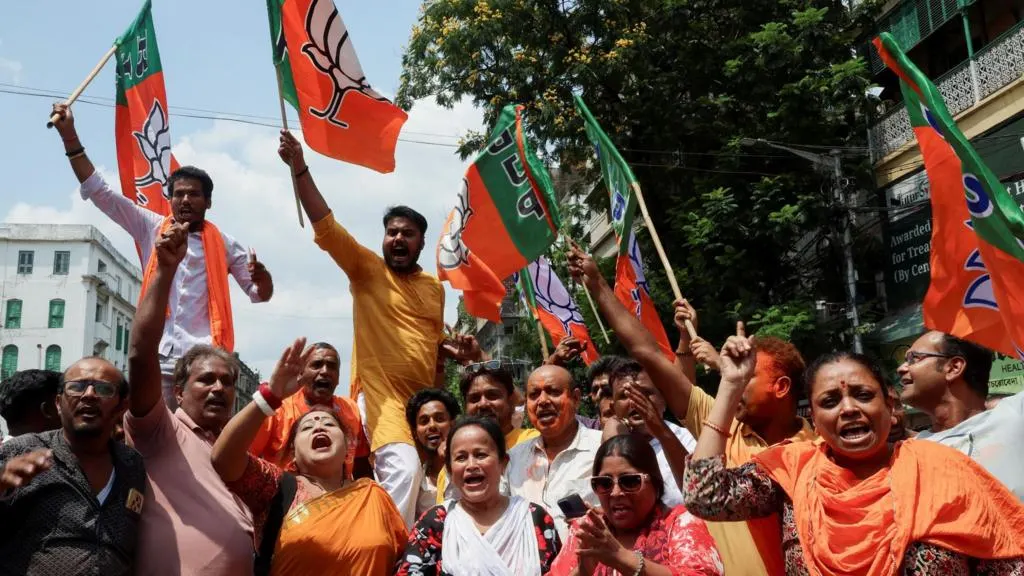
The Election Commission maintained there was no irregularity. The counting went forward. The BJP celebrated outside the Kalighat temple.
The BJP government in Bengal is scheduled to take oath on May 9.
The Vijay Effect in Tamil Nadu
If Bengal was the headline, Tamil Nadu was the earthquake no one fully predicted.
Actor-turned-politician Vijay's Tamilaga Vettri Kazhagam emerged as the single-largest party in Tamil Nadu. By 5 PM on counting day, TVK had won 15 seats and was leading on 94, putting it ahead of all rivals.
And then came the moment that stopped Tamil Nadu cold.
Tamil Nadu Chief Minister MK Stalin lost from Kolathur , a constituency that had been a DMK stronghold since 2011. TVK's VS Babu secured 82,997 votes against Stalin's 74,202, winning by a margin of 8,795 votes.

A sitting chief minister losing his own seat. In his own stronghold. To a political party that did not exist in its current form a few years ago. If you need a single image to capture how dramatically Tamil politics has shifted, that is it.
MK Stalin subsequently resigned as Tamil Nadu Chief Minister.
The AIADMK, which had been the other pillar of Tamil Nadu's two-party system for decades, was also humbled. AIADMK won 2 seats and was leading on 43 , a fraction of what it once commanded. The old binary that had defined Tamil politics for generations , DMK versus AIADMK , was effectively dismantled in a single night by a man who, not long ago, was best known for his action films.
Read More: Virat Kohli Becomes First Batter to Score 9000 Runs in IPL History: A Record Nobody Else Is Close To
Why Vijay Won: The Political Rise of Thalapathy
Tamil cinema stars have entered politics before. It is almost a tradition in the state. But Vijay's political project was different in its structure, its timing, and its appeal.
His party, TVK, built its base among young voters, women, and communities that felt unrepresented by both the established Dravidian parties. The TVK campaign focused on clean governance, anti-corruption promises, and the personal charisma of its founder , but without the baggage of either the DMK or AIADMK.
TVK's representatives described the victory as a mandate from women who saw Vijay "as their son, their brother, their family , an emotional, trustworthy leader." That framing tells you something about how the campaign was run. It was personal. It was relational. It was not the usual politics of caste arithmetic and freebies alone.
The Congress party, sensing a new centre of gravity in Tamil politics, sent a report to party president Mallikarjun Kharge urging an alliance with the Vijay-led TVK. That move, taken within hours of results becoming clear, signals how quickly the national parties are adjusting to the new Tamil political reality.
Kerala and the Broader Picture
In Kerala, the Congress-led UDF toppled the ruling Left Democratic Front, with UDF leading in 100 seats against the LDF's 34. That result completed a picture in which the political left, as a governing force across India, has effectively been extinguished.
As Al Jazeera noted in its analysis of these results, India may now have no state governed by a left-leaning party for the first time in over five decades. The implications of that for Indian political culture , for labour, for social policy, for the nature of opposition , will take years to fully understand.
Read More: Core Member Sandeep Pathak's Exit from AAP Hits Party the Most , And Here Is Why
The Mistakes Most People Are Making in Reading These Results
The temptation, after a night like this, is to declare a permanent verdict. BJP dominates India. Regional parties are finished. The Dravidian model is dead.
None of that is true, or at least not yet.
West Bengal has a new government, but it also has a deeply polarised electorate and credible allegations of counting irregularities that will not disappear. The BJP's challenge now is to govern a complex, diverse state where its support is wide but, in some areas, still shallow.
In Tamil Nadu, TVK has the most seats but not necessarily a majority. Coalition arithmetic will define what actually happens next. And a film star's popularity does not automatically translate into administrative experience or legislative discipline.
The results are real. The scale of the shifts is real. But the work of governing is different from the work of winning, and these results are the beginning of several long and complicated stories , not the end of them.
What This Means for National Politics
These five state results collectively represent the most significant restructuring of India's political map since the 2019 general elections. The BJP has now demonstrated it can break into Bengal , something that had seemed like a permanent ceiling. The opposition's flagship state-level governments have crumbled in one night.
But opposition politics in India rarely stays down for long. New formations emerge. Vijay's TVK is itself a reminder of that. The political energy in the country is shifting, searching, and in some states, choosing something entirely new.
The next test is already being discussed. Uttar Pradesh watches. Bihar watches. Every state assembly that votes before 2029 will be read through the lens of what happened on May 4, 2026.
Closing Thoughts
Indian democracy has, once again, surprised everyone who thought they understood it completely.
A chief minister losing her own seat. A film star is becoming the most powerful politician in Tamil Nadu. The BJP is governing Bengal for the first time. The left is disappearing from every statehouse in the country.
These results did not happen because of any single factor. They happened because millions of voters, in their own constituencies, made decisions that, taken together, produced something unexpected. That is the quiet power of a functioning democracy , even one as noisy, contested, and complicated as India's.
The victory rallies are starting. The allegations are being filed. The new governments are being formed. And somewhere in the political machinery of each losing party, serious people are sitting in quiet rooms, asking themselves what they missed.
Disclaimer: This article is based on information available across the web. Parchar Manch does not take responsibility for its complete accuracy, as the content could not be fully verified.
Read More: Modi's Matua Gambit: The One Speech That Could Decide West Bengal's 2026 Election
FAQs
Who won the West Bengal Assembly Election 2026?
The BJP won a landslide victory in West Bengal, crossing the 200-seat mark with over 203 seats. The TMC was reduced to around 84 seats. The BJP is set to form the government and take oath on May 9, 2026.
Did Mamata Banerjee lose her seat?
Yes. Mamata Banerjee lost the Bhabanipur constituency to BJP's Suvendu Adhikari by a margin of approximately 15,000 votes , the second time Adhikari has defeated her after Nandigram in 2021.
Who won the Tamil Nadu Election 2026?
Vijay's Tamilaga Vettri Kazhagam emerged as the single-largest party. The DMK and AIADMK both suffered major losses. MK Stalin lost his own seat in Kolathur and subsequently resigned as Chief Minister.
What happened in Kerala's 2026 Assembly Election?
The Congress-led United Democratic Front defeated the ruling Left Democratic Front, winning 100 seats. The result means India now has no left-governed state for the first time in over five decades.
What are the allegations of irregularities in West Bengal?
TMC alleged that counting agents were beaten, CCTV cameras were switched off, and party agents were denied entry into counting centres from around 3 PM. The Congress echoed these concerns. The Election Commission stated all procedures were followed correctly and initiated enquiries where formal complaints were received.