India Has Just 9 Days of Oil Left If Imports Stop. Here Is Why India's Strategic Oil Storage Policy Needs an Urgent Rethink
There is a number that should alarm every Indian, and almost nobody is talking about it loudly enough. If India's oil imports were to stop tomorrow, the country's strategic petroleum reserves would last roughly nine to ten days. That is it. Ten days before refineries slow down, fuel pumps run dry, and an entire economy built on imported crude starts to crack.
Japan keeps over 200 days of reserves. South Korea maintains a similar buffer. China has been building its stockpile quietly and aggressively for years. And India, the world's third-largest oil consumer, sits on a 10-day cushion.
Why India's Strategic Oil Storage Policy Is in the Spotlight Right Now
The recent tensions in the Strait of Hormuz made this vulnerability impossible to ignore. A large share of India's crude oil travels through that narrow waterway. When conflict erupts in the region, even temporary disruptions can send prices surging and supply chains into panic. The Iran war scare of 2026 exposed just how thin India's energy buffer really is.
The government's response has been swift. The Indian government has asked ONGC to build a new strategic oil reserve at Mangaluru at a cost of Rs 15,000 crore. Industry sources suggest India is now seriously mulling a national reserve policy that would push crude storage capacity to 100 to 150 days. That would be a transformational shift.
Read More: Ram Temple Donation Fraud: How Scammers Are Exploiting Faith and What Devotees Need to Know
What India's Strategic Petroleum Reserve Actually Is
Think of it as a savings account, but for oil. A country stores large quantities of crude in underground facilities or specially built tanks, not for daily use, but as insurance against supply shocks.
India currently has three Strategic Petroleum Reserve (SPR) facilities, managed by the Indian Strategic Petroleum Reserves Limited (ISPRL). These are located in Visakhapatnam, Mangaluru, and Padur. Together, they hold around 5.33 million metric tonnes of crude oil. That sounds significant until you realize India imports close to 4.5 million barrels per day. The math works out to roughly 9 to 10 days of import cover.
Operational stocks held by refineries add a little more buffer, but even those do not bring the total anywhere near what energy security experts consider adequate.
The Gap Between India and the World
The International Energy Agency (IEA) recommends member countries maintain at least 90 days of net import cover. India is not an IEA member, but the benchmark still holds as a standard for energy resilience.
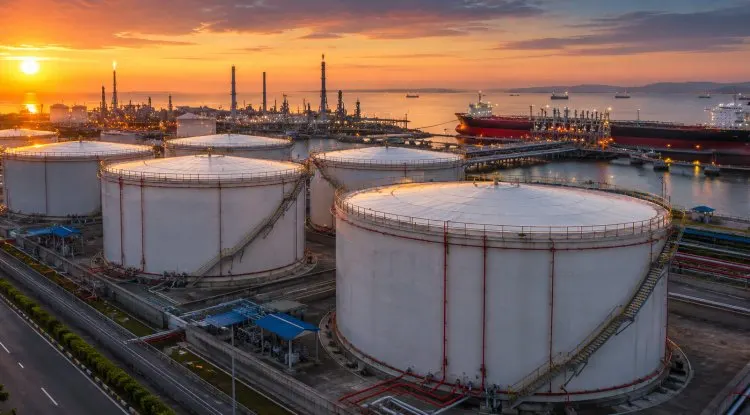
Japan and South Korea, both island nations that import virtually all their oil, have built over 200 days of reserves. They took the lessons of the 1973 Arab oil embargo seriously and never looked back. China, learning the same lesson decades later, has been on an aggressive oil stockpiling drive and now holds an estimated 80 to 100 days of cover.
India, despite being the world's third-largest oil consumer and importing over 80% of its crude needs, has lagged. The CEEW report flagged this as a structural vulnerability in India's energy security that goes well beyond just supply disruptions.
Read More: Twenty Rebel Trinamool Congress MPs to Merge with NCPI? The Political Buzz Raising Big Questions
Why India Has Not Built More Reserves Until Now
Building underground storage is enormously expensive. Land acquisition, construction, and maintenance of large crude oil storage facilities require sustained capital commitment over many years. The payoff is essentially invisible until a crisis hits.
There has also been a tendency to rely on diversified import sources as a substitute for actual physical storage. India buys crude from Saudi Arabia, Russia, Iraq, the UAE, and others. That diversity helps, but it is not the same as having oil sitting in a tank on Indian soil.
What the New Push Actually Means
The proposed ONGC project at Mangaluru is not just infrastructure. It is a signal that India's approach to petroleum reserves policy is shifting from passive diversification to active strategic stockpiling. If the 100 to 150-day target becomes policy, India would need to invest tens of thousands of crores over the next decade to build the capacity.
The China comparison is instructive. China began its strategic petroleum reserve program in earnest in the early 2000s after seeing how vulnerable it was during a price spike. Today, it is one of the world's most energy-secure large economies. India is now at a similar inflection point.
Closing Thoughts
A 10-day oil reserve in a country that runs on imported crude is not a policy. It is a hope. What is encouraging is that policymakers seem to have finally internalised the risk. The question is no longer whether India needs more storage. It is how fast the country can build it, and whether the commitment survives the inevitable budget pressures that follow the initial alarm.
Energy security is the kind of problem that demands patience and money in peacetime. The reward only becomes visible in a crisis. India has had its warning. The next decade will show whether it was heeded.
Read More: Keir Starmer to Announce Social Media Ban for Under-16s: What It Could Mean for Millions of Families
Disclaimer: This article is based on information available across the web. Parchar Manch does not take responsibility for its complete accuracy, as the content could not be fully verified.