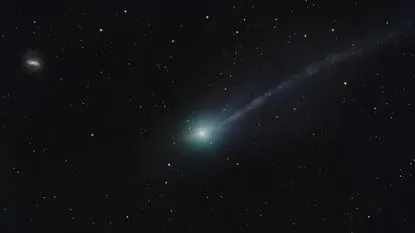
James Webb Just Cracked the Secret of Interstellar Comet 3I/ATLAS — and It May Be Older Than the Sun Itself
Something arrived in our solar system last summer. It was not from here. It came from another star possibly from a time before our Sun even existed and for a few months, every major space telescope humanity owns turned to look at it. The object is interstellar comet 3I/ATLAS, and what scientists have found inside it is quietly rewriting what we know about the early universe.
This is not a once-in-a-generation discovery. It might be a once-in-civilisation one.
What Is Interstellar Comet 3I/ATLAS and How Was It Found
On the morning of 1 July 2025, the NASA-funded ATLAS survey telescope at Rio Hurtado in Chile detected an unusual moving point of light against background stars. Within hours, follow-up observations confirmed something extraordinary: this was not a solar system comet on a long elliptical orbit. It was moving too fast, on too steep an angle, to have originated anywhere near the Sun.
It was moving at approximately 137,000 miles per hour. Even pulled by solar gravity at its closest point, the speed only climbed to 153,000 miles per hour. Nothing in our solar neighbourhood launches things that fast.
Scientists determined that 3I/ATLAS was interstellar because of its high velocity and its trajectory. The comet has an icy nucleus and a coma a bright cloud of gas and dust that surrounds it and grows as the comet approaches the Sun which is textbook comet behaviour. It was on what is called a hyperbolic trajectory, meaning it was moving too fast to be bound by the Sun's gravity, and therefore not following a closed orbital path. It simply passed through our solar system.
The name means exactly what it says: third interstellar object ever confirmed, found by the ATLAS telescope. Before this, there were only two 1I/Oumuamua in 2017 and 2I/Borisov in 2019.
Why 3I/ATLAS Is Different From Any Comet We Have Ever Seen
The previous two interstellar visitors were remarkable, but 3I/ATLAS is in a different category entirely.
As 3I/ATLAS began moving away from the Sun in December 2025, astronomers turned NASA's James Webb Space Telescope in its direction and captured detailed measurements of its chemical components. The comet was freshly warmed from its closest pass by the Sun, and its ancient ice had been converted to a bright coma of gas ideal for observation. Webb captured chemical ratios of carbon and deuterium also known as heavy hydrogen that are not found in solar system comets. The results surprised researchers.
Working backward, astronomers used these components to understand the environment in which 3I/ATLAS formed. A paper detailing the findings published in the journal Nature. "This was a unique opportunity to study an ancient object from the distant galaxy, probably pre-dating our Sun and solar system," said astrochemist Martin Cordiner of NASA's Goddard Space Flight Center.
Read More: Madhur Virli Rape Joke Controversy: Why India's Stand-Up Comedy Scene Is in Crisis Again
Scientists estimate 3I/ATLAS could be up to 11 billion years old more than twice as old as the Sun. A team led by the University of Michigan used the ALMA observatory in Chile's Atacama Desert to examine the comet and trace its origins to a cold, isolated corner of the galaxy that had not yet formed its own solar system.
Think about what that actually means. This chunk of ice formed before our Sun was born. It drifted through the Milky Way for billions of years. Then it happened to pass close enough to our small corner of the galaxy to be spotted by a telescope in Chile.
The odds of that are almost incomprehensible.
Read More: The Hidden Walking Rule Nobody Knew Existed: Why Humans Naturally Turn Counterclockwise
What NASA and ESA Learned Before It Left
More than a dozen NASA science missions trained their instruments on 3I/ATLAS, including Hubble, Webb, TESS, Swift, SPHEREx, the Perseverance Mars rover, Europa Clipper, Lucy, Psyche, and Parker Solar Probe. That list alone signals how seriously scientists took this window of opportunity.
3I/ATLAS reached its closest point to the Sun around 30 October 2025, at a distance of about 130 million miles, just inside the orbit of Mars. The comet came no closer than 170 million miles to Earth. There was no danger to our planet at any point.
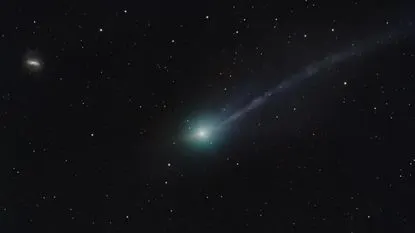
In April 2026, ESA released findings from the JUICE spacecraft reporting that 3I/ATLAS was emitting the equivalent of 70 Olympic swimming pools worth of water vapour per day, with most of that water vapour being emitted toward the Sun.
That much water, from a comet born around an older, colder star. The chemistry is not like ours. "So far, we know of only one place in the vast cosmos where chemical ingredients led to life our solar system, our Earth. Analysis of these interstellar objects is a major step toward learning how common, or uncommon, the conditions for the evolution of life are in the universe," said Stefanie Milam of NASA Goddard.
Where 3I/ATLAS Is Now
After its closest approach to the Sun in late October 2025, 3I/ATLAS began its journey back into interstellar space. Traveling on a clearly hyperbolic trajectory, it crossed beyond Jupiter's orbit in March 2026. By the early 2030s, it will have left the planetary region of the Solar System continuing its silent voyage through the galaxy, just as it once arrived.
It will not return. Ever. The data it left behind, though, will be studied for decades.
Read More: Twenty Rebel Trinamool Congress MPs to Merge with NCPI? The Political Buzz Raising Big Questions
Closing Thoughts
There is something humbling about the whole sequence of events. A telescope in Chile spotted a faint moving dot. Scientists ran the numbers. And what they found was a frozen messenger from a part of the galaxy older than our Sun, carrying chemical information about conditions we will never otherwise be able to observe directly.
"Thirty-five years from now, when astronomers have seen another thirty-five years' worth of data on interstellar comets, they're going to be asking different questions," said NASA's Tom Statler. "The way we leave a legacy so scientists of the future can answer the questions of the future is by having these data here and preserved for them to use."
3I/ATLAS is gone. But it left something behind.
Read More: Ebola Is Back and Spreading Fast: Everything You Need to Know About the 2026 Outbreak
Disclaimer: This article is based on information available across the web. Parchar Manch does not take responsibility for its complete accuracy, as the content could not be fully verified.
FAQs
What makes 3I/ATLAS an interstellar comet?
Its speed and trajectory. 3I/ATLAS was moving too fast to be gravitationally bound to the Sun. When traced backward, its path clearly originates from outside our solar system. It is only the third interstellar object ever confirmed.
Is 3I/ATLAS dangerous to Earth?
No. The comet came no closer than 170 million miles to Earth, well outside any danger zone. NASA confirmed there was no threat at any point during its passage through the solar system.
How old is interstellar comet 3I/ATLAS?
Scientists estimate it may be up to 11 billion years old, making it more than twice as old as our Sun. Analysis from the University of Michigan traces its origin to an ancient, isolated corner of the Milky Way that had not yet formed a solar system when 3I/ATLAS was created.
What did the James Webb Space Telescope find inside it?
Webb detected chemical ratios of carbon and deuterium that are not found in comets native to our solar system. These ratios point to formation around an older, lower-metallicity star in a very different environment from our own.
Can 3I/ATLAS return to our solar system?
No. Because it is on a hyperbolic trajectory, it will never orbit the Sun. It passed through once and is now heading back into interstellar space permanently.
What were the most important things scientists learned from 3I/ATLAS?
The comet provided direct chemical evidence of planetary formation conditions around an ancient star, offered data on water composition from another stellar environment, and opened new questions about whether the building blocks of life are common or rare across the galaxy.