
India-Africa Partnership Signals "Stability in a Turbulent World": What Jaishankar's Statement Really Means
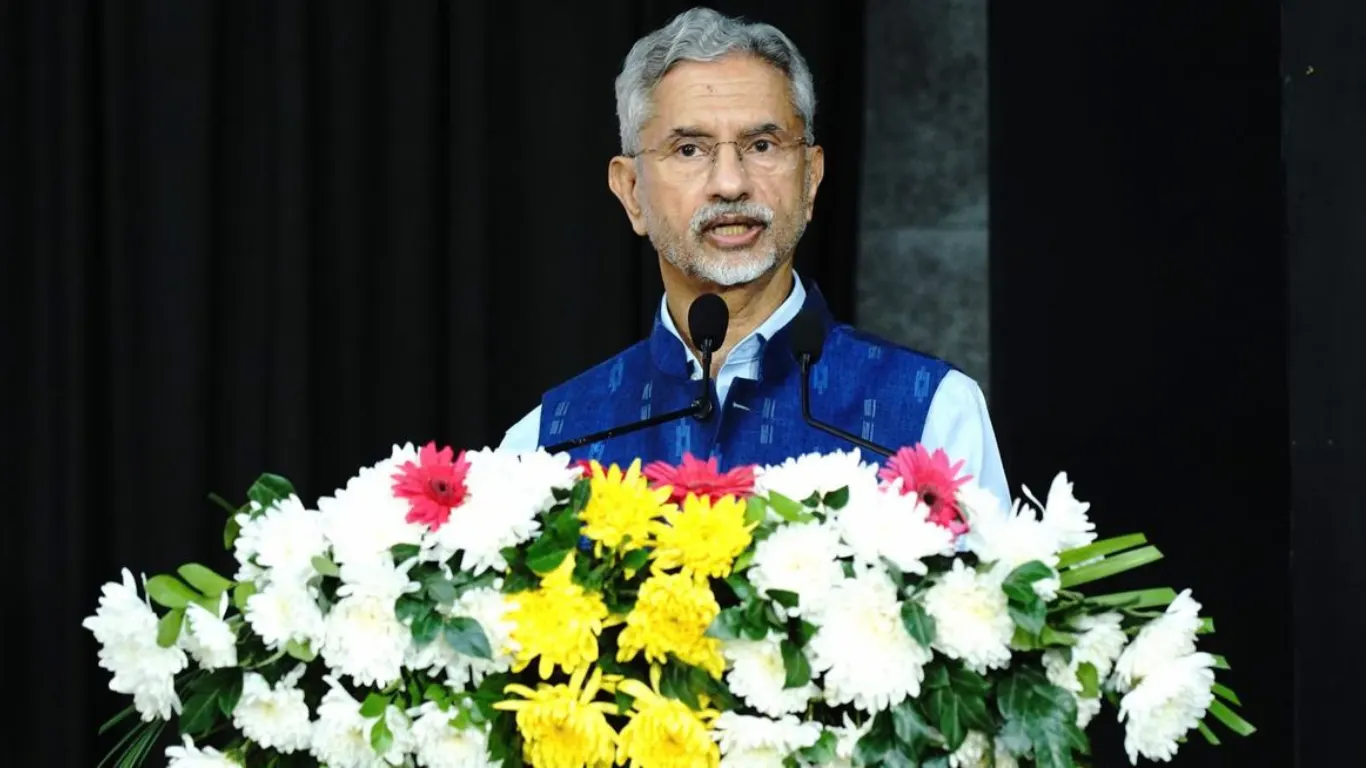
India-Africa partnership is not a new phrase. It has been used in speeches, summit communiques, and diplomatic handshakes for decades. But when External Affairs Minister S. Jaishankar stood before a room full of African ambassadors in New Delhi on April 23, 2026, and described these ties as a "message of stability in a turbulent world," something felt different. More deliberate. More urgent.
The occasion was the unveiling of the logo, theme, and official website for the upcoming India-Africa Forum Summit 2026 (IAFS-IV), scheduled for May 31 in New Delhi. The world outside that room was anything but calm. West Asia was still in crisis. Global supply chains were brittle. Great power rivalries were tightening. And yet, here was India signalling something quieter and perhaps more consequential: that some partnerships still work on trust.
Read More: Why Dhurandhar 2 is the Most Intense Revenge Story of the Year
Why the India-Africa Forum Summit 2026 Matters More Than Ever
The last time India hosted the India-Africa Forum Summit was 2015. A decade passed. The world changed enormously, and the relationship needed to catch up.
After a decade-long pause, the summit returns to a fractured global landscape. Against the backdrop of brittle supply chains and intensifying great power rivalries, India and Africa have an opportunity to send a crucial message by upholding a different kind of partnership.
That different kind of partnership is not built on conditionality or aid dependency. Jaishankar described this engagement as steered by a vision based on the "principle of equality," mutual respect, and collective advancement. That distinction matters, especially when African nations are being courted by multiple global powers with their own agendas.
The world is watching who shows up with what. India's answer, at least symbolically, was a lion.
What the IAFS-IV Logo Tells You
There is something quietly striking about the summit's official logo. The design features a lion superimposed on interlocked maps of India and Africa, carrying the theme 'Enduring Partnership, Shared Vision.' It reflects the primordial bond between India and Africa , regions once united as a single landmass, an ancient geological connection.
India and Africa were literally one, millions of years ago. The logo does not let you forget that. It is clever branding, yes, but it also anchors the summit's ambition in something older than politics.
The lion, native to both regions, carries that symbolism further. Jaishankar highlighted the lion as uniquely native to both India and Africa, symbolising pride, courage and a shared identity, bringing together the maps of two regions once united in a single landmass.
The IA SPIRIT Theme: Innovation, Resilience, Transformation
The summit will be held under the theme "IA SPIRIT: India Africa Strategic Partnership for Innovation, Resilience, and Inclusive Transformation," capturing the focus on co-creation, joint innovation and long-term development.
That acronym is doing a lot of work. Co-creation is different from aid. Joint innovation is different from technology transfer. The framing signals a shift from India offering something to Africa toward India and Africa building something together.
Read More: Why Iran and Israel are at War: 2026 Conflict & Operation Epic Fury Explained
The emphasis is increasingly on measurable outcomes rather than broad declarations. This matters because credibility in global partnerships is built on delivery.
The India-Africa relations development cooperation model being proposed here is not about charity. It is about building ecosystems , pharmaceutical clusters, digital infrastructure, fintech platforms, and human capital networks that serve both sides over the long run.
From Colonial Solidarity to Complementary Roadmaps
The historical foundation of India-Africa relations is something Jaishankar returned to deliberately. The relationship is "rooted in our civilisational linkages" and was forged through centuries of cultural and human exchange. These "bonds were further strengthened as India stood in solidarity with the African nations in their struggle against colonialism." The "shared history of struggle, solidarity, resilience and aspirations continues to shape our partnership."
But solidarity with the past is not enough. What makes the current moment compelling is that both India and Africa now have long-horizon development visions that align naturally.
Africa's Agenda 2063 articulates a continental ambition to transition from commodity dependence to diversified industrial and knowledge-driven economies. India's Viksit Bharat 2047 vision similarly reflects an aspiration to move beyond emerging economy status toward becoming a rule-shaping technological and economic power.
These are not identical goals. But they are compatible ones. Jaishankar pointed out that India's "Viksit Bharat 2047" vision and "Africa's Agenda 2063" serve as "complementary roadmaps" aimed at achieving prosperity through sustainable and inclusive growth.
Two regions. Two timelines. One general direction. That is nothing.
Read More: Strait of Hormuz Crisis 2026: Latest News on Shipping & Oil Supply
Diplomacy on the Ground: 46 Missions and 20+ Visits
One thing that separates rhetoric from commitment is presence. India has significantly bolstered its diplomatic presence on the continent, opening 17 new missions in recent years to reach a total of 46.
And Jaishankar himself has been there. He noted, "I myself have made more than 20 visits to African countries and our Ministers of State many more."
That level of personal diplomatic engagement is not accidental. It reflects a strategic decision to treat Africa not as a single bloc to address once every decade, but as a continent of 54 distinct nations, each with its own priorities, each deserving direct engagement.
The Global Governance Argument: AU in G20
One of the more consequential outcomes of recent India-Africa cooperation happened in 2023, at India's G20 presidency. India highlighted its consistent advocacy for Africa's "rightful place in global governance," citing the inclusion of the African Union in the G20 during India's 2023 presidency as a "seminal step" in this direction. This move reflected a "firm belief that the voices of the Global South must shape global governance in times to come."
Getting the African Union a permanent seat at the G20 table was not a small thing. It changed the composition of the most powerful economic forum in the world. It gave 55 African nations a collective institutional voice where previously they had none.
That is the kind of India-Africa strategic partnership that goes beyond bilateral trade figures. It reshapes how the world governs itself.
Defence, Digital, and the MAHASAGAR Vision
The S Jaishankar IAFS-IV address did not stop at diplomacy and development. It went into harder terrain. Defence, security and maritime cooperation play a central role in the engagement. Driven by the Vision MAHASAGAR, India is working closely with African partners to ensure the security and stability of the Indian Ocean region, combat piracy, promote safe and open sea lanes and collaborate in UN peacekeeping operations.
MAHASAGAR, India's maritime vision for the Indian Ocean, is a recognition that India and the eastern coast of Africa share a strategic geography. The Indian Ocean is not just a trade route.
Read More: New Flight Seat Rules 2026: 60% Free Seats & Family Seating Guide
It is a security domain. And keeping it stable requires partners who trust each other.
On the technology front, Jaishankar noted that going forward, India and Africa are pushing new frontiers in digital, fintech and innovation, reshaping economies across the African continent, with a stronger focus on co-creation, mutual investments and joint innovation.
India's digital public infrastructure model, including systems like UPI and Aadhaar, has real-world applications in Africa's rapidly expanding mobile-first economies. That is not a stretch. It is an existing conversation already underway in several African capitals.
What People Often Miss About This Relationship
Here is what gets underreported: this partnership is not primarily about India getting resources from Africa or Africa getting loans from India. India and Africa are positioned not only as development partners but as potential co-designers of the future architecture of development cooperation itself.
That framing changes everything. It means the goal is not for India to build a road in Kenya. The goal is for India and Kenya to co-design the regulatory and financing model for how roads get built across the Global South, and take that model to multilateral forums.
That ambition requires delivery. Announcements are easy. The long-term success of IAFS 2026 will be measured less by the scale of announcements and more by the durability of systems built.
Closing Thoughts
When Jaishankar said the India-Africa partnership is a message of "stability in a turbulent world," he was making an argument about identity, not just foreign policy. He was saying: in an era when global relationships are being transactional, extractive, or openly coercive, India and Africa choose something else. A shared history, complementary futures, and a seat at the same table.
The forthcoming IAFS-IV on May 31, 2026, provides a unique platform for both sides to exchange best practices, address shared challenges and expand cooperation in emerging areas.
Whether the summit delivers on that promise will depend not on the speeches but on what gets signed, funded, and actually built. History is watching. And so are 54 African nations, many of whom have heard these words before.
Disclaimer: This article is based on information available across the web. Parchar Manch does not take responsibility for its complete accuracy, as the content could not be fully verified.
Read More: Who Was Bhagat Singh? 10 Facts About the Young Hero
FAQs
What is the India-Africa Forum Summit (IAFS-IV)?
India will host the fourth India-Africa Forum Summit (IAFS-IV) on 31 May 2026 in New Delhi in partnership with the African Union Commission. The summit will focus on co-creation, joint innovation and long-term development under the theme "IA SPIRIT."
What does "IA SPIRIT" stand for?
It stands for India Africa Strategic Partnership for Innovation, Resilience, and Inclusive Transformation. The theme signals a shift from traditional aid-based cooperation toward co-development between equals.
How many African nations does India have diplomatic missions in?
India has opened 17 new missions in recent years, taking the total number of diplomatic missions across the African continent to 46.
What is Vision MAHASAGAR?
MAHASAGAR is India's strategic vision driving defence, security and maritime cooperation with Africa, focusing on the security and stability of the Indian Ocean region, combating piracy, and promoting safe and open sea lanes.
How are Viksit Bharat 2047 and Africa's Agenda 2063 connected?
Both frameworks focus on structural transition, moving from resource-dependent, input-driven economies toward technology-enabled, high-value production and stronger global governance roles. They are complementary long-term visions that make a sustained partnership logical, not just symbolic.
What was significant about the African Union joining the G20?
The inclusion of the African Union in the G20 during India's 2023 presidency was described as a "seminal step," reflecting the belief that the voices of the Global South must shape global governance going forward.