Scientists Built a Synthetic Cell That Grows and Divides, and It's Closer to Life Than Anything Made Before
There's a version of this story that sounds like science fiction. Chemists mixing fats, DNA, and proteins in a lab, watching a tiny bubble start to feed itself, grow, copy its own genetic code, and split into two. No living starting material involved. Just chemistry, assembled piece by piece. That's exactly what happened, and the synthetic cell that grows and divides now has a name. Researchers are calling it SpudCell.
Why This Actually Matters
Here's the honest reason to care about this beyond the wow factor. For decades, synthetic biologists could only recreate individual pieces of what makes a cell alive, feeding, dividing, replicating DNA, but never all of it together in one system built entirely from nonliving parts. SpudCell changes that. It's the first time a lab has strung together a complete cell cycle from scratch, and that milestone matters because it edges science closer to answering one of biology's oldest questions. How did nonliving chemistry first become life, roughly four billion years ago. It also opens doors toward engineered biological systems designed for specific jobs, from medicine to environmental cleanup.
Read More: West Bengal Post-Poll Violence Explained: What Is Happening on the Ground and Why It Refuses to Stop
What SpudCell Really Is, Explained Simply
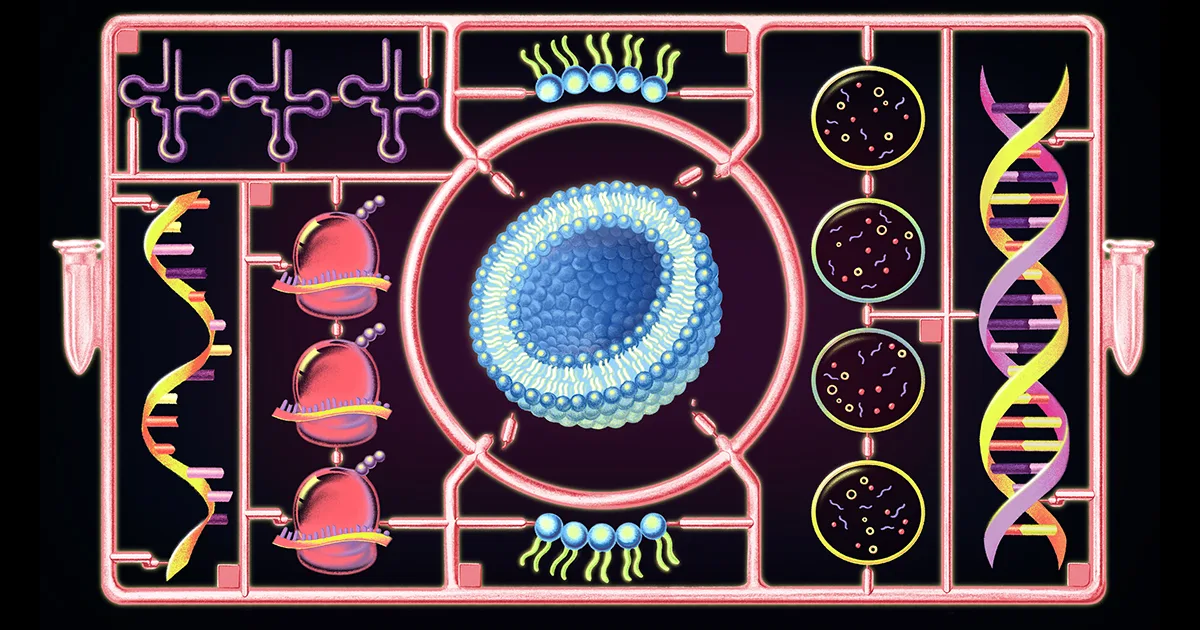
Think of a natural cell like a self-sufficient factory, importing raw materials, running its own machinery, and eventually splitting into two identical factories. SpudCell is a stripped down, simplified attempt at that same idea, built by researchers Kate Adamala and Aaron Engelhart at the University of Minnesota. It's made from just 150 to 200 molecules, compared to the billions found in a natural bacterial cell, so it's genuinely tiny and simple by comparison.
Instead of building its own complete metabolism, which would require far more genes than the researchers wanted to manage, SpudCell takes a shortcut. It fuses with tiny feeder liposomes, essentially small packets of nutrients, enzymes, and ribosomes, the machinery cells use to build proteins. That fusion gives SpudCell the raw materials it needs to grow, without requiring it to manufacture everything internally.
Read More: Core Member Sandeep Pathak's Exit from AAP Hits Party the Most , And Here Is Why
How the Synthetic Cell Cycle Actually Works, Step by Step
- Feeding. SpudCell produces a protein called alpha-hemolysin from its own DNA and inserts it into its membrane, using it to latch onto and fuse with nearby feeder liposomes.
- Growing. Once fused, the synthetic cell absorbs fresh membrane material and internal cargo, allowing its overall size to increase.
- Replicating DNA. Before dividing, SpudCell copies its genetic material, mirroring what natural cells do during their own cell cycle.
- Dividing. Unlike natural cells, which rely on an internal cytoskeleton to physically pull themselves apart, SpudCell accumulates proteins on its membrane until mechanical stress causes the membrane to split into two separate cells.
- Repeating. The whole cycle takes roughly 12 hours per generation, while the process is kept running at around 86 degrees Fahrenheit with external feeding support.
Real-World Evidence That Makes This More Than a One-Off Trick
Here's where it gets genuinely interesting. Researchers introduced a genetic change that boosted production of the fusion protein SpudCell uses to feed. The modified cells grew faster and produced more offspring than the unmodified ones.
After five generations, the faster growing version had completely outcompeted the original population, and that advantage became even stronger when nutrients were limited. That's a basic demonstration of natural selection happening inside an entirely synthetic system, something no prior artificial cell project had shown at this level.
Read More: Sun Pharma's $11.75 Billion Organon Acquisition: India's Biggest Pharma Bet Explained
Mistakes People Keep Making While Reading About This Discovery
A very common mistake is assuming SpudCell counts as living, artificial life. It doesn't, at least not by the usual definition. It can't survive without constant outside feeding, it can't run independently for long, and researchers are careful to describe the genetic changes introduced as engineered, not spontaneous mutations, meaning it technically doesn't evolve on its own yet. Another mistake is assuming this immediately unlocks dangerous biotechnology. Experts have pointed out there are far simpler methods available to create harmful organisms, so this specific achievement isn't a shortcut to that kind of risk.
Pro Tips for Understanding Synthetic Biology News Like This
If you want to follow this field without getting lost in hype, pay attention to the word cycle. A cell cycle means feeding, growing, replicating, and dividing all working together, which is a much bigger deal than any single function alone. Also watch how many generations a synthetic system can sustain, since that number tells you how close, or far, a project actually is from true self-sufficiency.
Closing Thoughts
Somewhere between chemistry and biology, there's a blurry line that scientists have been circling for years, and SpudCell just nudged that line a little further than anyone had managed before. It's not alive, not yet, maybe not ever in the way we usually mean that word. But watching a bag of molecules feed, grow, and split into two, entirely from nonliving parts, is the kind of quiet, patient progress that eventually rewrites what we thought was possible.
Disclaimer: This article is based on information available across the web. Parchar Manch does not take responsibility for its complete accuracy, as the content could not be fully verified.
FAQs
What is SpudCell?
SpudCell is a synthetic cell built from nonliving chemical components by researchers at the University of Minnesota, capable of completing a full cell cycle.
Is SpudCell considered alive?
No, most scientists, including the researchers themselves, say SpudCell isn't alive by standard definitions since it can't survive without external feeding.
How does SpudCell get nutrients?
It fuses with small feeder liposomes that supply the molecules, enzymes, and ribosomes it needs to grow.
How long does it take SpudCell to divide?
Roughly every 12 hours, much slower than natural bacteria like E. coli, which divides in about 30 minutes.
Why is this discovery considered important?
It's the first synthetic cell to demonstrate a complete life cycle, combining feeding, growth, DNA replication, and division in one engineered system.