
West Bengal Election Results 2026: BJP Wins Historic Majority With 206 Seats, TMC Reduced to 81 in Stunning Verdict
West Bengal election results 2026 have delivered one of the most dramatic political shifts in the state's modern history. The Bharatiya Janata Party has crossed the majority mark of 148 seats in the 294-member West Bengal Legislative Assembly and then some. With 206 seats confirmed in the Election Commission of India's latest count, the BJP has not just won an election. It has redrawn the political map of a state that was, for 15 consecutive years, ruled by Mamata Banerjee's Trinamool Congress.
The final seat count stands at 293 out of 294 results declared. One seat Falta Assembly constituency — remains pending due to a re-poll ordered on May 21, with results expected on May 24. But the arithmetic is settled. BJP: 206. AITC: 81. INC: 2. AJUP: 2. CPI(M): 1. AISF: 1.
That is not a narrow win. That is a rout.
What Happened in West Bengal's 2026 Assembly Election
West Bengal voted in two phases April 23 and April 29, 2026. Voter turnout hit a historic 92.93%, the highest the state has ever recorded, surpassing even the landmark 2011 election. When that many people come out to vote, they are not coming out to maintain the status quo.
For context: in the 2021 assembly elections, the Trinamool Congress had won 215 of 294 seats. Mamata Banerjee had been sworn in as Chief Minister for a third consecutive term. The BJP, despite an aggressive national-level campaign, had managed only 77 seats. The political wisdom at the time was that Bengal was TMC's fortress, and the BJP was still finding its feet in the state.
Five years later, those numbers have flipped almost completely. TMC went from 215 seats to 81. BJP went from 77 seats to 206. If that kind of reversal happened in corporate earnings, analysts would call it a structural collapse. In politics, it is called a mandate.
The Issues That Shaped This Election
No election result this decisive happens in a vacuum. Several overlapping debates shaped the 2026 West Bengal assembly election, and understanding them matters not just for political watchers, but for anyone trying to understand what voters were actually thinking.
The Special Intensive Revision (SIR) of Electoral Rolls
This became one of the most contested issues of the entire campaign. The Election Commission conducted a Special Intensive Revision that removed approximately 9 million voters from the electoral rolls in West Bengal roughly 12% of the electorate. Over six million were categorised as absentee or deceased. The status of 2.7 million remained pending before tribunals when voting began.
Observers noted that around 65% of the voters in the undecided category were Muslims, while Dalit Hindus particularly from the Matua community were also significantly affected in certain districts. The TMC argued the exercise risked disenfranchising genuine voters. The BJP called it a necessary cleanup of bogus entries and illegal migrants. The courts were watching. So were the voters.
Anti-Incumbency After 15 Years
Fifteen years is a long time to run a state government. Anti-incumbency sentiment was consistently noted throughout the campaign particularly around issues of job creation, delayed recruitment examinations, and corruption linked to the state's recruitment scandal. The BJP placed jobs and industrial revival at the centre of its pitch. TMC countered with welfare schemes and infrastructure promises. Voters, it seems, wanted something different.
CAA, Border Security, and Identity
The Citizenship Amendment Act remained a live issue, especially in areas with significant refugee and Matua communities. BJP leaders are committed to accelerating citizenship processing under CAA if voted to power. TMC accused the party of using citizenship and border security rhetoric to polarise voters. Border fencing and the security of the Siliguri Corridor also featured prominently in the BJP's campaign narrative in North Bengal.
The Numbers in Detail: BJP West Bengal 2026 seat count
The official Election Commission figures tell a clear story:
BJP secured 206 seats 58 seats above the simple majority mark of 148 in a 294-member house. That is not a razor-thin majority. That is a government with room to govern, legislate, and potentially withstand floor tests without sweating.
AITC managed 81 seats. From 215 to 81 that is a loss of 134 seats across a single election cycle. For a party that has run Bengal for a decade and a half, that is a collapse of historic proportions. The question now, inside TMC, will not simply be what went wrong. It will be whether the party can reconstitute itself as an effective opposition or whether this verdict signals something more permanent.
Congress and AJUP each won 2 seats. CPI(M), once the dominant political force in Bengal for over three decades before TMC's 2011 wave, managed just 1 seat. The Left in West Bengal is effectively a footnote now.
One seat Falta is pending due to re-polling scheduled for May 21, with results on May 24. The outcome there will not change the overall picture.
What the 92.93% Voter Turnout Actually Means
Numbers like this deserve attention. A 92.93% turnout in a state election is extraordinary. For comparison, most developed democracies celebrate when national elections hit 65-70% turnout. In a state assembly election, West Bengal crossed 92%.
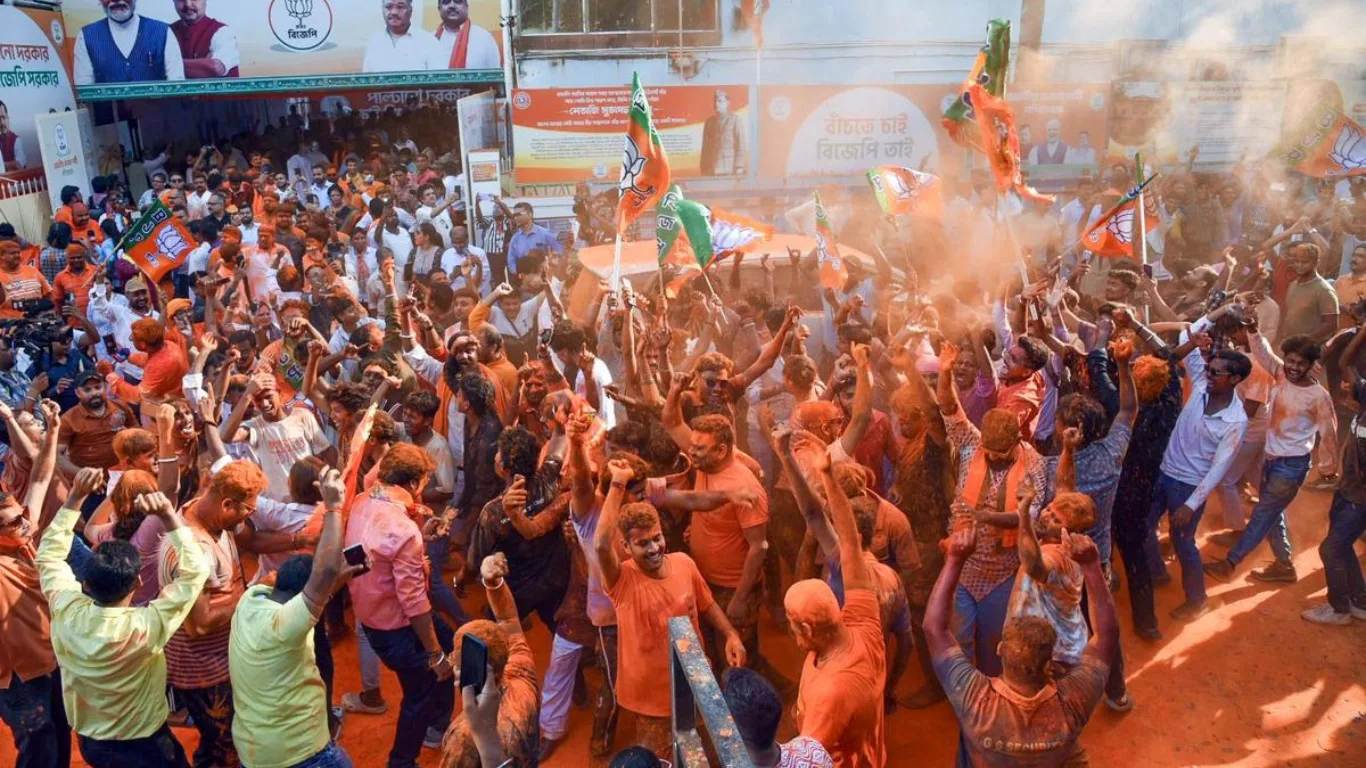
High turnout does not automatically benefit any one party. But in this case, combined with the scale of the BJP's win, it suggests that a very large number of voters who might not have voted in previous cycles came out specifically to vote and voted for change.
The turnout also matters because it weakens any narrative that the result was driven by voter suppression or roll manipulation. When 92% of registered voters show up, the result reflects something real in public sentiment.
Is Mamata Banerjee Winning or Losing Her Own Seat
As of the final count, Mamata Banerjee and the question of her personal constituency have been central to TV coverage and online discussion. The BJP's wave in 2026 swept through districts that the TMC had previously considered safe territory. Whether Mamata herself won or lost her seat will be determined in the coming hours, but the party she leads has lost its mandate to govern the state.
A Chief Minister whose party is reduced from 215 to 81 seats is, politically speaking, in a fundamentally different position regardless of personal constituency results.
Read More: Modi's Matua Gambit: The One Speech That Could Decide West Bengal's 2026 Election
What a BJP Government in West Bengal Would Mean
The BJP has never governed West Bengal. This would be its first state government in a state with over 100 million residents, a complex social fabric, a significant Muslim minority population, and decades of Left and then TMC political culture baked into its institutions.
The party's election promises centred on job creation, cleaning up the recruitment process, border security, and faster CAA implementation. Converting campaign promises into governance will be the real test. Bengal's bureaucracy, its police establishment, its panchayat system all of these have been shaped by TMC for 15 years and by the Left before that. A new government inherits those structures.
There will also be questions around the SIR controversy. The approximately 2.7 million voters whose status remained pending in tribunals their legal situation does not resolve automatically with an election result. That remains a live issue.
What Happened to the Left Front in West Bengal
The Left Front which ruled West Bengal for 34 consecutive years from 1977 to 2011 has been virtually erased from the political landscape. CPI(M) managed 1 seat. That is not a political party. That is a presence. A reminder.
The trajectory is worth understanding. TMC swept the Left out in 2011 by winning 215 seats. BJP swept TMC in the same direction in 2026 with the same number. There is a cruel symmetry to it.
What the Left's near-total absence means is that the political debate in West Bengal will now be structured as BJP versus TMC — with everything else as noise. That is a significant change in a state that had complex, multi-party politics for decades.
Dilip Ghosh's Win in Kharagpur Sadar
One of the high-profile results of this election has been Kharagpur Sadar, where BJP's Dilip Ghosh a senior party figure — leads by approximately 71,800 votes according to Sunday Guardian Live. A margin that large in a single constituency speaks to the kind of wave that the BJP has ridden across the state. It is not close wins in marginal seats. It is comfortable, often commanding wins across the map.
Common Misconceptions About This Result
Some early commentary has framed this as simply a "BJP wave" driven by the national party machinery. That reading undersells the local factors 15 years of anti-incumbency, the recruitment scandal, employment anxiety among young voters, and the specific dynamics of Matua community politics in the border districts.
Similarly, framing it purely as an anti-Mamata vote misses the BJP's ground-level organisational work in Bengal over the past several years. This result was built over time. The 2021 election, where the BJP won 77 seats despite losing, was itself a significant leap from near-irrelevance a decade earlier.
Results like this are rarely mono-causal. They accumulate.
What Happens Next: Formation of Government and the One Pending Seat
With 206 seats, the BJP has more than enough to form a government without any coalition partners. The party's floor strength would still be 206 even if the Falta seat goes against it, which is still 58 seats above the majority threshold.
The swearing-in ceremony and the selection of a Chief Minister for West Bengal will dominate political news over the next week. West Bengal's Legislative Assembly tenure was due to end on May 7 the new government will need to be constituted promptly.
The one remaining result Falta constituency — will be declared on May 24 following a re-poll on May 21. The Election Commission cited severe electoral offences in the constituency as the reason for ordering a fresh vote.
Closing Thoughts
There is something quietly astonishing about this result not the BJP victory itself, which polls and ground reports had signalled, but the scale of it. 206 seats. In Bengal. Five years after losing 215-77.
Elections at this scale, with turnovers this large, are democratic statements. Fifteen years is a long time to run anything a company, a relationship, a state. Voters eventually want to see something different, or they want accountability for what has accumulated. The 92.93% turnout suggests West Bengal's voters were not indifferent. They were engaged. They came out.
What comes next governance, the court cases around the electoral roll, the CAA question, employment those are not election stories anymore. They are the harder, quieter work that follows a mandate. That work always proves more complicated than the campaign that preceded it.
Disclaimer: This article is based on information available across the web. Parchar Manch does not take responsibility for its complete accuracy, as the content could not be fully verified.
FAQs
How many seats did the BJP win in West Bengal in 2026?
BJP won 206 seats in the 2026 West Bengal Legislative Assembly election, well above the majority mark of 148 in the 294-seat house.
How many seats did TMC win in West Bengal 2026?
AITC (Trinamool Congress) won 81 seats, a sharp fall from its 2021 tally of 215 seats.
Which seat is still pending in the West Bengal election results?
The Falta Assembly constituency result is pending. Re-polling was scheduled for May 21, 2026, with results expected on May 24, 2026.
What was the voter turnout in the 2026 West Bengal election?
The election recorded a historic voter turnout of 92.93%, the highest ever in West Bengal's electoral history.
Has the BJP ever formed a government in West Bengal before?
No. If the BJP forms the government following this result, it will be the party's first-ever government in West Bengal.
What was the majority mark in the West Bengal 2026 election?
The majority mark in the 294-seat West Bengal Legislative Assembly is 148 seats.