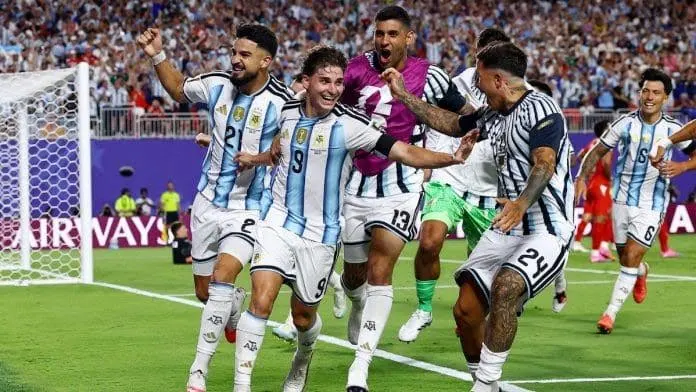
World Cup 2026: Down To Four Teams, And Somehow None Of The Three Hosts Made It This Far
Here's something that feels almost strange to sit with. The United States, Mexico, and Canada spent years preparing to host this tournament, building stadiums, planning logistics, dreaming about a home nation run deep into the knockout rounds. And yet, as the World Cup 2026 semifinals kick off this week, all three host nations are already home, watching from the sidelines like everyone else.
Let me walk through how we actually got here, because the road to these final four teams has been genuinely dramatic.
Why This Tournament Actually Matters
Here's why this World Cup carries extra weight beyond the usual excitement. This is the first time in history that three nations, the United States, Mexico, and Canada, have jointly hosted the tournament. It's also the first World Cup to feature 48 teams instead of the previous 32, a genuinely significant expansion that reshaped how the entire competition unfolded, from group stage format to the sheer number of matches played.
For fans, that expansion meant more countries getting a shot at the global stage than ever before. For host cities, it meant an enormous logistical undertaking spread across sixteen venues in three countries. Whether you followed every match or just the headlines, this tournament has been unlike any World Cup that came before it.
Read More: Modi at 12: A Decade-Plus of Leading India , What Changed, What Didn't, and What It All Means
What The Current Situation Actually Looks Like, Explained Simply
Here's the concept simplified for anyone who's only half been following along. Think of the World Cup as an elimination bracket, similar to March Madness but for national soccer teams. Forty eight teams started, and after group stages, a round of 32, a round of 16, and now the quarterfinals, only four remain standing, each just two wins away from lifting the trophy.
Those four teams are Argentina, England, France, and Spain, notably, the exact same top four in FIFA's own world rankings, marking the first time the top four ranked teams have all advanced this far together in the same tournament.
How We Got Here, Step By Step
Following the knockout stage sequence helps explain how dramatic this run actually was.
It started with the Round of 16, where all three host nations were eliminated in quick succession. Canada fell to Morocco, Mexico lost to England in a tense Estadio Azteca clash, and the United States men's team was eliminated by Belgium. That's a rough outcome for host nations hoping for a deep run, though not entirely unprecedented in World Cup history.
Read More: BAT-BMS App E-Rickshaws Scandal: How a Chinese Battery Tool Became India's Weirdest Road Hazard
Then came the quarterfinals, spread across four separate matches. France defeated Morocco 2-0, with Kylian Mbappe scoring after missing an earlier penalty, and Ousmane Dembele sealing the result. Spain edged past Belgium 2-1, continuing a stretch where Mikel Merino has repeatedly delivered decisive moments for his team. England beat Norway 2-1, with Jude Bellingham scoring twice, extending his run as arguably the tournament's most decisive individual performer. And Argentina needed extra time to defeat Switzerland 3-1, setting up their semifinal date with England.

Now, the semifinal bracket is fully set. France faces Spain on Tuesday, July 14, at AT&T Stadium in Arlington, Texas, while England takes on Argentina on Wednesday at Mercedes-Benz Stadium in Atlanta. The semifinal losers will meet in the third place match at Hard Rock Stadium in Miami Gardens, before the final itself takes place July 19 at MetLife Stadium in East Rutherford, New Jersey.
Real World Examples That Make This Click
Consider Spain's defensive record heading into this stage, they've conceded remarkably little throughout the tournament, with goalkeeper Unai Simon recording five straight clean sheets to begin the competition, the longest such streak in World Cup history for Spain's side.
Or consider France's road here, they remain the only team to win all five of their matches so far without needing extra time, a notably efficient path compared to Argentina, who needed dramatic, narrow finishes against both Cape Verde and Egypt earlier in the tournament just to advance.
Mistakes People Keep Making When Following This Tournament
A common mistake is assuming host nation elimination signals something is fundamentally wrong with the tournament itself. It doesn't, host nations have been eliminated early in previous World Cups too, and this tournament's competitive depth, driven partly by the expanded 48 team format, has simply meant tougher paths for everyone, hosts included.
Another misunderstanding is treating FIFA rankings as a reliable predictor once the knockout rounds begin. While it's genuinely notable that the top four ranked teams all reached the semifinals this time, tournament football regularly produces upsets that rankings alone can't anticipate, which is part of why these final matches remain so compelling to watch.
Read More: India's Current Account Surplus Hit $7.1 Billion in Q4 FY26: What the Numbers Are Really Saying
Pro Tips For Following The Remaining World Cup 2026 Matches
If you want to follow the rest of this tournament with real context, watch two things specifically. Watch individual form heading into the semifinals, players like Bellingham, Mbappe, and Messi have each shown they can single handedly shift a match's outcome, so recent performance matters more than historical reputation at this stage. And pay attention to squad fatigue and injuries, several teams, including Morocco earlier in the tournament, have shown that a grueling knockout run can catch up with even in form squads by the later stages.
Closing Thoughts
There's something genuinely fitting about a tournament this historically significant, three host nations, 48 teams, more matches than ever before, coming down to exactly the four teams currently ranked highest in the world. Whatever happens across these remaining World Cup 2026 matches, this tournament has already reshaped what a World Cup can look like, and the final at MetLife Stadium on July 19 will simply be the last chapter in a genuinely unprecedented competition.
Disclaimer: This article is based on information available across the web. Parchar Manch does not take responsibility for its complete accuracy, as the content could not be fully verified.
FAQs
Which teams are in the World Cup 2026 semifinals?
Argentina, England, France, and Spain, with France facing Spain and England facing Argentina.
Where and when is the World Cup 2026 final?
The final will be played on July 19, 2026, at MetLife Stadium in East Rutherford, New Jersey.
Is this the first World Cup with three host countries?
Yes, this is the first men's World Cup jointly hosted by three nations, the United States, Mexico, and Canada.
How many teams competed in the World Cup 2026?
A total of 48 teams competed, an expansion from the previous format of 32 teams.
Where is the third place match being played?
The third place match between the semifinal losers will be held at Hard Rock Stadium in Miami Gardens.