NASA's Dust-Zapping Tech Is Now Cleaning Solar Panels on Earth — And It's Changing Everything
Solar panel soiling is one of the most overlooked problems in clean energy. Nobody talks about it. But it's quietly costing solar farm operators millions of dollars every year, shrinking power output sometimes by more than half, and nobody has had a truly scalable fix. Until now.
Researchers and entrepreneurs connected to Carnegie Mellon University are working on something genuinely surprising: borrowing technology originally built for the Moon and Mars to keep solar panels clean right here on Earth.
Why Dirty Solar Panels Are a Bigger Problem Than You Think
Most people assume solar panels just sit there and work. Set them up, let the sun do its job. Simple.
Not quite.
The technical term for when dust, pollen or other particles settle on top of solar panels is called "soiling," and it can significantly reduce how much light a panel can absorb. This is especially a problem in arid, sunny regions where solar farms are often located, such as the American Southwest, India, and the Sahel region of Northern Africa.
Some solar farms see up to 60% losses in revenue just from dust accumulation, according to Michael Provenzano, a CMU Tepper School of Business graduate whose startup is trying to solve this. That number is staggering. A clean energy source, losing more than half its potential output to something as ordinary as dust.
Read More: United States and Iran Agree to Reopen Strait of Hormuz: Why the World Is Watching Closely
The Electrodynamic Dust Shield: Space Tech Meets Solar Farm
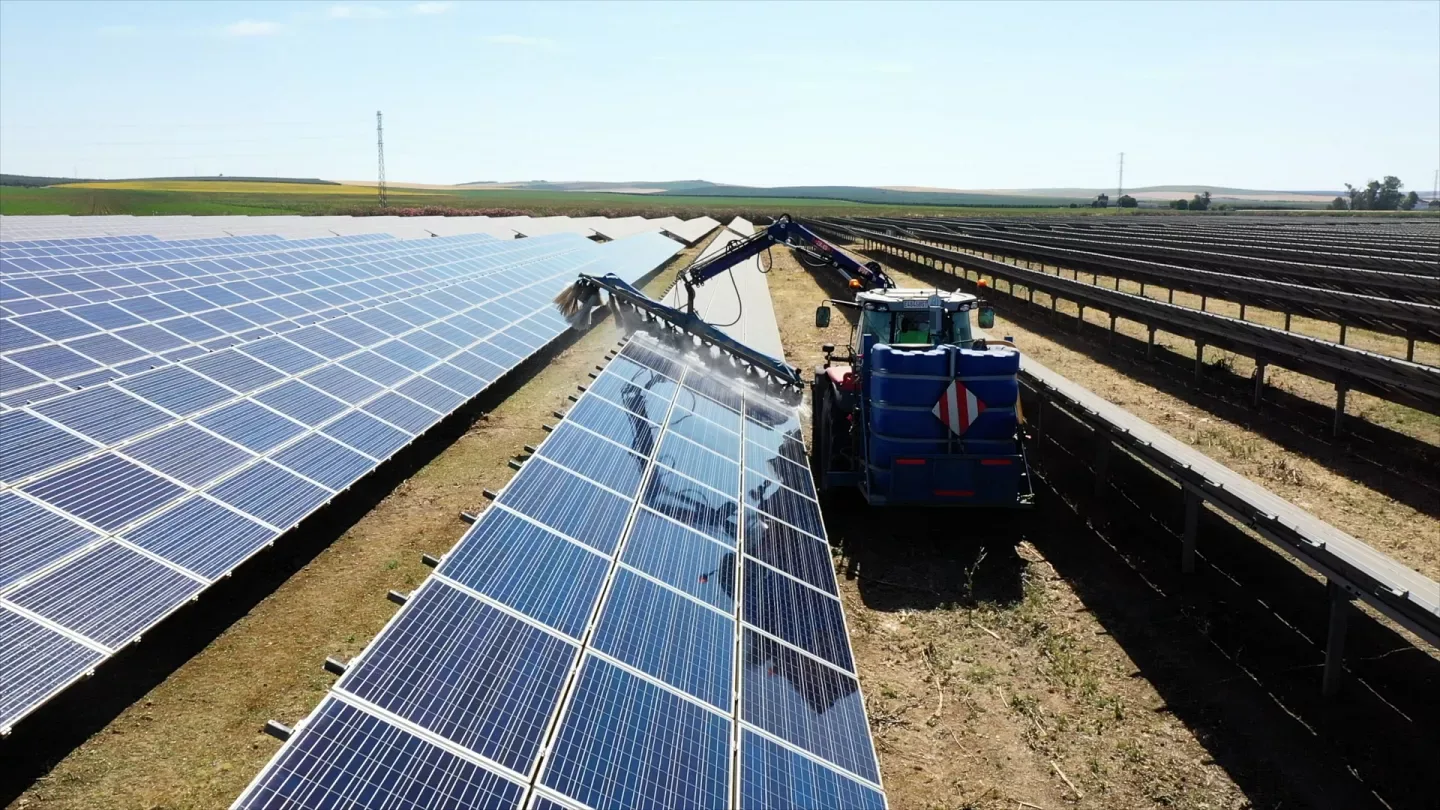
Right now, most solar panels are cleaned with water by hand or robotic equipment, which requires a lot of time and resources. On a solar farm spanning hundreds of acres with millions of panels, that becomes an operation costing millions of dollars annually.
Provenzano's Pittsburgh-based company, Clear Solar, has licensed panel-cleaning technology from NASA originally designed for missions on the Moon and Mars, where it successfully demonstrated dust removal from critical surfaces.
The technology is called an electrodynamic dust shield (EDS). It sounds complex. The idea is actually elegant.
The process works like this: thin lines of conductive material are added to the glass top of the solar panel and covered with a clear protective film. An electrical current is then channeled through the conductive traces, charging everything on the panel's surface. When the polarity of the electrical current is quickly flipped, the charged dust particles are repelled and pushed off the surface.
No water. No brushes. No manual labour. Just electricity, physics, and dust particles bouncing off glass.
The dust shield removes 97% of dust from glass panels, according to Provenzano. That's not an incremental improvement. That's a transformation.
Read More: Indian Vessel Virat 1 in Oman: Why This Maritime Visit Is Getting Attention
How NASA Proved This Works (First in Space, Now on Earth)
This is not a theory that emerged in a lab last month. NASA's Electrodynamic Dust Shield successfully demonstrated its ability to remove lunar dust from surfaces during Firefly Aerospace's Blue Ghost Mission 1, which concluded in March. Before-and-after images confirmed that dust-covered surfaces were visibly cleared following EDS activation.
The technology uses electrodynamic forces — electrically generated waves — to lift and transport dust particles away from sensitive surfaces without the need for moving parts or manual cleaning.
NASA understood the problem viscerally. NASA researchers saw this situation play out when dust settled on the Opportunity rover's solar panels and diminished its power supply, eventually contributing to the mission's end. If it can cripple a spacecraft 140 million miles away, imagine what a quieter version of the same problem is doing to Earth's solar infrastructure every single day.
What CMU Researchers Are Building Next
Provenzano is not working alone on this.
CMU assistant research professor Stewart Isaacs, working at Carnegie Mellon University Africa, is taking a different angle. Isaacs uses computational models to analyze solar panel performance at different levels of soiling, aiming to understand exactly how often panels need cleaning and whether strategic cleaning methods can be explored.
Read More: Twenty Rebel Trinamool Congress MPs to Merge with NCPI? The Political Buzz Raising Big Questions
He is also thinking about panel design itself. Isaacs is researching how the aerodynamics of wind interact with dust on panel surfaces, with the goal of designing solar panels that use natural wind patterns to stay cleaner.
On the business side, CMU operations management professor Alan Scheller-Wolf frames this plainly: clean panels are not just a technical question but a holistic investment decision. The most efficient way to make something more sustainable is simply to use it longer — and maintenance that extends a solar panel's useful lifetime increases the sustainability of the entire project.
What This Costs (And Why It Pencils Out)
While there are installation costs and the EDS technology does reduce energy transmittance by roughly 1%, cleaning one megawatt of capacity, approximately 2,000 solar panels, would cost around $0.14.
That is almost nothing compared to the millions spent on traditional cleaning. The solar panel efficiency loss from the coating is real but minimal. The gain from keeping dust off consistently is far larger.
Clear Solar currently has 13 pilot projects across the world and within the U.S., including in Pittsburgh, with field tests scheduled to begin in July.
A Small Mistake Solar Farm Operators Keep Making
Most operators clean reactively. Dust builds up over weeks or months, efficiency quietly drops, and by the time cleaning happens the revenue loss has already occurred.
The EDS approach flips that. Because it can run daily or even multiple times per day at negligible cost, it turns solar panel maintenance from a scheduled expense into a quiet, continuous background process. Like keeping a window clean rather than scrubbing it once a year.
The Bigger Picture
There is something quietly fascinating about this story. Technology designed to keep spacecraft alive on the lunar surface is now being scaled down and wired into glass panels on rooftops and fields here on Earth.
The solar industry is maturing. And maturity means grappling with maintenance, longevity, and efficiency at scale. Dust is not a glamorous problem. But the solutions being built around it, from CMU's labs to NASA's space missions, are pushing clean energy closer to its actual potential.
Read More: Ram Temple Donation Fraud: How Scammers Are Exploiting Faith and What Devotees Need to Know
Disclaimer: This article is based on information available across the web. Parchar Manch does not take responsibility for its complete accuracy, as the content could not be fully verified.
FAQs
What is solar panel soiling?
Soiling is when dust, pollen, or airborne particles settle on a solar panel's surface, reducing its ability to absorb sunlight and lowering its power output. In highly dusty regions, losses can reach 60%.
How does the electrodynamic dust shield work?
Conductive traces are embedded under the panel glass. An electrical current charges the surface, and when the polarity flips rapidly, dust particles are repelled and ejected off the panel, requiring no water or physical contact.
Did NASA actually test this technology in space?
Yes. NASA's EDS was tested on the lunar surface during the Blue Ghost Mission 1 in early 2025 and successfully removed dust from solar panels and thermal radiators.
Does the EDS coating reduce solar panel performance?
Slightly. The coating lowers energy transmittance by approximately 1%, but the consistent removal of dust far outweighs that minor reduction in most real-world conditions.
How affordable is this technology for solar operators?
The estimated cost is around $0.14 per megawatt of capacity to clean, making it dramatically cheaper than water-based or robotic cleaning systems currently used on large solar farms.
When will Clear Solar's technology be available commercially?
The company has 13 pilot projects globally and in the U.S. and plans to begin full field testing in July 2026.