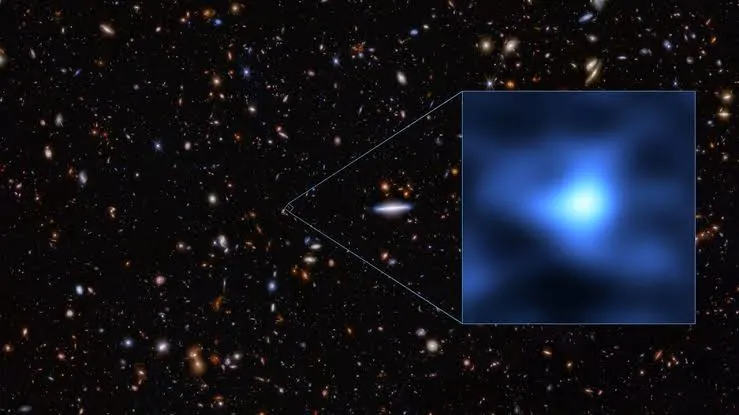
Scientists Just Looked 13 Billion Years Into the Past and Found a Galaxy Already Loaded With Star-Forming Gas
Thirteen billion years ago, the universe was barely getting started. It was roughly 700 million years old, which sounds ancient until you consider the universe is approximately 13.8 billion years old today. That makes this early period just five percent of cosmic history. And yet, in that barely-formed universe, a massive galaxy called REBELS-25 was already sitting on an enormous stockpile of fuel ready to build stars at a scale that still puzzles scientists.
Now, for the first time, astronomers have directly detected that fuel. What they found is quietly rewriting what we thought we knew about how early galaxies grew so large, so fast.
Why This Discovery About Star-Forming Gas in an Early Universe Galaxy Matters
Here is the short version of why this is a big deal. Scientists have long known that early galaxies were forming stars at intense rates. What they could not figure out was where all the raw material was coming from. The prevailing assumption was that gas reserves in young galaxies must be large, but that was always inferred, never directly confirmed.
By detecting the star-forming fuel itself, astronomers can now measure the gas driving this rapid growth rather than infer it indirectly. That is a fundamental shift. It is the difference between guessing there is water underground and actually drilling down and finding it.
What Is REBELS-25 and Why Is It So Significant?
REBELS-25 is a massive, star-forming galaxy seen when the universe was only about 700 million years old, around 5% of its current age. When we observe it now, we are essentially looking at light that left this galaxy 13 billion years ago. We are not seeing what it looks like today. We are seeing its past, preserved in the form of ancient light traveling across the cosmos.
When we look at REBELS-25, we are looking at a galaxy that had barely started converting its fuel into stars. Almost everything in it was still waiting to be used. It had entered its most active star-forming phase already loaded and fuelled up. Our own Milky Way, by comparison, has a gas fraction of just a few percent today. Most of its raw material was used up long ago.
Think of it like finding a car with a completely full tank in a museum from an era before cars were common. You would want to understand where all that fuel came from.
How Astronomers Detected Cold Molecular Gas at This Distance
This is where the science becomes genuinely impressive. The team used deep observations with the NSF Very Large Array (VLA) and the Atacama Large Millimeter/submillimeter Array (ALMA), led from Leiden University, and was able to overcome the observational challenges posed by the cosmic microwave background.
That last part deserves a moment. The cosmic microwave background is ancient radiation left over from the Big Bang itself. It fills the entire universe with a faint glow that, at the extreme distances involved in observing early galaxies, is bright enough to partially drown out the very signals scientists are trying to detect. Finding a CO signal at this distance is not just technically difficult. It is like trying to hear a whisper in a room full of noise.
The signal they were listening for was carbon monoxide (CO) gas emissions, a well-known tracer of cold molecular hydrogen, which is the actual raw material that collapses under gravity to form new stars. Cold molecular gas is the direct star-formation fuel, and detecting it directly in a galaxy this distant is a first.
What REBELS-25 Tells Us About the Epoch of Reionization
REBELS-25 sits firmly in what astronomers call the Epoch of Reionization, a dramatic period when the first galaxies and stars were switching on and fundamentally changing the nature of the cosmos. This was the universe coming alive, and it happened faster than anyone expected.
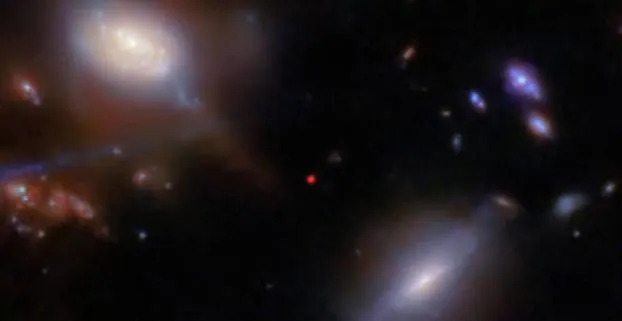
"Galaxies just 700 million years after the Big Bang already contained large reservoirs of cold gas available for star formation," said Karin Cescon, a PhD student at Leiden University and lead author of the study. That timeline is startling. It suggests that the conditions for massive star formation were in place almost immediately after the universe became structured enough to hold galaxies together.
Read More: United States and Iran Agree to Reopen Strait of Hormuz: Why the World Is Watching Closely
What Comes Next: The ngVLA and the Future of This Research
This discovery foreshadows the Next-Generation Very Large Array (ngVLA), a planned National Radio Astronomy Observatory telescope that will make these measurements approximately ten times faster, enabling detections for much larger samples of early galaxies, moving beyond individual bright case studies. Where REBELS-25 may be the tip of the iceberg, ngVLA will study fainter and more distant systems.
REBELS-25 is a single data point, extraordinary and significant, but still singular. The ngVLA changes the game entirely.
A Quiet Thought to Sit With
There is something almost humbling about this. Scientists on Earth, using radio telescopes positioned across deserts and mountains, listened carefully enough through 13 billion years of cosmic noise to hear one galaxy's worth of cold gas. And in doing so, they learned something new about how the universe made itself. That is not a small thing. That is the universe, slowly and patiently, teaching us its own history.
Disclaimer: This article is based on information available across the web. Parchar Manch does not take responsibility for its complete accuracy, as the content could not be fully verified.
Read More: Keir Starmer to Announce Social Media Ban for Under-16s: What It Could Mean for Millions of Families
Disclaimer: This article is based on information available across the web. Parchar Manch does not take responsibility for its complete accuracy, as the content could not be fully verified.
FAQs
What is REBELS-25?
REBELS-25 is a massive, star-forming galaxy observed when the universe was only 700 million years old. It is located approximately 13 billion light-years away and is one of the earliest galaxies ever studied in detail.
What is cold molecular gas and why does it matter?
Cold molecular gas, primarily molecular hydrogen, is the direct raw material from which stars form. When this gas cools and becomes dense enough, gravity causes it to collapse and ignite into new stars.
What tools did astronomers use to make this discovery?
The team used the NSF Very Large Array (VLA) and the Atacama Large Millimeter/submillimeter Array (ALMA) to detect carbon monoxide emissions, which trace the presence of cold molecular gas.
What is the Epoch of Reionization?
It is a period in the early universe, roughly 200 to 1,000 million years after the Big Bang, when the first stars and galaxies formed and began transforming the surrounding hydrogen gas. REBELS-25 was observed during this period.
Why was this detection so difficult?
The cosmic microwave background, ancient radiation left over from the Big Bang, creates interference that makes faint signals from distant galaxies very hard to isolate. Overcoming this required deep, high-sensitivity observations.
What does this mean for our understanding of the early universe?
It confirms that some early galaxies had enormous gas reserves from very early on, helping explain why they were able to build stars so rapidly and grow to large sizes in a relatively short cosmic timeframe.