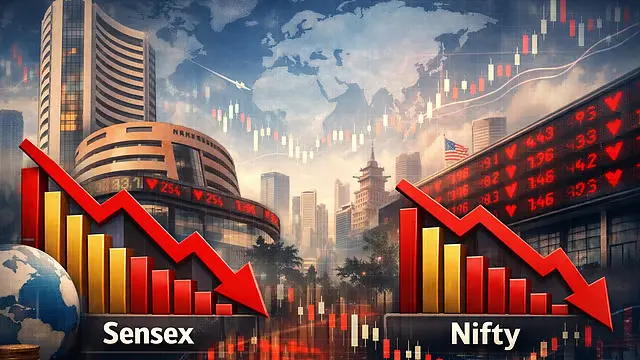
Sensex Nifty June 11 Update: How Markets Are Navigating Geopolitical Fire and RBI Relief
It has been a week of whiplash for Indian markets. Down sharply on Monday. Up cautiously on Tuesday. And on Wednesday, June 10, 2026, trading with a strange mix of resilience and nervousness as US airstrikes on Iran following the downing of a military Apache helicopter reshaped the global mood overnight.
The Sensex Nifty June 11, 2026 session arrives against this backdrop. Let us break down exactly what has happened, why, and what it means going forward.
The Week That Was: What Triggered the Volatility
On June 8, 2026, Indian benchmark indices ended sharply lower, with the Nifty tumbling to 23,123 and Sensex declining 719 points to close at 73,524, as fresh escalation in the Iran-Israel conflict sent shockwaves through global markets and pushed crude oil prices above $96 per barrel.
That was Monday. A broad-based selloff where almost no sector was spared.
On Tuesday, June 9, the Nifty50 settled 119.10 points or 0.52 per cent higher at 23,242.10, and the Sensex rose 394.50 points to 73,918.76, on Trump's peace talks remark.
The recovery on Tuesday came primarily from the banking and financial sector. The rise was led by IndusInd Bank at 3.35%, Axis Bank at 2.07% and ICICI Bank at 1.89%. On the downside, the weakest performers were Titan Company at minus 2.20%, NTPC at minus 1.82% and Power Grid at minus 1.65%.
Read More: Modi at 12: A Decade-Plus of Leading India , What Changed, What Didn't, and What It All Means
Wednesday June 10: Markets Hold Despite US Strikes on Iran
On June 10, 2026, the Nifty50 rose 96.10 points or 0.41 per cent to 23,338.20, and the Sensex was trading 380.76 points or 0.52 per cent higher at 74,299.52. Hindustan Unilever, Nestle India, and Tata Consumer Products were the top gainers in the Nifty50 index.
This resilience is notable. The US launched retaliatory strikes against Iran after Tehran was blamed for downing a US Army Apache helicopter near the Strait of Hormuz. In a different market environment, this would have sent indices into a tailspin. Instead, Indian markets held their ground. Why?
Sector-wise, Nifty FMCG rose 1 per cent to lead gains. The Nifty IT, the Nifty Private Bank, and the Nifty Oil and Gas also outperformed. The Nifty Metal and the Nifty Auto declined the most.
The rotation into defensives, particularly FMCG and pharmaceuticals, tells the story. Investors were not exactly bullish. They were repositioning into sectors less exposed to crude oil price spikes and geopolitical disruption.
Read More: Oman in the Crossfire: Why the World's Most Neutral Nation Is Now Under Enormous Pressure
The RBI Factor Keeping Indian Markets Grounded
Beyond geopolitics, there is a key domestic anchor that has been providing support to Indian markets through this turbulence.
The RBI rolled out a concessional foreign-exchange swap facility designed to pull more overseas dollars into the financial system. The measure should ease forex pressure on banks by removing foreign exchange holding costs, lowering funding costs, and strengthening liquidity positions. Strong buying was seen across banks and financials, with ICICI Bank and Axis Bank rising around 2% each.
This is important context. When global events are pushing risk premiums higher, the RBI's supportive policy stance has been acting as a partial counterweight. For long-term investors, this monetary backstop matters more than any single day's geopolitical headline.
Read More: INDIA Bloc's High-Stakes Delhi Meeting: Fault Lines, Five Decisions, and the Long Road to 2029
What to Watch Going Into June 11 Sensex Nifty Session
Several factors will shape the opening and direction on June 11. Crude oil prices are a key variable. Brent crude futures rose 83 cents or 0.9% to $92.29 a barrel on June 10, rebounding after Iran and Israel's brief halt to direct strikes had temporarily eased supply fears in the previous session.
Additionally, the Wipro share buyback opens on June 11, at Rs 15,000 crore, which could influence IT sector sentiment. FII activity has been mixed, with foreign institutional investors pulling out Rs 4,566 crore on June 9 while domestic institutional investors bought Rs 6,159 crore, providing a critical cushion.
The mid-cap and small-cap space needs close attention. Both the Nifty MidCap and Nifty SmallCap indices have been underperforming the benchmarks through this period, suggesting retail and HNI nervousness is running higher than institutional caution.
Read More: India's Current Account Surplus Hit $7.1 Billion in Q4 FY26: What the Numbers Are Really Saying
What This Market Environment Teaches Investors
Markets in geopolitical stress tend to reward patience and punish panic. The investors who sold out on June 8 when Sensex fell 719 points missed a 395-point recovery the very next day. That pattern repeats across market history.
The key insight from this week is that Indian markets have demonstrated genuine structural resilience. Global conflict, a surging rupee, oil price volatility and FII outflows would have been crushing to Indian equities five years ago. The domestic institutional flow, anchored by mutual fund SIPs and the RBI's measured policy, has changed that equation meaningfully.
Disclaimer: This article is based on information available across the web. Parchar Manch does not take responsibility for its complete accuracy, as the content could not be fully verified.
FAQs
What is the Sensex level as of June 10, 2026?
Sensex was trading around 74,299 on June 10, 2026, up approximately 380 points, as markets held steady despite US strikes on Iran.
What caused the Sensex fall on June 8, 2026?
Sensex dropped 719 points on June 8 due to fresh escalation in the Iran-Israel conflict, which pushed crude oil prices above $96 per barrel and triggered a broad global sell-off.
Why did markets recover on June 9, 2026?
Markets recovered after Trump's peace talks remark eased geopolitical fears temporarily, and the RBI's concessional forex swap facility boosted banking sector sentiment.
Which sectors are performing best during this geopolitical uncertainty?
FMCG, IT, and private banking stocks have been the key outperformers, while metals, auto, and power utilities have faced the most pressure.
What is the Wipro buyback announced for June 11?
Wipro opens a Rs 15,000 crore share buyback programme on June 11, 2026, offering eligible shareholders the opportunity to tender shares at a premium, open until June 17, 2026.
How are FIIs and DIIs behaving in Indian markets in June 2026?
FIIs sold Rs 4,566 crore on June 9, while domestic institutional investors bought Rs 6,159 crore, providing significant support to prevent deeper market declines.