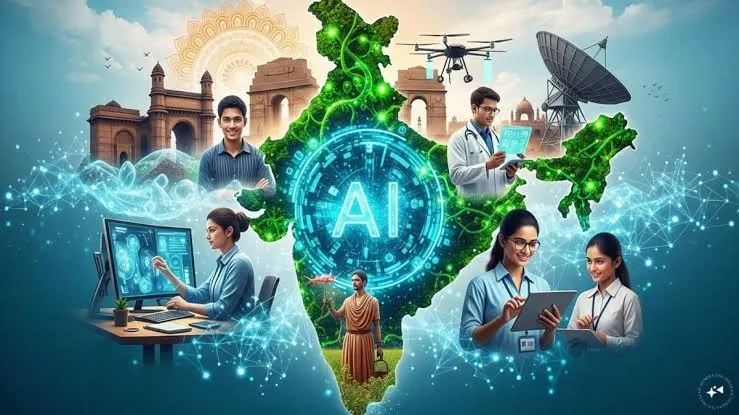
India's AI Problem: Why the World's Fastest-Growing Digital Nation Is Struggling to Keep Up
Artificial intelligence is everywhere right now. It's writing emails, creating videos, helping doctors read scans, and even answering customer support questions at 2 a.m. Yet when people talk about global AI leaders, India often appears in the conversation for talent, not for breakthrough AI products.
That's the uncomfortable reality behind India's AI problem.
The country produces some of the world's best engineers. Indian professionals work at leading AI companies across the globe. Yet India still faces challenges in building AI systems at the same scale as the United States or China. The gap isn't about intelligence. It's about infrastructure, investment, data, and execution.
India's AI Problem Is Bigger Than Most People Realize
India has over a billion people, one of the world's largest internet user bases, and a rapidly growing startup ecosystem. On paper, it looks like the perfect environment for an AI revolution.
But AI development requires more than skilled people.
Modern AI models need massive computing power, specialized chips, high-quality datasets, and billions of dollars in long-term investment. These are areas where India still lags behind major AI powers.
Many Indian startups are building AI-powered applications, but relatively few are creating foundational AI models from scratch. That's where the challenge becomes visible.
The concern isn't just technological. It is economic.
Countries that build AI platforms often control the future value created by those technologies.
Read More: Iran-Israel War 2026: What's Really Happening, Why the US Is In the Middle, and What Comes Next
Understanding the Core of India's AI Problem
Think of AI like building a high-speed railway network.
Having talented engineers is important. But engineers alone cannot build the system. You also need tracks, stations, electricity, funding, and long-term planning.
AI works similarly.
To create world-class AI systems, countries need:
- Advanced computing infrastructure
- Large-scale data resources
- AI research institutions
- Access to powerful semiconductor chips
- Strong public and private investment
India has strengths in talent and software development. The missing pieces are largely infrastructure and capital.
Read More: A Judge Just Killed Trump's $100,000 H-1B Visa Fee , Here Is What That Actually Means
How India's AI Ecosystem Works Today
The current AI landscape in India follows a clear pattern:
- Global AI companies build foundational models using enormous computing resources.
- Indian startups and businesses use those models to create applications and services.
- Consumers benefit from AI-powered products in sectors such as healthcare, education, finance, and customer service.
- Demand grows faster than domestic AI infrastructure can support.
This creates dependence on foreign AI platforms.
That dependence is at the heart of India's AI problem.
Real-World Examples Showing the Challenge
Several Indian companies have successfully integrated AI into their operations. Banks use AI for fraud detection. Hospitals use AI-assisted diagnostics. E-commerce platforms rely on recommendation systems.
The issue isn't adoption.
The issue is ownership.
Many of these systems rely on technologies developed outside India. While businesses gain efficiency, the underlying AI foundations often remain controlled by foreign organizations.
That means a significant share of future AI value may also flow elsewhere.
Mistakes People Make When Discussing India's AI Problem
One common misconception is that India is "behind" in AI.
That's not entirely accurate.
India is among the world's largest AI talent hubs. The challenge is converting talent into globally competitive AI infrastructure and products.
Another mistake is assuming AI success comes only from startups.
Government policy, university research, semiconductor access, and large-scale funding all play critical roles. AI leadership requires an entire ecosystem, not just a handful of successful companies.
Read More: INDIA Bloc's High-Stakes Delhi Meeting: Fault Lines, Five Decisions, and the Long Road to 2029
Practical Solutions That Could Change the Story
Experts increasingly point toward several areas where India can strengthen its position:
- Expanding domestic AI computing infrastructure.
- Investing in AI-focused research institutions.
- Supporting local language AI models.
- Encouraging collaboration between government, academia, and industry.
- Increasing long-term funding for deep technology projects.
These efforts won't deliver overnight results. Building AI leadership is measured in years, sometimes decades.
The Future of India's AI Problem May Also Be Its Biggest Opportunity
There is an interesting contradiction here.
The same factors creating challenges also create opportunity.
India has one of the world's largest digital populations, a rapidly growing economy, and an unmatched pool of technology talent. If investment and infrastructure catch up with that talent, the country could become one of the most influential AI markets in the world.
The next phase of AI may not be decided solely by who invents the technology first. It may also be shaped by who adapts it most effectively for billions of people.
And that is where India's story is still being written.
Read More: I Am a Cockroach": How India's Gen Z Protest Movement Stormed Delhi Over Exam Irregularities
Disclaimer: This article is based on information available across the web. Parchar Manch does not take responsibility for its complete accuracy, as the content could not be fully verified.
FAQs
What is India's AI problem?
India's AI problem refers to challenges related to computing infrastructure, funding, semiconductor access, and building foundational AI models despite having strong technical talent.
Is India good at AI?
Yes. India has a large pool of AI engineers, researchers, and software professionals. The challenge lies in infrastructure and large-scale AI development.
Why is AI infrastructure important?
AI systems require powerful computers, specialized chips, and massive data processing capabilities. Without these, developing advanced AI becomes difficult.
Can India become an AI leader?
Yes. With continued investment in research, infrastructure, and innovation, India has significant potential to become a major AI power.
What industries in India are using AI today?
Healthcare, banking, education, e-commerce, manufacturing, and customer service are among the sectors actively adopting AI technologies.
Why does AI matter for India's future economy?
AI is expected to improve productivity, create new industries, and strengthen global competitiveness, making it an important driver of future economic growth.